
TL;DR

Turn the school run and nap time into listening time
- Thousands of audiobooks, podcasts and originals
- Listen on your phone, tablet or Echo — also offline
- Cancel anytime
A woman who had two children in different countries describes her experience of postnatal care in Britain and France in a first-person report for MadeForMums. Her account contrasts limited-feeling follow-up after her first birth with a more structured French system, but the available source cuts off before details of her French birth and postnatal recovery.
MadeForMums has published a first-person account by a mother who gave birth in Britain and France, describing contrasting experiences of maternity care and postnatal support. The writer says she valued her midwife-led first birth at Swindon Hospital but felt under-supported after going home, while pregnancy care in France was more medically intensive; the supplied article excerpt ends before it explains her French birth and recovery.
The writer, who is identified in the report as Claire McAteer, says she was living in the Cotswolds when she became pregnant with her first child. Considered low risk, she chose a water birth at a midwife-led unit at Swindon Hospital. She describes the delivery as close to what she had hoped for, with support from a midwife and a student midwife. Her son Eddie was born weighing 9 pounds 4 ounces, and McAteer says she had a minor tear that was repaired.
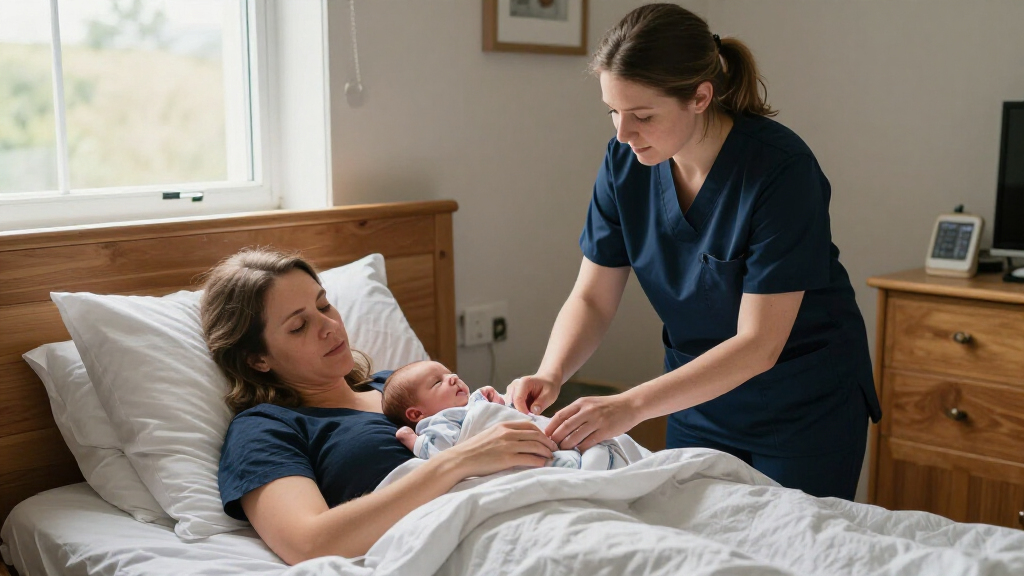
Her account draws a distinction between that birth and the months afterward. McAteer says she struggled with feeding and severe sleep deprivation, and that visits from health visitors felt superficial because she saw different people. She felt attention was directed mainly to her baby’s weight and feeding, rather than her own recovery. She also describes being disappointed by a six-week GP check, saying her stitches and abdomen were not examined.
During her second pregnancy, the family moved to France at about 20 weeks because of her husband’s military exchange role with the French Air Force. McAteer says she received health care there through that arrangement. She describes scans and appointments led by an obstetrician, additional monitoring and weight checks. After concern about the baby’s size, she was referred for a gestational diabetes test, which she says was negative. She writes that the more detailed approach made her anxious and that she asked to switch to midwife care, but the supplied excerpt ends before giving the outcome of that request.
How Follow-Up Shaped Her Recovery
McAteer’s account highlights how maternity care is experienced across more than labour and delivery. Her central concern about the British experience was not the birth itself, which she describes positively, but the adjustment afterward: feeding difficulties, exhaustion and a sense that health checks were concentrated on the baby. That distinction matters to readers comparing care systems because an apparently straightforward birth does not rule out a difficult postnatal period.
The France comparison also shows that more appointments and testing do not necessarily feel more supportive to every patient. McAteer says closer monitoring made her worry, while she missed the less medicalised feel of hearing a heartbeat during midwife appointments in Britain. This is her personal assessment, not evidence that one country’s system is better for all families. The report is useful as an individual account of what care felt like to one parent, rather than a measured comparison of national outcomes or services.
As an affiliate, we earn on qualifying purchases.
Two Pregnancies, Different Care Models
For her first pregnancy, McAteer says she was considered low risk and received midwife-led care in England. She had scans at 12 and 20 weeks and says she expected no further scan before birth. She prepared with birth podcasts and an online hypnobirthing course because her husband was often overseas and she did not attend NCT classes.
After the family moved to France during her second pregnancy, care was organized differently in her experience. She says an obstetrician performed her scan and that French care involved more monitoring, including an additional third-trimester scan. The report recounts her understanding of the care she received; it does not establish that every patient in either country follows the same pathway. The available source material covers only part of the original feature, so it cannot support a full comparison of the two births or their postnatal services.
“I loved my birth at Swindon. But I can’t say I enjoyed much of what came after.”
— Claire McAteer, in her MadeForMums account
breastfeeding and sleep deprivation relief
As an affiliate, we earn on qualifying purchases.
As an affiliate, we earn on qualifying purchases.
What the Account Does Not Establish
The supplied excerpt is incomplete and stops while McAteer is describing her request to change to midwife care in France. It does not say whether the request was accepted, how her second birth went, or what postnatal support she received there. Those missing details limit any direct comparison of recovery care in the two countries.
The account is a personal report, not a study of national maternity systems. It does not provide data on how common the experiences she describes are, nor does it establish that all British or French patients receive the same care. The excerpt also gives no publication date, and it does not specify the details of the documents required for health-care eligibility in France.
As an affiliate, we earn on qualifying purchases.
The French Birth Account Is Missing
The next relevant detail is the remainder of McAteer’s original feature: whether she was able to move to midwife care, what happened during her second birth, and how she experienced postnatal support in France. Until those details are available, the comparison should be read as an account of her first postnatal experience and her second-pregnancy care, rather than a complete Britain-versus-France assessment.
As an affiliate, we earn on qualifying purchases.
Key Questions
What does the mother say about postnatal care in Britain?
McAteer says she struggled with feeding and sleep deprivation after her first birth. She felt health-visitor follow-up focused more on her baby’s weight and feeding than on her own recovery, and she was disappointed with her six-week GP check.
Where did she give birth to her first child?
She says her first child, Eddie, was born in a midwife-led unit at Swindon Hospital after a water birth. She describes the delivery and support from the midwife as positive.
What was different about pregnancy care in France?
In her account, an obstetrician carried out scans and appointments, with more monitoring and an additional third-trimester scan. McAteer says the approach felt too medical for her, although she recognized that other patients might find it reassuring.
Does the report prove one country has better maternity care?
No. It is a first-person account of one woman’s experiences, not a comparison based on national data. The supplied excerpt also does not include the outcome of her French birth or her postnatal care there.
Source: rss
Halloween Picks
halloween
As an affiliate, we earn on qualifying purchases.