TL;DR

Turn the school run and nap time into listening time
- Thousands of audiobooks, podcasts and originals
- Listen on your phone, tablet or Echo — also offline
- Cancel anytime
To keep your white noise machine safe and effective, place it at least 7 feet from your baby’s crib or your bed, and keep the volume below 50 dBA. Distance and volume are the two main tools to prevent noise-induced hearing damage while maintaining sleep benefits.
If you’ve ever cranked up the white noise machine to drown out household chaos, you know how powerful that steady hum can be. But loud noise, especially close to tiny ears, can pose real risks. This guide breaks down practical, proven tips to position your device so it calms without harming. Whether it’s for your infant or a noisy household, mastering volume and placement keeps sleep safe and sound.
Many parents struggle with finding that perfect spot—too close, too loud, or both. With simple physics and real-world advice, you’ll learn how a few inches and a few decibels can make all the difference. Let’s turn that noisy problem into a peaceful, safe sleep environment.
Place the white noise machine at least 7 feet from your baby or bed to keep volume at safe levels.
Use a smartphone SPL app to measure the sound level at the sleeper’s ear and keep it below 50 dBA.
Moving the machine farther away is often more effective than turning down the volume because of how sound diminishes with distance.
Position the device between noise sources and the sleeper to maximize masking and minimize disruption.
Limit continuous use at high volumes; consider timers or auto-off features to reduce long-term exposure risks.
How far should your white noise machine be from your baby or bed?
The safest placement is at least 7 feet (around 2 meters) away from your baby’s crib or your bed. Sound pressure diminishes significantly with distance—roughly 6 dB every time you double the space. This means that if you move the device from 1 foot to 2 feet away, the perceived loudness halves; moving from 2 to 4 feet cuts the volume again, roughly halving perceived loudness. This reduction is crucial because it allows you to keep the device at a higher volume without exposing your child to harmful levels.
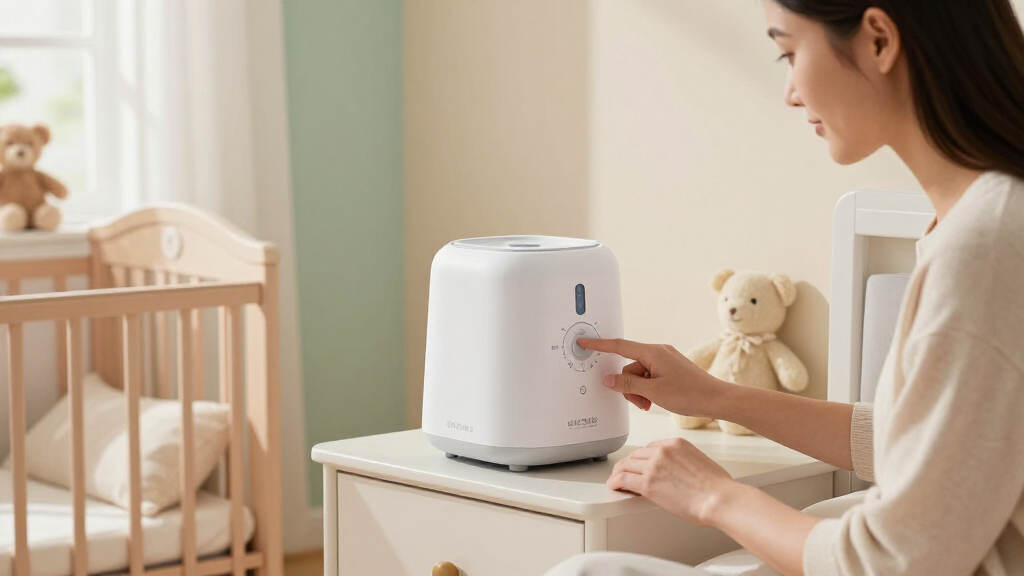
Understanding this helps you balance the need for effective white noise with safety. For example, placing the machine on a dresser across the room makes use of natural sound dissipation, which can maintain soothing levels at the crib while preventing potential hearing damage. The tradeoff is that if you place the device too close, you might be tempted to turn the volume up, risking harm. Conversely, placing it too far might reduce effectiveness, but with proper volume control, you can still achieve a calming environment.
Use a smartphone SPL app to measure the sound level at your child’s ear or pillow. Aim for 50 dBA or lower at the crib, which aligns with safety guidelines from the American Academy of Pediatrics. Keeping this balance ensures your child benefits from white noise without risking hearing health.
Popular right now

Sony WH-1000XM6 Wireless Noise-Canceling Over-Ear Headphones, Blue, Bundle

Sony WH-1000XM4C Wireless Noise-Cancelling Headphones, Black

De'Longhi Stilosa Compact Manual Espresso Machine with Milk Frother
As an affiliate, we earn on qualifying purchases.
How to measure and keep your volume safe at home
Measuring your white noise machine’s volume is a simple yet vital step in ensuring safety. Download a free SPL (sound level) app like NIOSH or Decibel X on your smartphone. Place your phone where your child’s head will be, or where your pillow is, to get an accurate reading of what they are exposed to during sleep.
Set your machine at your usual volume setting. Check the reading—if it exceeds 50 dBA, it indicates the volume may be too high for safe sleep. Turn the device down incrementally and re-measure until you’re below this threshold. This process emphasizes the importance of personal measurement because device labels often lack precise decibel outputs, and actual noise levels can vary based on placement, room acoustics, and device specifications.
This quick, practical step helps you make informed adjustments, balancing soothing sound and safety. Regularly checking ensures that even as your environment or device settings change, your child’s hearing safety remains protected.
Why placement matters more than you think: masking sounds effectively
White noise’s primary role is to mask disruptive sounds that can wake or disturb your child. Placement affects how well it performs this function, often more than the volume setting itself. Positioning the machine between the noise source (like a hallway, shared wall, or street) and the sleep zone creates a barrier—this strategic placement helps muffling external sounds before they reach your child’s ears.
For instance, if street noise is an issue, placing the machine on the side facing the street means it actively intercepts and masks those sounds, making the environment calmer. Conversely, placing it on the opposite side of the noise source might be less effective, as sounds can bypass the white noise, reducing its effectiveness. This approach leverages the principle that the proximity of the device to noise sources enhances its masking ability. It’s a tradeoff: optimal placement can compensate for lower volume levels, which is safer for hearing health.
Research supports this, showing that strategic placement often yields better sleep environments than simply turning up the volume. When you understand and apply this, you create a more effective and safer white noise environment, reducing the need for louder settings that could pose risks.
Compare indoor sound level benchmarks: what’s safe and what’s too loud?
| Sound Level | Common Source | Perceived Loudness |
|---|---|---|
| 30 dBA | Whisper, quiet library | Very soft, barely audible |
| 40 dBA | Refrigerator hum, quiet office | Soft background noise |
| 50 dBA | Normal conversation, white noise at safe volume | Comfortable, soothing |
| 60 dBA | Street traffic, vacuum cleaner | Moderate, potentially disruptive |
| 70 dBA | Hairdryer, loud music | Quite loud, risk for sensitive ears |
For infants, keeping the white noise below 50 dBA at the ear is critical because prolonged exposure to higher levels can damage hearing over time. For adults, levels up to 60 dBA are generally tolerable, but for sleep, lower is better to prevent potential masking of important environmental sounds or causing ear fatigue. Recognizing these ranges helps you judge whether your device’s volume is appropriate, balancing effectiveness with safety.
What are the risks of white noise at different volumes and distances?
High volumes close to the ear can cause temporary or permanent hearing damage, especially in infants with more sensitive ears. Research from 2014 indicates that some infant sleep machines can produce sound levels exceeding 85 dBA at 30 cm, which is significantly above safe limits for prolonged exposure. Such high levels, if sustained, can damage delicate auditory structures, leading to issues like tinnitus or even permanent hearing loss.
The risk amplifies with longer exposure times and closer proximity. For example, a device set at 85 dBA right next to your baby’s pillow could cause damage within hours, akin to occupational safety limits but with greater vulnerability in infants. Even brief exposure to loud sounds can cause acoustic trauma, which is why controlling both volume and distance is critical. Moving the device farther away reduces the sound intensity reaching your child’s ears, and turning down the volume further minimizes the risk. These tradeoffs are essential to prevent hearing damage while still providing the calming effects of white noise.
Understanding this balance underscores why safety isn’t just about turning down the volume but also about thoughtful placement, especially in environments where noise levels or device settings might be high. Prioritizing both factors ensures a safer sleep environment without sacrificing the soothing benefits of white noise.
Can I run white noise all night safely? Here’s what the science says
Many parents wonder if leaving white noise on throughout the night is safe. The current evidence suggests that continuous exposure at high volumes can pose risks, but with proper precautions, it can be safe. The key is maintaining a low volume—preferably below 50 dBA—and ensuring the device is placed at a safe distance from your child’s ears. This reduces the likelihood of noise-induced hearing damage over prolonged periods.
Using timers or auto-off features is highly recommended. For instance, setting the machine to turn off after 30 minutes or an hour allows your child to fall asleep with the white noise and minimizes prolonged exposure. If you prefer constant sound, keep the volume low, and check regularly with a SPL app to confirm levels stay within safe limits. Remember, the goal is to create a calming, safe sleep environment that doesn’t compromise hearing health. Balancing these factors—volume, placement, and timing—helps you achieve both comfort and safety throughout the night.
Should I choose white noise, pink noise, or brown noise for sleep?
White noise, pink noise, and brown noise all have distinct sound profiles that can influence sleep quality differently. White noise produces a bright, static-like hiss, which can be effective but sometimes too harsh or inconsistent for sensitive sleepers. Pink noise is deeper and softer, resembling a steady rainfall or gentle wind, which many find more soothing for longer sleep cycles. Brown noise is even deeper and more mellow, akin to distant thunder, and can be particularly calming for those who prefer a more subdued soundscape.
Research suggests pink noise may promote deeper sleep and improve memory consolidation, especially in older adults, but for infants, the priority is on consistent, non-disruptive sound environments. The choice depends on personal preference and the child’s responsiveness; some babies may find pink or brown noise more soothing, reducing the need for higher volumes. Experimenting within safe volume ranges can help you find the most effective and gentle option for your sleep environment. Ultimately, the goal is to select a sound profile that maintains a stable, calming presence without causing auditory overstimulation, which can be counterproductive.
Frequently Asked Questions
How do I know if my white noise machine is too loud?
Use a SPL app to measure the decibel level at your child’s ear or pillow. Keep it below 50 dBA for infants. If it’s louder, turn the volume down or move the machine farther away.
Should I place the machine inside the crib or on a nearby shelf?
No. Always keep the device outside the crib, on a sturdy surface at least 7 feet away. Inside the crib or on rails can be dangerous, and it makes volume control harder.
Can I leave white noise on all night?
Yes, if the volume is kept low (under 50 dBA) and the machine is placed farther from the sleep zone. Using timers or auto-off features helps prevent prolonged exposure to higher volumes.
Is pink noise better than white noise for sleep?
Pink noise is softer and deeper, which some find more soothing. Research indicates it can promote deeper sleep, but for babies, consistent white noise is often preferred for simplicity.
What’s the most effective way to improve white noise safety?
Place the machine farther away, measure the volume, keep it below 50 dBA, and use timers if possible. These steps create a safer environment while maintaining the calming effect.
Conclusion
Good placement and volume control turn a white noise machine from a potential risk into a sleep helper. Think of it as a simple equation: farther + quieter = safer + just as soothing. The next time you press that button, remember—less is often more, and a few inches can make a big difference.
Imagine a peaceful, safe sleep for your little one, with the comforting hum just enough to drown out the world, not harm tiny ears. That’s a goal worth hearing—loud and clear.