TL;DR

Turn the school run and nap time into listening time
- Thousands of audiobooks, podcasts and originals
- Listen on your phone, tablet or Echo — also offline
- Cancel anytime
Smart bottles estimate how much liquid leaves the container, but they can’t measure your hydration level. They are best for understanding drinking patterns, not diagnosing dehydration. Use them to build habits, not to judge your body’s needs.
Ever wonder if that fancy smart bottle actually tells you when you’re truly hydrated? Or if it’s just a fancy gadget that estimates how much liquid leaves the container? The truth is, these gadgets are habit trackers—tools that show patterns, not medical diagnoses. They can help you see your drinking habits, but they don’t measure your body’s hydration status.
If you’re considering a smart bottle, understanding what the data really means can save you from false confidence or unnecessary worry. In this guide, you’ll learn what these bottles track, their limits, and how to interpret the numbers they display. Let’s cut through the marketing hype and focus on what really matters at 3 a.m.
Smart bottles estimate liquid leaving the container, not hydration status.
Data accuracy varies; focus on trends, not exact measurements.
Hydration goals are guidelines—listen to your body, not just numbers.
Reminders can help build habits but risk fatigue if overused.
Privacy policies differ—choose models that respect your personal data.
Smart Bottles: What the Tracking Actually Tells You
A smart bottle can estimate what leaves the container. It cannot see what your body absorbs, loses, or needs. Its real value is habit awareness—not a medical verdict.
What the bottle can observe
Models combine weight, liquid-level, angle, motion, or flow sensors. Some also depend on manual refill entries. Every output begins with an observation about the bottle—not the body.
Estimated intake
A calculated reduction in bottle contents, often presented as milliliters or liters consumed.
Drinking events
When the bottle was lifted, tilted, or registered a change—and how long gaps lasted.
Goal tracking
Estimated progress toward a daily target generated by the app or chosen by the user.
Habit patterns
Refills, reminder responses, temperature, location, and recurring workday or weekend behavior.
“1.8 liters” is an estimate, not proof
A falling liquid level can represent drinking—but it can also represent pouring, sharing, spilling, or a missed synchronization event.
Sensor detects change
Weight, level, flow, or motion shifts inside the bottle.
App estimates intake
The software interprets the event as liquid consumed.
Body hydration
Absorption, fluid loss, medical factors, and total intake remain unknown.
The bottle observes apparent intake from one container. Hydration status also depends on urine, sweat, breathing, illness, climate, exercise, food, other beverages, medications, and health conditions.
Tracker versus hydration assessment
The useful distinction is simple: behavioral signals are often available; direct biological evidence is not.
| Question | Smart bottle | Physiological assessment | Best interpretation |
|---|---|---|---|
| How much left the bottle? | ✓ Estimated | ✗ Not the focus | Useful for approximate daily trends |
| When did drinking occur? | ✓ Often tracked | ✗ Not usually | Useful for identifying long gaps |
| Was the liquid actually swallowed? | ✗ Cannot prove | ~ Context dependent | Pouring and sharing can look like drinking |
| How much did the body absorb? | ✗ Cannot measure | ~ Requires context | Intake is not identical to absorption |
| Is the user dehydrated? | ✗ Cannot diagnose | ✓ Broader assessment | Symptoms and clinical markers matter |
| Is the daily goal appropriate? | ~ General estimate | ✓ Can be individualized | Needs vary with body, activity, climate, and health |
Expect noise, not laboratory precision
These bars show the relative potential to distort a reading, not measured error rates. The lesson is to notice how your own routine affects the data.
Use patterns to ask better questions
A device can be internally consistent even when its absolute measurement is imperfect. That makes repeated patterns more informative than a single exact-looking total.
Timing
Do most long gaps happen during meetings, commuting, exercise, or late-night work?
Consistency
Is your drinking pattern becoming steadier across comparable days and routines?
Reminder response
Do prompts produce useful action, or have they become background noise and notification fatigue?
Confidence spectrum
Marker: behavioral trendFrom bottle movement to a useful habit
The data becomes valuable when each inference stays within its limits.
Liquid changes
The sensor records weight, level, angle, or flow.
Event logged
The app converts that change into an intake estimate.
Pattern appears
Timing, gaps, refills, and routine become visible.
Behavior shifts
A reminder may encourage more regular drinking.
Habit support
The win is greater awareness—not a diagnosis.
Stop the chain before “hydrated.” The bottle does not know your sweat loss, urine output, food-derived water, illness, medication effects, or physiological markers.
How to use a smart bottle wisely
Treat the device as a supportive nudge. Your health is a broader system than one container can capture.
Read totals as estimates. Liquid leaving the bottle is not proof that every drop was consumed.
Favor trends over precision. A rising or falling pattern matters more than an exact milliliter count.
Treat goals as guidelines. Needs vary with activity, climate, body size, health, food, and other drinks.
Tune reminders deliberately. Keep prompts that change behavior; reduce those that create fatigue.
Review privacy before purchase. Check what personal, location, and health-adjacent data is stored or shared.
Frequently asked questions
Smart-bottle data is easiest to understand when the measurement and the inference are kept separate.
Are smart water bottles accurate?
They provide useful estimates, but pouring, spilling, sharing, refilling, placement, and sensor quality can alter results. Focus on trends.
Can one tell if I am dehydrated?
No. Most models do not measure physiological markers such as blood or urine concentration and cannot diagnose dehydration.
How does it know I drank?
It detects changes in weight, liquid level, flow, angle, or movement. The resulting intake value remains an estimate.
Does water from food count?
Yes. Fruit, vegetables, soups, and other drinks contribute water, but most bottles only track events involving that bottle.
How much water should I drink each day?
There is no universal target for everyone. Needs vary widely, and excessive intake over a short period can be dangerous. Use general guidance as a starting point and seek personalized medical advice when health conditions, medications, pregnancy, intense exercise, or concerning symptoms are involved.
The bottle’s biggest gift is awareness.
Use it to notice when and how often you drink from that container. Then combine the pattern with your routine, your body’s signals, and appropriate professional guidance—without letting a precise-looking number create false confidence or unnecessary worry.
What smart bottles actually track—and what that means for you
Most smart bottles estimate how much liquid leaves the bottle, not how much your body absorbs. For example, a bottle might say you’ve consumed 1.8 liters today. That usually means the sensor detected a reduction in liquid volume—either from drinking or spilling. It doesn’t prove you drank every drop, or that your body absorbed it.
This distinction is crucial because it highlights the core limitation: the data reflects your drinking behavior, not your hydration status. If you see a consistent pattern of low intake, it might signal you need to drink more, but it doesn’t confirm dehydration or proper hydration. Conversely, high intake doesn’t guarantee optimal hydration if, for example, you’re losing more fluid through sweat or respiration.
Understanding this helps you interpret the data more thoughtfully. For instance, if your goal is to stay hydrated, the smart bottle can serve as a behavioral guide—prompting you to drink more regularly—rather than a diagnostic tool. Recognizing what the data truly represent avoids false reassurance and helps set realistic expectations about what these devices can tell you about your body’s hydration levels.
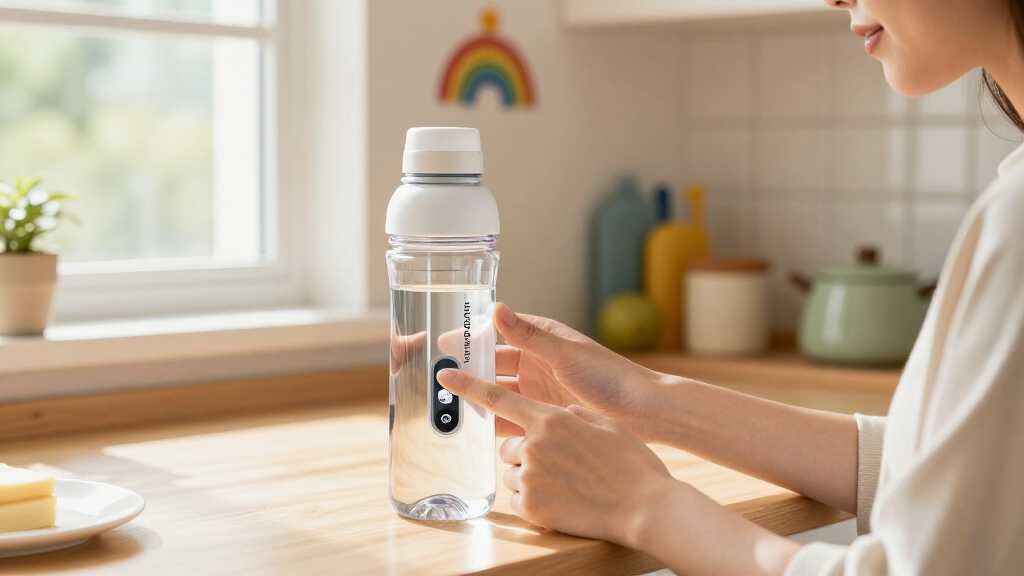
smart water bottle with hydration tracking
As an affiliate, we earn on qualifying purchases.
As an affiliate, we earn on qualifying purchases.
How accurate are these bottles? Expect some errors, not perfect precision
Smart bottles are designed to assist with habit formation, not to serve as medical-grade measurement devices. Their sensors are susceptible to various factors that can introduce errors. For example, spilling liquid, refilling the bottle mid-use, or pouring into a glass instead of drinking directly from the bottle can all distort the data. These inconsistencies matter because they can lead to mistaken assumptions about your fluid intake.
Moreover, user behavior—like how you hold or place the bottle—affects sensor readings. Calibration issues or environmental factors such as temperature can also influence accuracy. This means that while a bottle might consistently underestimate or overestimate your intake, it’s unlikely to provide perfectly precise measurements. Instead, the focus should be on recognizing patterns over time.
For example, if you typically drink around 1.5 liters daily, observing whether your intake is generally rising or falling is more meaningful than obsessing over exact milliliter counts. The key takeaway: accept some margin of error and use trend data to guide your hydration habits, rather than relying on the numbers as absolute truth. This understanding prevents frustration and helps you use the device effectively for habit-building rather than health diagnostics.
As an affiliate, we earn on qualifying purchases.
What the numbers really mean: hydration? Not quite
Many people assume that the numbers displayed by their smart bottle directly indicate their hydration status, but this is a misconception with significant implications. Hydration is a complex physiological state influenced by multiple factors—fluid intake, fluid loss through sweat, respiration, urination, and even food consumption. A smart bottle’s reading of how much liquid leaves the container doesn’t account for these variables.
For instance, if your bottle shows you’ve consumed 2 liters during an intense workout, you might still be dehydrated if you lost more fluid through sweat than you replaced. Conversely, if you’re drinking a lot but also losing fluids rapidly, the number alone won’t reveal your true hydration level. Relying solely on these numbers can lead to misguided conclusions—either overestimating your hydration or falsely reassuring yourself.
This distinction underscores why smart bottles are best used as behavioral tools—tracking how often and when you drink—rather than as diagnostic devices. Recognizing that these data points are proxies, not direct measures, helps you avoid unnecessary worry and focus on signs your body provides, like thirst, urine color, and energy levels. Ultimately, understanding this nuance prevents misinterpretation that could lead to poor hydration decisions or health concerns.
smart bottle for drinking patterns
As an affiliate, we earn on qualifying purchases.
As an affiliate, we earn on qualifying purchases.
Frequently Asked Questions
Are smart water bottles accurate?
They provide useful estimates of how much liquid leaves the bottle, but accuracy depends on sensor quality and user behavior. Pouring, spilling, or sharing can distort results, so focus on trends over exact numbers.Can a smart bottle tell if I am dehydrated?
No. Most smart bottles only track drinking habits—they don’t measure physiological hydration markers like blood or urine concentration. Dehydration requires more comprehensive assessment.How does the bottle know I drank water?
It detects changes in weight, liquid level, or movement. Some models combine sensors for better estimates. But remember, it’s estimating what left the bottle, not what your body absorbed.Does water from food count?
Yes. Fruits, vegetables, soups, and drinks all contribute to your hydration. However, most smart bottles don’t track intake from food—only from the bottle itself.How much water should I drink each day?
Needs vary widely based on age, activity, climate, and health. Use general guidelines as a starting point, but listen to your body and consult a healthcare professional for personalized advice.As an affiliate, we earn on qualifying purchases.
Conclusion
Remember, a smart bottle’s biggest gift isn’t perfect hydration data. It’s awareness—seeing when and how often you drink from that specific container. That insight can help you build better habits, not diagnose health issues.
At the end of the day, hydration isn’t just about numbers. It’s about listening to your body, understanding your routine, and choosing tools that support your real-life needs—without adding stress or confusion. So pick wisely, drink intentionally, and enjoy the simple act of staying hydrated.
Cold & flu season Picks
humidifiers
As an affiliate, we earn on qualifying purchases.