
TL;DR

Turn the school run and nap time into listening time
- Thousands of audiobooks, podcasts and originals
- Listen on your phone, tablet or Echo — also offline
- Cancel anytime
A contributor to The 74 argues that schools should replace routine one-to-one laptop distribution with computer labs or limited-use laptop carts. The argument draws on a survey of more than 2,000 high school students and recent graduates, but the survey documents reported behavior rather than proving that school devices cause lower achievement.
The 74 published an opinion article calling on school leaders to scale back or end routine one-to-one laptop and tablet programs, arguing that school-issued devices contribute to classroom distraction and unauthorized AI use. The case rests partly on a survey of more than 2,000 high school students and recent graduates; the survey records students’ reports and does not establish that devices cause academic harm.
The article’s author, writing on behalf of the Thomas B. Fordham Institute, says the organization commissioned a nationally representative survey fielded by Impact Research and UpONE Insights. According to the article, 76% of respondents reported some form of technology misuse every day. Half said they scrolled social media or messaged friends during class daily, while one in three reported daily use of videos not assigned by a teacher or video games. The article also says 22% reported daily unauthorized AI use.
The author reports that six in 10 students spend most of class on a school-issued device, and nearly one-third spend more than three-quarters of class on one. Students surveyed said school devices were a main way they accessed AI, games and YouTube at school. The piece also reports that nearly half of respondents used AI to solve math problems and one in four used it to cheat on quizzes or tests. These figures are presented as survey findings in the opinion article; details of the questionnaire and results are not included in the supplied material.
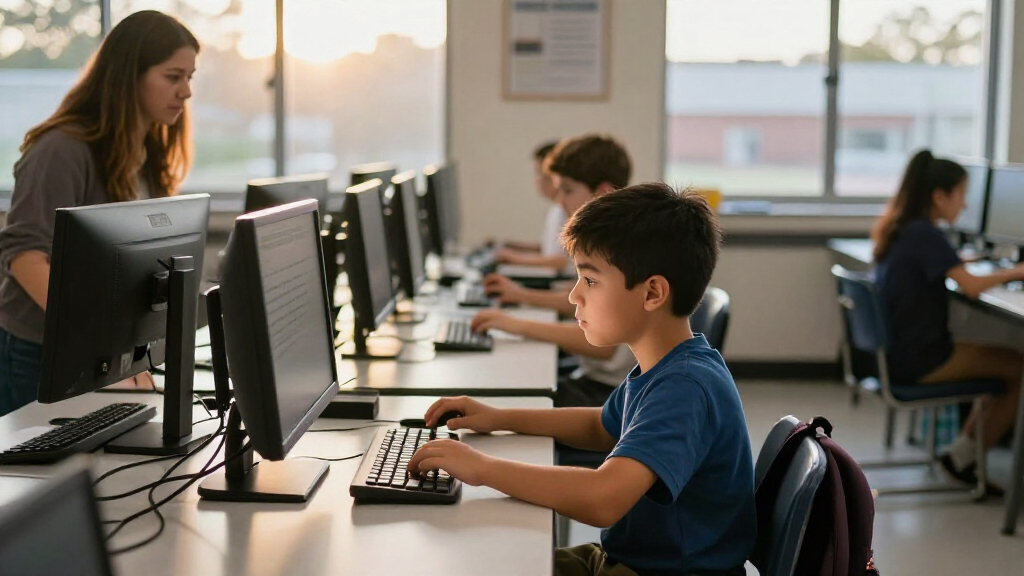
The proposed alternative is not to remove computers from education altogether. The author recommends using computer labs or laptop carts for lessons that require devices, while keeping classrooms device-free much of the time. The article allows for exceptions, including computer-science courses, schools with specialized programs, and students who need access to a computer at home.
How Schools Could Change Device Access
The proposal would shift technology from an always-available classroom resource to a tool used for specific lessons. Supporters of that approach could seek fewer opportunities for students to switch from assignments to social media, games or unauthorized AI use. It could also change how teachers plan lessons and how districts budget for purchasing, maintaining and replacing devices.
The survey figures matter because they describe behavior students say is common, but they do not by themselves show whether limiting devices improves learning, attention or academic integrity. The article acknowledges that its research is not a causal study. School leaders weighing the recommendation would need to consider both the reported misuse and the educational value of access, including whether students have reliable computer access outside school.
Popular right now

Samsung 48 4K OLED Smart TV (2026) with WireLogic 8ft Ultra High Speed HDMI Cable

KitchenAid Artisan 5-Quart Tilt-Head Stand Mixer, Almond Cream

Ninja Foodi Air Fryer 8 Qt DualZone 6-in-1 Grey DZ201
As an affiliate, we earn on qualifying purchases.
A Local Debate Over Screen Limits
The opinion article points to recent efforts in large U.S. school systems to restrict device use. It says Los Angeles set daily limits on school-issued device use and banned YouTube on district devices. It also says New York City issued screen-time recommendations that are not mandatory and do not cover high school students. The supplied source does not give dates or further details about the policies.
The author places the argument within a broader dispute over whether giving every student a laptop improves education. The article says some studies report benefits, but characterizes much of that research as small-scale or low-quality and describes the strongest studies as mixed or negative. Those assessments are the author’s interpretation, not a detailed review of the studies in the source material. The survey adds evidence about reported device use, but it does not resolve whether one-to-one programs improve or weaken academic outcomes.
““76% of students report some kind of technology misuse each and every day.””
— The opinion article’s author
What the Survey Cannot Establish
The supplied material does not include the survey questionnaire, response rates, detailed methodology or full breakdowns of the results. It is also unclear how respondents defined “misuse,” whether their reports were independently verified, or how responses varied by school type and student circumstances.
Most importantly, the survey does not establish that one-to-one devices cause distraction, cheating or lower achievement. The article does not provide a direct comparison of learning outcomes between schools using individual devices and those using labs or carts. It also does not specify how the proposed changes would address students who rely on school-provided computers for accessibility, coursework or internet access.
Local Leaders Face the Policy Choice
The author argues that decisions about school-issued technology should be made locally by administrators, school boards and parents, rather than imposed by states. The article describes no specific vote, deadline or planned policy change arising from its recommendation. Any next steps would depend on local districts reviewing their own device policies, instructional needs and student access.
Readers can watch for whether districts expand screen limits, change device-use rules or retain one-to-one programs with stronger restrictions. The central question is whether schools can reduce off-task use without limiting legitimate learning and computer access.
Key Questions
What does the opinion article recommend?
It recommends that schools sharply reduce or end routine one-to-one laptop and tablet distribution and use computer labs or laptop carts for lessons that need devices.
What did the survey report about student technology use?
The article says 76% of respondents reported some kind of daily technology misuse. The findings are based on student and recent graduate reports, not a direct measure of classroom learning.
Does the survey prove school laptops cause distraction?
No. The author says the research is not a causal study. It reports patterns of device use but does not establish that school-issued computers caused the behavior or affected achievement.
Would the proposal eliminate computer access at school?
No. The author supports computer labs and laptop carts for planned use and describes exceptions for some courses and specialized schools. The article also suggests lending computers to students who need them at home.
Source: the74million.org