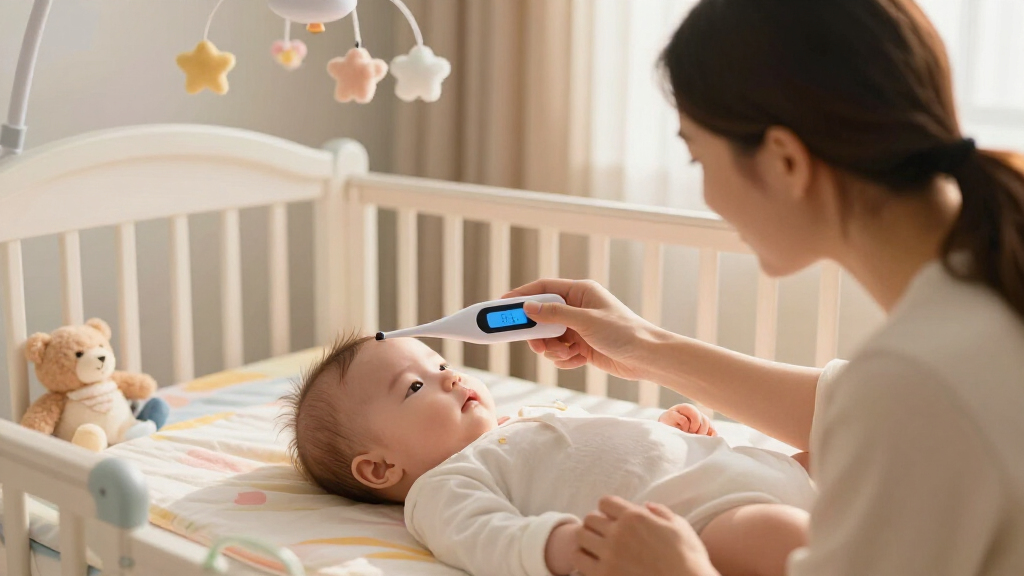

The best smart thermometer for most babies is the Kinsa QuickCare, which pairs a familiar digital thermometer format with app-connected tracking. For hands-free monitoring, the Momcozy Wearable Digital Thermometer stands out, while the Braun ThermoScan 7+ Connect is a stronger fit for families who prefer ear readings and connected records. Your main choice is between contact and no-touch readings, simple temperature checks and app features, or quick convenience and the consistency of a carefully repeated measurement. Read on for the full breakdown, including the tradeoffs that matter when choosing for a baby.

Turn the school run and nap time into listening time
- Thousands of audiobooks, podcasts and originals
- Listen on your phone, tablet or Echo — also offline
- Cancel anytime
Complete the kit


Key Takeaways
- Kinsa QuickCare is the most balanced pick: its standard digital thermometer format and app connection make it a practical starting point, though this list includes the same model twice, not two distinct Kinsa options.
- Braun ThermoScan 7+ Connect and ThermoScan 5 serve different needs: the 7+ adds connected tracking, while the 5 keeps the focus on ear readings and a stability indicator.
- The Momcozy wearable is the outlier: continuous app monitoring suits caregivers who want ongoing temperature updates, but it is a more specialized choice than a thermometer used for spot checks.
- No-touch and multi-mode models offer flexibility, not a guaranteed shortcut: the Viproud, Goodbaby, Momcozy forehead-and-ear model, Frida, and generic 2-in-1 device vary in how many measurement approaches they offer, so mode instructions matter.
- More features can mean more decisions: app connectivity, multiple measurement sites, fever alerts, and memory are useful only when they fit how your family plans to take, record, and discuss readings.
| Kinsa QuickCare Smart Digital Thermometer |  | Best for Flexible, Fast Checks | Brand and model: Kinsa QuickCare | Thermometer type: Digital | Reading time: Under 8 seconds | VIEW LATEST PRICE | See Our Full Breakdown |
| Braun ThermoScan 7+ Connect Digital Ear Thermometer |  | Best for Age-Based App Guidance | Measurement site: Ear | Connectivity: Bluetooth | Response time: 2 seconds | VIEW LATEST PRICE | See Our Full Breakdown |
| Braun ThermoScan 5 Digital Ear Thermometer with ExacTemp Stability Indicator |  | Best Straightforward Ear Thermometer | Measurement site: Ear | Suitable for: Babies, infants, and adults | Stability indicator: ExacTemp | VIEW LATEST PRICE | See Our Full Breakdown |
| Momcozy Wearable Digital Thermometer with Continuous App Monitoring |  | Best for Continuous Temperature Trends | Model: T31 | Placement: Underarm | Accuracy: ±0.2°F | VIEW LATEST PRICE | See Our Full Breakdown |
| Kinsa QuickCare Smart Digital Thermometer | 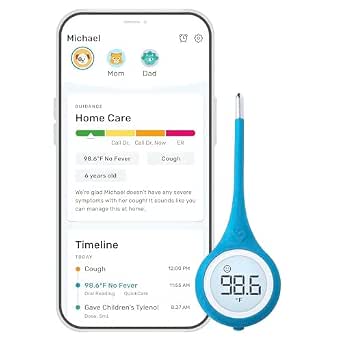 | Best Bluetooth-Connected Spot Check | Brand and model: Kinsa KSA-120 | Measurement methods: Oral, rectal, or underarm | Response time: About 8 seconds | VIEW LATEST PRICE | See Our Full Breakdown |
| Viproud Non-Contact Infrared Thermometer for Adults, Kids, and Babies |  | Best for Simple Nighttime Checks | Measurement modes: Forehead and object | Temperature range: 89.6°F to 109.2°F | Response time: About 1 second | VIEW LATEST PRICE | See Our Full Breakdown |
| Momcozy Digital Forehead and Ear Thermometer, Non-Contact, for Adults and Kids |  | Best for Multiple Reading Methods | Measurement modes: Forehead, ear, object, and room | Child mode: 0–3 years | Display: LCD screen | VIEW LATEST PRICE | See Our Full Breakdown |
| Forehead Thermometer for Adults and Kids, Non-Contact, Fast Accurate Result, 3-Color Fever Alarm, 35 Memory Recalls, 1s Result, 2-in-1 Mode, Silent Mode, Large Backlit Display |  | Best for Clear Fever Cues | Measurement type: Non-contact forehead | Modes: 2-in-1: body and surface | Response time: About 1 second | VIEW LATEST PRICE | See Our Full Breakdown |
| Goodbaby No-Touch Forehead Thermometer for Adults, Children, and Infants |  | Best for Room and Object Checks | Measurement method: Infrared, no-touch | Measurement modes: Forehead, room, and object | Temperature units: Celsius and Fahrenheit | VIEW LATEST PRICE | See Our Full Breakdown |
| Frida 3-in-1 Infrared Thermometer for Ear, Forehead, and Touchless Use | 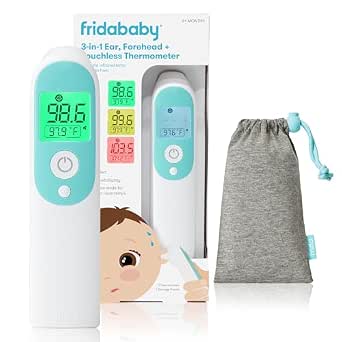 | Best for Three Ways to Take a Reading | Temperature modes: Ear, forehead contact, and touchless | Display: Backlit digital | Response time: About 1 second | VIEW LATEST PRICE | See Our Full Breakdown |
| smart thermometers for babie | Power | Display | Response time |
|---|---|---|---|
| Kinsa QuickCare Smart Digital | — | Large lighted display with fever indication icons | — |
| Braun ThermoScan 7+ Connect Di | 2 included AA batteries | — | 2 seconds |
| Braun ThermoScan 5 Digital Ear | 2 AA batteries | — | — |
| Momcozy Wearable Digital Therm | — | — | — |
| Kinsa QuickCare Smart Digital | Battery powered; 1 included lithium metal battery | — | About 8 seconds |
| Viproud Non-Contact Infrared T | 2 AAA batteries, included | Digital LED | About 1 second |
| Momcozy Digital Forehead and E | — | LCD screen | — |
| Forehead Thermometer for Adult | Battery operated | Large backlit LCD | About 1 second |
| Goodbaby No-Touch Forehead The | — | — | — |
| Frida 3-in-1 Infrared Thermome | 1 AAA battery, included | Backlit digital | About 1 second |
More Details on Our Top Picks
Kinsa QuickCare Smart Digital Thermometer
The Kinsa QuickCare suits families who want one thermometer for oral, underarm, and rectal readings rather than a device tied to a single measurement site. Its under-eight-second readings and flexible tip can make a brief check easier with a restless child, while the backlit display helps when the room is dim. The optional app adds symptom and medication tracking, a useful extra for caregivers managing details across family members. Compared with the Braun ThermoScan 7+ Connect, QuickCare offers more measurement methods, but it does not provide Braun’s ear-position stability indicator or age-based, color-coded guidance. The app is optional, yet its smartphone animation and tracking features are less useful to caregivers who prefer a standalone device. Choose it for adaptable, quick checks; skip it if you specifically want an ear thermometer or do not want phone-linked features.
Pros:- Provides readings in under 8 seconds
- Supports oral, underarm, and rectal measurement
- Flexible tip and large backlit display support easier checks
- Optional app tracks symptoms and medications
Cons:- App-based tracking and guidance require a smartphone
- Smartphone app includes a bubble-blowing animation that may not suit every caregiver
Best for: Caregivers who want a fast thermometer that can be used orally, under the arm, or rectally and value optional symptom tracking.
Not ideal for: Families seeking a dedicated ear thermometer with positioning guidance, or caregivers who want all features without a smartphone.
- Brand and model:Kinsa QuickCare
- Thermometer type:Digital
- Reading time:Under 8 seconds
- Measurement methods:Oral, underarm, or rectal
- Temperature units:Fahrenheit and Celsius
- Tip:Flexible, bendable
- Display:Large lighted display with fever indication icons
- App:Optional Kinsa app for symptom and medication tracking
- Standards:FDA-cleared; meets ASTM standards
Our verdict“Choose QuickCare for fast, flexible measurement methods; pick the Braun ThermoScan 7+ Connect instead if ear positioning guidance and age-based results matter more.”
Braun ThermoScan 7+ Connect Digital Ear Thermometer
The Braun ThermoScan 7+ Connect is the most guidance-focused pick here: its Age Precision technology interprets ear readings by age and uses color coding to make the result easier to read in context. Bluetooth links readings, profiles, medication reminders, and a health journal to the Braun Family Care app. A pre-warmed tip, stability indicator, and nighttime mode are aimed at making ear checks more manageable, while the included lens caps support repeated family use. Compared with the Braun ThermoScan 5, this model adds connected tracking and age-based display guidance, but also depends on a compatible phone for its app features. Its ear-only method is less flexible than the Kinsa QuickCare, which supports oral, underarm, and rectal use. It fits caregivers who want structured tracking and clear positioning feedback, not those avoiding batteries or app reliance.
Pros:- Age Precision technology provides age-specific, color-coded guidance
- Stability indicator gives light and sound feedback on positioning
- Bluetooth app supports profiles, reading history, medication reminders, and a health journal
- Pre-warmed tip and nighttime mode support more convenient checks
Cons:- App features require a compatible phone and Bluetooth connection
- Uses disposable AA batteries
- Measures at the ear only
Best for: Caregivers who want age-based interpretation, positioning feedback, and app records for multiple family members.
Not ideal for: Families who want one thermometer for several measurement sites or prefer a fully standalone device without disposable batteries.
- Measurement site:Ear
- Connectivity:Bluetooth
- Response time:2 seconds
- Temperature resolution:0.1 degree
- Upper temperature range:104 °F
- Power:2 included AA batteries
- Included lens caps:21
- Item length:5.4 inches
- App functions:Reading tracking, profiles, medication reminders, and health journal
Our verdict“Pick the ThermoScan 7+ Connect for age-based guidance and connected records, but choose Kinsa QuickCare if you need more than an ear measurement.”
Braun ThermoScan 5 Digital Ear Thermometer with ExacTemp Stability Indicator
The Braun ThermoScan 5 keeps the focus on a simple ear-reading routine: a pre-warmed tip and ExacTemp stability indicator offer positioning feedback without making app setup part of the process. It is suitable for babies, children, and adults, and comes with 21 hygiene caps plus a protective cap for home use. The supplied product information describes it as clinically proven to be as accurate as rectal measurements in newborns, a useful point for caregivers comparing ear readings with other methods. Unlike the Braun ThermoScan 7+ Connect, it does not add Bluetooth tracking or age-based color guidance, so its appeal is simpler operation rather than connected records. It also cannot match the Kinsa QuickCare for measurement-site flexibility. Choose this Braun when an ear-only device is enough; skip it if you want app logs or multi-site readings.
Pros:- ExacTemp stability indicator helps with ear positioning
- Pre-warmed tip is designed for comfortable measurement
- Includes 21 hygiene caps and a protective cap
- Suitable for babies, children, and adults
Cons:- Limited to ear temperature measurement
- Requires lens cleaning to support accurate readings
- Runs on AA batteries that need replacement over time
Best for: Caregivers who want a family-use ear thermometer with positioning feedback and no need for app connectivity.
Not ideal for: Families who need oral, underarm, or rectal readings, or want Bluetooth tracking and age-based guidance.
- Measurement site:Ear
- Suitable for:Babies, infants, and adults
- Stability indicator:ExacTemp
- Tip:Pre-warmed
- Power:2 AA batteries
- Hygiene caps included:21
- Other included accessory:Protective cap
- Measurement claim:Clinically proven to be as accurate as rectal measurements in newborns
Our verdict“Choose the ThermoScan 5 for straightforward ear checks with positioning feedback, while the ThermoScan 7+ Connect is the better fit for app tracking and age-based guidance.”
Momcozy Wearable Digital Thermometer with Continuous App Monitoring
The Momcozy Wearable Digital Thermometer takes a different approach from spot-check devices: it sits under the arm and continuously tracks temperature, sending readings and trend charts to the Momcozy app. That can help caregivers follow changes over time instead of repeatedly waking or repositioning a child for a single reading. Its lightweight form, hypoallergenic 3M sticker, and stated battery life of up to 180 hours support longer monitoring periods. The tradeoff is a phone-dependent setup: the app must remain in the foreground, and the sticker needs replacement every eight hours. Compared with the Braun ThermoScan 7+ Connect, Momcozy emphasizes ongoing trends rather than quick, guided ear readings; compared with the Kinsa QuickCare, it is not a flexible spot-check thermometer. It makes sense for trend monitoring, not for caregivers who want a quick standalone result.
Pros:- Continuously tracks temperature and presents trend charts
- Supports multiple user profiles
- Designed for babies, children, and adults
- Battery life is stated as up to 180 hours
Cons:- Momcozy app must remain in the foreground during monitoring
- The sticker must be replaced every 8 hours
- Uses an included nonstandard battery
Best for: Caregivers who want to monitor temperature trends over time and can keep the Momcozy app open during monitoring.
Not ideal for: Families who need occasional standalone readings, do not want recurring sticker replacement, or cannot keep a phone app in the foreground.
- Model:T31
- Placement:Underarm
- Accuracy:±0.2°F
- App:Momcozy app; foreground connection required
- Battery life:Up to 180 hours
- Sticker material:3M hypoallergenic material
- Sticker replacement interval:Every 8 hours
- Dimensions:3.46 x 1.81 x 1.1 inches
- Weight:0.24 ounces
Our verdict“Choose Momcozy for ongoing underarm trend tracking, but select Braun ThermoScan 7+ Connect or Kinsa QuickCare for quick spot checks.”
Kinsa QuickCare Smart Digital Thermometer
This Kinsa QuickCare pairs a familiar digital thermometer format with Bluetooth symptom tracking, making it a practical pick for caregivers who want a quick reading and a record of what followed. It reads in about eight seconds, has a flexible tip and backlit display, and supports oral, rectal, and underarm use. The app adds symptom tracking and personalized care guidance, so its smart features are tied to a short, routine-friendly check rather than continuous monitoring. Compared with the Momcozy wearable thermometer, it is better for individual spot readings and does not require a sticker to be replaced every eight hours; Momcozy is the more suitable choice for tracking trends over time. This Kinsa’s app features require Bluetooth and the app, and its stated range is 96–108 °F. Choose it for connected records, not phone-free use.
Pros:- Provides readings in about 8 seconds
- Supports oral, rectal, and underarm measurement
- Flexible tip and backlit digital display support easier checks
- Bluetooth app offers symptom tracking and personalized care guidance
Cons:- App-connected features require Bluetooth and the Kinsa app
- Temperature range is limited to 96–108 °F
Best for: Caregivers who want a quick, flexible spot-check thermometer with Bluetooth symptom tracking and personalized guidance.
Not ideal for: Families seeking continuous temperature trends or those who want readings and tracking without Bluetooth or a smartphone app.
- Brand and model:Kinsa KSA-120
- Measurement methods:Oral, rectal, or underarm
- Response time:About 8 seconds
- Temperature range:96–108 °F
- Connectivity:Bluetooth
- Power:Battery powered; 1 included lithium metal battery
- Display and tip:Backlit digital display; flexible tip
- Length:5.5 inches
- Standards:FDA-cleared; meets ASTM standards
Our verdict“Choose this Kinsa for fast, multi-site spot checks with Bluetooth records; pick Momcozy if ongoing trend monitoring is your priority.”
Viproud Non-Contact Infrared Thermometer for Adults, Kids, and Babies
The Viproud is a straightforward pick for parents who want a one-second, no-contact forehead reading without choosing between a complicated feature set and basic usability. Its large LED screen, color-coded guidance, and mute mode make quick checks easier when a baby is asleep. Compared with the Momcozy Digital Forehead and Ear Thermometer, Viproud is more limited because it does not offer an ear-reading mode; in return, its 35-reading memory gives parents a useful way to track changes. It also measures room and object temperatures, though those readings are separate from assessing a baby’s temperature. The main tradeoff is its stated forehead range of 89.6°F to 109.2°F, which is a constraint for readings outside that span, plus reliance on two AAA batteries.
Pros:- Takes non-contact readings in about one second
- Mute mode and a large LED display suit quiet nighttime checks
- Stores up to 35 readings for tracking changes
- Measures forehead and object temperatures
Cons:- Forehead range is limited to 89.6°F–109.2°F
- Needs two AAA batteries
- Does not offer an ear measurement mode
Best for: Parents who want a simple, quiet, non-contact forehead thermometer with memory for keeping track of readings.
Not ideal for: Caregivers who want ear readings or a broader stated forehead temperature range; the Momcozy offers an ear mode.
- Measurement modes:Forehead and object
- Temperature range:89.6°F to 109.2°F
- Response time:About 1 second
- Memory:35 readings
- Display:Digital LED
- Resolution:0.1°C / 0.1°F
- Power:2 AAA batteries, included
- Weight:2.56 ounces
- Warranty:1 year
Our verdict“Choose the Viproud for quiet, quick forehead checks and reading history, but choose the Momcozy if you also want ear measurements.”
Momcozy Digital Forehead and Ear Thermometer, Non-Contact, for Adults and Kids
The Momcozy makes the most sense for households that want forehead and ear readings in one compact device. That flexibility gives parents another way to take a temperature when a forehead check is inconvenient, while silent mode and a storage bag suit nighttime use and travel. It also measures objects and room temperature, giving it broader modes than the Viproud, which lacks an ear option. The tradeoff is that more modes mean parents need to select the intended method and handle the thermometer as directed; the supplied information also cautions that mishandling can affect calibration. Its LCD is clear, but the listed details do not specify a memory capacity or a reading time, unlike the Viproud’s defined 35-reading history and one-second response. That makes Momcozy the more versatile pick, not necessarily the easiest to compare over time.
Pros:- Offers forehead, ear, object, and room measurement modes
- Silent mode supports checks while a baby sleeps
- Compact, lightweight design includes a storage bag
- Child mode is specified for ages 0–3
Cons:- Requires battery replacement over time
- Careful handling matters because mishandling may affect calibration
- The supplied specifications do not state memory capacity or response time
Best for: Parents who want forehead and ear options, silent operation, and a portable thermometer for home and travel.
Not ideal for: Caregivers who prioritize a clearly specified reading history or want the simplest single-method device; the Viproud lists 35 stored readings.
- Measurement modes:Forehead, ear, object, and room
- Child mode:0–3 years
- Display:LCD screen
- Silent mode:Yes
- Battery:Included; replacement required over time
- Portability:Compact, lightweight; storage bag included
- Users:Infants, children, and adults
Our verdict“Pick Momcozy if having both ear and forehead options matters more than a specified memory history or response time.”
Forehead Thermometer for Adults and Kids, Non-Contact, Fast Accurate Result, 3-Color Fever Alarm, 35 Memory Recalls, 1s Result, 2-in-1 Mode, Silent Mode, Large Backlit Display
This forehead-only model puts at-a-glance temperature cues ahead of measurement variety: its three-color fever indicator and large backlit screen make readings easy to check, including in a dim room. The 35-reading memory and one-second result also give it a stronger tracking feature set than the Goodbaby No-Touch Forehead Thermometer, whose supplied details do not list memory or a response time. Both can measure beyond body temperature, but this model’s listed 2-in-1 modes are body and surface rather than Goodbaby’s forehead, room, and object modes. That distinction matters if you specifically want room readings. Its non-contact design avoids touching a baby during a check, but it offers no ear option, and it depends on batteries and careful handling. Choose it for simple visual feedback, not multi-method flexibility.
Pros:- Three-color fever indicator makes readings easier to scan
- Large backlit display is suited to low-light checks
- Stores up to 35 readings
- Provides results in about one second without contact
Cons:- Limited to forehead body readings and surface mode, with no ear option
- Requires batteries and correct battery installation
- Electronic operation can be affected by mishandling
Best for: Parents who want a quick forehead check with visible fever indicators and stored readings for tracking.
Not ideal for: Families who want ear measurements or room-temperature readings; the Momcozy offers ear and room modes.
- Measurement type:Non-contact forehead
- Modes:2-in-1: body and surface
- Response time:About 1 second
- Memory:35 readings
- Display:Large backlit LCD
- Fever indicator:3-color indicator
- Temperature units:°F and °C, switchable
- Power:Battery operated
Our verdict“Choose this model for visual fever cues and a 35-reading history, but look to the Momcozy for ear and room measurements.”
Goodbaby No-Touch Forehead Thermometer for Adults, Children, and Infants
Goodbaby is the practical choice for parents who want a no-touch forehead thermometer that can also read room and object temperatures. Its recommended 1.5-inch forehead distance gives caregivers a concrete positioning guide, while included batteries and quick-start materials help make setup more direct. Compared with the Viproud, Goodbaby shares forehead, room, and object use but does not list a 35-reading memory, mute mode, or a one-second response time. Its clearest tradeoff is measurement pace: the instructions recommend waiting 10 seconds between readings, so it is less suited to repeated rapid checks than the Viproud or the one-second forehead model. It also works best within stable room temperatures of 50°F–104°F. This is a basic multi-purpose option, not the pick for extensive tracking or frequent back-to-back readings.
Pros:- Measures forehead, room, and object temperatures
- Displays readings in Celsius or Fahrenheit
- Includes two AAA batteries and quick-start guidance
- Specifies a recommended forehead distance of 1.5 inches
Cons:- Instructions recommend waiting 10 seconds between readings
- Works best in stable room temperatures of 50°F–104°F
- Supplied details do not list memory, mute mode, or a response time
Best for: Parents who want a simple no-touch thermometer for baby forehead checks plus occasional room or object readings.
Not ideal for: Caregivers who expect to take rapid consecutive readings or need stored temperature history; the Viproud specifies 35-reading memory.
- Measurement method:Infrared, no-touch
- Measurement modes:Forehead, room, and object
- Temperature units:Celsius and Fahrenheit
- Recommended forehead distance:1.5 inches
- Wait between readings:10 seconds recommended
- Recommended room conditions:Stable temperatures of 50°F–104°F
- Included accessories:2 AAA batteries, user manual, and quick guide
- Replacement coverage:12 months
Our verdict“Choose Goodbaby for straightforward forehead, room, and object readings, but not for rapid repeat checks or temperature-history tracking.”
Frida 3-in-1 Infrared Thermometer for Ear, Forehead, and Touchless Use
Frida’s main advantage is its three measurement methods: ear, forehead contact, and touchless. That makes it a flexible option for caregivers who want to adapt how they take a reading rather than rely on the forehead-only approach of the B08MT3D361. The backlit display, roughly one-second response, and memory recall support quick checks and basic tracking, while its three-inch length and included pouch make storage simple. The tradeoff is that flexibility depends on using the selected method correctly: the product notes that ear readings rely on careful probe placement, and clinicians may advise a particular method. Its stated temperature range is 95°F to 108°F, narrower at the low end than the Viproud’s listed range. This suits parents who value multiple modes, but less so those who want room or object readings or a wider stated range.
Pros:- Provides ear, forehead-contact, and touchless modes
- Reads in about one second
- Backlit display and memory recall support checks and basic tracking
- Compact three-inch design includes a storage pouch
Cons:- Ear readings depend on careful probe placement
- Stated temperature range is limited to 95°F–108°F
- No room or object measurement mode is listed
Best for: Caregivers who want ear, forehead-contact, and touchless options in a small thermometer for home use.
Not ideal for: Parents who need room or object measurements, or who prefer a wider stated temperature range; the Viproud includes object mode and lists a lower minimum.
- Temperature modes:Ear, forehead contact, and touchless
- Display:Backlit digital
- Response time:About 1 second
- Power:1 AAA battery, included
- Temperature range:95°F to 108°F
- Memory:Memory recall
- Length:3 inches
- Included component:Storage pouch
- Care:Wipe clean
Our verdict“Choose Frida if you want three ways to take a temperature in a compact device, but choose Viproud for object readings and a wider stated range.”
How We Picked
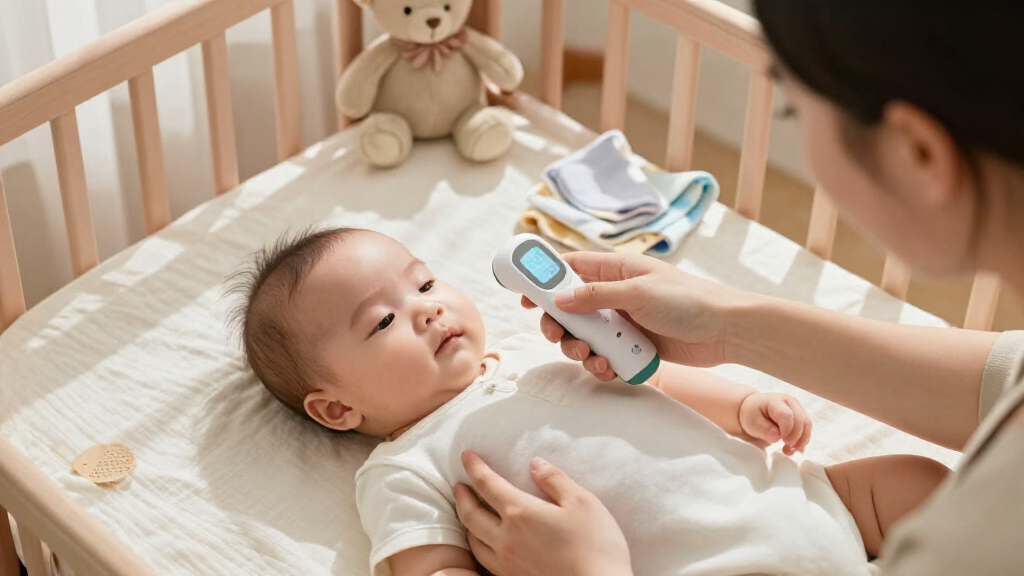
I ranked these options around the needs of caregivers taking a baby’s temperature: clear measurement instructions, practical usability, and useful records. I also weighed the differences between contact readings, ear thermometers, no-touch forehead models, and a wearable device. For connected models, I considered whether app features add a useful record or monitoring option rather than treating connectivity as a measure of medical accuracy. Build and maintenance needs, including any special supplies or handling, also matter for a device used during stressful moments.
The ranking favors clear, repeatable use for routine checks over a long feature list. That puts Kinsa QuickCare first as a versatile connected option, with Braun’s connected ear model close behind for caregivers who favor that measurement site. Specialized choices rank lower for shoppers who do not need continuous monitoring or multiple modes; a feature-rich listing with limited model-specific detail also receives a more cautious position. The Kinsa listing appears twice in the supplied lineup, so it counts as one distinct product rather than a separate alternative.
| smart thermometers for babie | Display |
|---|---|
| Kinsa QuickCare Smart Digital | Large lighted display with fever indication icons |
| Braun ThermoScan 7+ Connect Di | — |
| Braun ThermoScan 5 Digital Ear | — |
| Momcozy Wearable Digital Therm | — |
| Kinsa QuickCare Smart Digital | — |
| Viproud Non-Contact Infrared T | Digital LED |
| Momcozy Digital Forehead and E | LCD screen |
| Forehead Thermometer for Adult | Large backlit LCD |
| Goodbaby No-Touch Forehead The | — |
| Frida 3-in-1 Infrared Thermome | Backlit digital |
Factors to Consider When Choosing Best Smart Thermometers For Babies
Choosing a baby thermometer is less about collecting features and more about finding a method your household can use correctly when a child is unsettled. I would decide on the measurement approach first, then check how the device stores readings, what upkeep it requires, and what guidance the baby’s clinician recommends.
Choose a Measurement Site You Can Use Reliably
Thermometers in this roundup take readings by different routes, including contact, ear, forehead, and wearable methods. A device can be fast yet still produce confusing results if its position or technique is inconsistent. Before buying, check the manufacturer’s age guidance and instructions for the exact measurement site. Do not assume that readings from different sites are interchangeable or that a number from one method can be directly compared with another. If a reading seems unexpected, repeat it according to the device instructions and follow your clinician’s advice about which method to use for your baby.
Decide Whether App Features Will Get Used
Connected tracking can make it easier to record readings over time or share a history with another caregiver. It also adds setup, phone access, and potential account or connectivity steps that may be unhelpful during a late-night check. A basic memory function may be enough if you only need to compare a few recent readings. Before choosing an app-connected model, confirm which functions work without a phone and whether more than one caregiver can access the records. Treat app charts as a recordkeeping aid, not a substitute for clinical advice.
Separate Continuous Monitoring From Spot Checks
A wearable thermometer aims to provide ongoing monitoring, while handheld models are built for checks taken when needed. Continuous updates may appeal when caregivers want to watch a changing temperature without repeatedly waking or handling a child. That convenience comes with a different routine: the wearable must be positioned and maintained as directed, and its readings still need appropriate interpretation. For occasional checks, a wearable may add complexity without solving a frequent problem. Consider how often you expect to monitor before paying extra attention to continuous features.
Check What the Device Needs Between Readings
Small upkeep details can shape whether a thermometer is ready when you need it. Review whether the model calls for probe covers, cleaning steps, charging, batteries, or app setup, and check how those requirements fit your household. Ear models and contact devices may involve different cleaning or disposable-supply routines than no-touch options. A model with several modes can also require more care to select the right setting each time. I would favor a device whose maintenance steps are easy to keep up with over one whose extra modes are likely to be ignored.
Treat Alerts and Color Indicators as Prompts, Not Diagnoses
Fever alarms, color displays, and app notifications can make a reading easier to spot, but they do not tell the whole story of a baby’s health. Alert thresholds and display conventions can differ by model, so read the manual instead of assuming every warning means the same thing. A quiet mode may help avoid waking a child, while a backlit display can be useful during nighttime checks; neither changes how a measurement is taken. Keep the device’s instructions and your clinician’s guidance in view, especially for young infants. When symptoms or age-specific concerns arise, seek medical guidance rather than relying on an alert alone.
Pay for the Feature That Solves Your Actual Problem
A premium connected ear thermometer makes more sense for families who want ear readings plus digital records than for someone seeking a simple spare thermometer. A no-touch model may suit a household that values quick, low-contact checks, but extra modes are useful only if caregivers can follow their instructions. A wearable is most compelling when ongoing updates address a real monitoring need. For a first thermometer, a straightforward interface and readable display may matter more than a long list of functions. Compare the device’s exact model and included accessories before treating similarly named products as equivalent.
Frequently Asked Questions
Should I choose an ear, forehead, or contact thermometer for my baby?
There is no single measurement site that suits every baby and every situation. The models here differ in technique and age guidance, so check the manufacturer’s instructions and ask your child’s clinician which method they recommend. Consistent positioning and following the device directions matter more than switching between methods to chase a preferred number. Readings from different sites may not be directly comparable. If a measurement conflicts with your baby’s symptoms, contact a healthcare professional for guidance.
Is an app-connected thermometer useful if I already write readings down?
An app may help organize timestamps and share a record between caregivers, but it is not necessary for taking a temperature. If your current notes are easy to maintain and share, connected features may add little. Check whether the thermometer works as a standalone device and what phone or account steps are needed for its app functions. Also consider whether every caregiver who might use it can access the same record. Choose connectivity for the recordkeeping problem it solves, not simply because it is available.
Does a wearable thermometer replace a regular thermometer?
A wearable is designed for ongoing monitoring, which differs from taking a spot check with a handheld device. It may be useful when caregivers have a specific reason to follow changes over time, but it adds setup and placement steps. Do not assume a wearable reading is a substitute for a measurement method recommended by your clinician. Check its stated age range, instructions, and what to do if its reading seems inconsistent with your baby’s condition. Some households may prefer keeping a conventional thermometer available as well.
Can I compare a forehead reading with an ear reading?
It is better not to treat measurements from different sites as directly interchangeable. Each method has its own technique and can be affected by how and where the reading is taken. For tracking changes, use the same thermometer and measurement site when possible, following its instructions. If you switch devices or methods, tell your clinician how the reading was obtained. Ask for medical guidance when a result concerns you rather than trying to reconcile numbers from different sites on your own.
What should I check before buying a thermometer for a newborn?
Start with the manufacturer’s age guidance and ask your baby’s clinician which measurement method to use. Confirm that the device’s instructions clearly explain positioning, operation, and how to interpret its alerts. Check whether it needs probe covers, special cleaning, charging, or a phone connection, since those details can affect readiness. A fast result or no-touch design does not by itself establish that a device is suitable for every age. Keep the thermometer’s manual available and follow professional guidance for concerns about a newborn’s temperature.
Conclusion
For most families, I would start with the Kinsa QuickCare as the best overall because it combines a familiar digital thermometer format with app-based records. The best value in this lineup is the Braun ThermoScan 5 for buyers who want an ear thermometer and stability feedback without prioritizing connected tracking; compare current model details before choosing. The best premium pick is the Braun ThermoScan 7+ Connect for caregivers who specifically want connected ear readings. For beginners, I would favor the clearest instructions and simplest interface among the available models, with Kinsa QuickCare as the most balanced starting point. Choose the Momcozy wearable for a specific need for continuous monitoring, or consider a no-touch or multi-mode model when low-contact checks matter more; skip extra modes if you will not use them. The two Kinsa entries in this roundup are duplicates, so they do not represent two separate choices.
Columbus Day / Indigenous Peoples' Day Picks
long weekend sales
As an affiliate, we earn on qualifying purchases.