
TL;DR

Turn the school run and nap time into listening time
- Thousands of audiobooks, podcasts and originals
- Listen on your phone, tablet or Echo — also offline
- Cancel anytime
A home baby scale can help families monitor growth, especially in specific situations. Focus on consistent measurements over time, not daily fluctuations, to interpret progress accurately and reduce stress.
Imagine the gentle beep of a scale, the soft weight of your baby in your hands, and the quiet reassurance it can offer. A baby scale at home isn’t about catching every ounce — it’s about understanding your child’s growth over days and weeks. But with so many scales and so much conflicting advice, it’s easy to feel overwhelmed or obsessed.
In this guide, you’ll learn how to use a baby scale effectively—what to watch for, what to ignore, and how to keep your sanity while tracking your little one’s progress. Because, honestly, growth isn’t a daily sprint. It’s a slow, steady climb, best viewed from a distance, not through a microscope every morning.
Focus on long-term growth trends, not daily weight fluctuations.
Use the same scale, same conditions, and consistent timing for reliable readings.
Weigh weekly or bi-weekly unless your doctor advises otherwise.
Don’t react to small drops or spikes—look for overall progress over weeks.
Trust your pediatrician’s guidance and don’t let the scale cause anxiety.
A Baby Scale at Home: Tracking Weigh-Ins Without Obsessing
A home scale can offer useful reassurance when growth or feeding is being followed. Its real value is not catching every ounce—it is revealing a consistent pattern across days and weeks.
A snapshot, not a diagnosis
A scale measures weight at one moment. Clinicians interpret that number alongside feeding, diaper output, length, head circumference, development, medical history, and the child’s established growth curve.
Follow the curve
A stable lower or higher percentile can be healthy. Percentiles are reference lines, not grades or performance scores.
Expect some noise
A feeding, wet diaper, bowel movement, clothing layer, or different time of day can shift a single reading.
Use the right context
Age, prematurity, illness, genetics, feeding method, and corrected age can all shape the expected pattern.
Know the limit
A consumer scale may be convenient without being medical-grade. Extra decimal places do not guarantee accuracy.
Interpret weighted feeds carefully
A pre-feed and post-feed comparison estimates transfer during one feeding—not total milk supply or a full day’s intake.
Let professionals connect the dots
A meaningful change in the curve deserves clinical interpretation before feeding volumes or supplementation are changed.
Why one reading can mislead
Reliability improves as conditions become more consistent and the observation window becomes longer. These bars illustrate relative interpretive value—not measured clinical percentages.
The longer view usually separates real growth from normal short-term variation more clearly.
Make each weigh-in comparable
Consistency controls avoidable variation. Create one calm routine, record the stabilized reading, and then step away from the scale.
Set the surface
Place the scale on a hard, flat, stable surface.
Zero the scale
Confirm zero and use tare correctly before weighing.
Match conditions
Use the same scale, time, and clothing condition.
Center safely
Keep the baby still with a protective hand close by.
Record and stop
Log the stable number; repeat only if it is implausible.
Choose the least intensive plan that answers the question
Follow the pediatrician’s or lactation professional’s instructions when monitoring is medically necessary. Without a specific plan, healthy infants usually do not need daily home weighing.
| Situation | Useful approach | Avoid | Review point |
|---|---|---|---|
| Healthy, steadily growing baby | Routine care Clinical weigh-ins may be sufficient. |
Daily checks without a clear reason | Regular well-baby visit |
| Growth or feeding is being followed | Follow the plan Use the schedule set by the care team. |
Changing the plan after one reading | Clinician-defined date |
| No specific medical schedule | Weekly or less Use comparable conditions each time. |
Several readings in one session | Set an end date in advance |
| Weighted feeding | Targeted use Answer one defined transfer question. |
Treating one feed as a full-day forecast | Review with a feeding professional |
The anxiety rule
If weighing drives constant feeding changes, repeated checking, loss of sleep, or difficulty bonding, discuss a less-frequent schedule or stopping—unless monitoring remains medically necessary.
Watch the baby, not only the scale
Do not independently change formula concentration, feeding volume, or supplementation after a small dip or spike. Combine the trend with how the baby looks, feeds, behaves, and hydrates.
Contact the care team promptly
- Weight loss exceeds the expected early range or continues.
- The growth curve trends consistently downward over time.
- Feeding is persistently difficult or ineffective.
- Wet diapers become less frequent than usual.
- You are unsure how to interpret a home measurement.
Seek urgent medical guidance
- The baby is unusually weak, floppy, or difficult to wake.
- There are signs of dehydration.
- Vomiting is persistent or breathing is difficult.
- A fever or other acute symptom is concerning.
- Your instincts say the baby is seriously unwell.
What a baby scale really tells you (and what it doesn’t)
Using a baby scale at home offers a snapshot, but not the full story. The scale measures weight, yes, but it can’t tell you about your baby’s overall health. For example, a small fluctuation—say, half an ounce—may just be a diaper change or a different time of day.
Understanding this helps prevent unnecessary worry. For instance, if your baby’s weight drops slightly one day, it might be due to a full diaper or a change in weighing conditions rather than a health concern. Recognizing that these small fluctuations are normal allows you to interpret the data more effectively. Over time, consistent trends matter more than isolated numbers, which can be influenced by numerous external factors.
Most infants lose about 5-10% of their birth weight in the first few days. If your baby gains steadily after that, it’s a good sign. But don’t fixate on individual numbers; focus on the trend—are they gaining weight over weeks? This perspective helps you differentiate between normal variability and genuine concerns that warrant medical attention.
Keep in mind, weight is just one piece of the puzzle. Length, head circumference, feeding efficiency, diaper output, and your baby’s activity level matter just as much. A baby who is growing in length and developing normally might have a lower weight percentile but still be perfectly healthy. Recognizing these tradeoffs and the holistic nature of growth ensures you don’t overemphasize weight alone, which can lead to unnecessary stress or interventions.
As an affiliate, we earn on qualifying purchases.
How to get more accurate, consistent weight readings
Consistency is king. To make the most of your baby scale, follow these steps:
- Place the scale on a hard, flat surface—think kitchen counter or a sturdy table. Avoid soft surfaces like carpet. This ensures the scale’s readings are stable and reliable, reducing measurement errors caused by uneven surfaces.
- Always zero the scale before weighing. If it has a tare function, use it. This step removes any residual weight from previous measurements or packaging, so you’re only measuring your baby’s weight.
- Weigh your baby naked or in a dry, clean diaper. Clothes add extra weight and skew results. This standardization reduces variability caused by different clothing or diaper thickness, making trend analysis more accurate.
- Choose a regular time, ideally before feeding, when your baby is calm and not overly hungry or full. Weighing at a consistent time helps control for natural fluctuations related to feeding and activity levels that can influence weight.
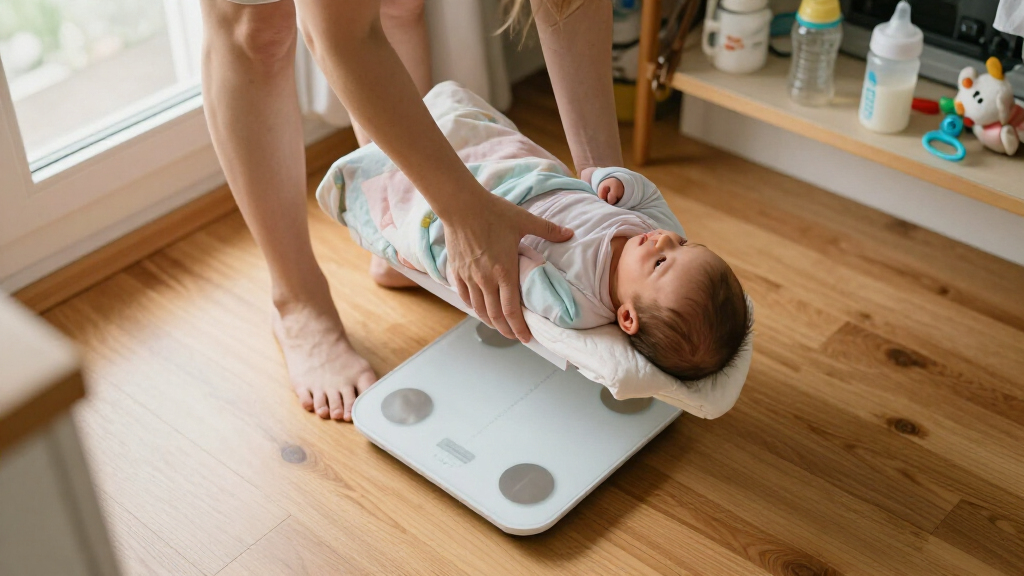
- Hold your baby still in the center of the scale, supporting gently but not squeezing. Keep the baby still until the reading stabilizes. Excess movement can cause inaccurate readings, so patience here is key.
- Record the number after it stops moving. Repeat if unsure. Multiple measurements can confirm accuracy, especially if the initial reading was shaky.
- Use the same scale for every measurement to avoid discrepancies caused by different devices’ calibration differences. Consistent equipment use helps you trust the trend rather than questioning each reading’s accuracy.
For example, if you weigh your baby at 8 am every Wednesday in the same spot, you’ll start noticing patterns and spotting real changes versus random noise. This consistency allows you to interpret growth more meaningfully and reduces the risk of overreacting to minor fluctuations.
baby weight scale with tare function
As an affiliate, we earn on qualifying purchases.
As an affiliate, we earn on qualifying purchases.
How often should you weigh your baby without losing your mind?
Many parents worry about missing something or obsessing over every tiny change. The truth? Most healthy babies don’t need daily weighing. Weekly or bi-weekly checks usually give a clearer picture of growth trends.
If your pediatrician doesn’t specify, consider weighing your baby once a week, always under similar conditions. Multiple weigh-ins in one day can be misleading—your baby’s weight can vary by ounces due to feeding, stool, or even how they’re dressed.
Resist the urge to weigh every single day. Instead, set a schedule, record each measurement, and trust the trend—upward is good, steady is better, and occasional dips aren’t alarming. This approach reduces the risk of overreacting to normal daily fluctuations, which are often caused by factors outside your control.
And if weighing causes anxiety or leads to constant feeding adjustments, take a break. After all, your baby’s health isn’t just about the numbers. Prioritizing your mental health and your baby’s overall well-being is essential for a balanced approach to monitoring growth.
As an affiliate, we earn on qualifying purchases.
Deciphering the numbers: What’s a healthy trend?
It’s tempting to react to every fluctuation, but in reality, small ups and downs are normal. Focus on the overall trajectory. Is your baby gaining weight weekly? Are they staying within a healthy growth percentile? Recognizing these patterns helps you avoid unnecessary worry and provides a more accurate picture of your baby’s health.
Use growth charts from the World Health Organization or your pediatrician’s guidance. These charts help you see whether your baby’s growth aligns with typical development patterns, which vary among infants. Remember, a baby on a stable growth curve—whether in a lower or higher percentile—is usually fine. What matters most is consistency, not perfection.
For example, if your baby was at the 50th percentile at two months and stays there at four months, it’s a good sign. If they drop from the 50th to the 10th percentile over a few months, that warrants a chat with your doctor. But don’t overreact to short-term dips; focus on the long-term trend.
Don’t obsess over single readings. Look for patterns over weeks, not days. Understanding these patterns allows you to make informed decisions without undue stress or panic.
baby scale with consistent readings
As an affiliate, we earn on qualifying purchases.
As an affiliate, we earn on qualifying purchases.
When to ring the doctor (and when not to panic)
Not every weight dip signals disaster. But certain signs should prompt immediate contact:
- Your baby seems unusually weak, floppy, or difficult to wake—these are signs of potential serious issues requiring prompt medical attention.
- Fewer wet diapers than usual, signs of dehydration, which can be dangerous if not addressed.
- Persistent vomiting, trouble breathing, or a high fever—these symptoms can indicate infections or other health emergencies.
- Weight loss beyond expected early loss—more than 10% of birth weight—especially if it persists or worsens, indicating potential feeding or health problems.
- Consistent downward trend in growth percentiles over multiple check-ins—this could suggest underlying issues affecting growth and warrants professional evaluation.
If your baby appears normal, feeding well, and is active, a small fluctuation is often no cause for alarm. Trust your instincts and consult your pediatrician if in doubt. Remember, a good weight isn’t just the number—your baby’s overall well-being, activity level, and feeding are equally important indicators of health.
The latest in baby scales: tech that can help or hinder
New tech makes tracking easier, but it’s not magic. Bluetooth-enabled scales can automatically log weights and generate graphs, offering a visual trend. Some apps sync with your phone, making it simple to see progress over time.
However, these tools can also tempt parents into obsessing over every tiny change. Remember: the goal is to see patterns, not obsess over each decimal point. Also, connectivity and fancy features don’t make a scale more accurate—consistent technique and proper placement matter more.
Privacy is another concern. Check how your data is stored and shared before linking your baby’s health info to apps or cloud services. Being aware of data security helps you make informed choices about technology use.
Ultimately, technology can be helpful if used wisely. It’s a supplement, not a substitute for good judgment and regular pediatric checkups. Emphasize that technology should enhance, not replace, attentive and consistent measurement practices.
Frequently Asked Questions
Do I really need a baby scale at home?
Not for most healthy babies. Routine pediatric visits provide all the monitoring most families need. A home scale is helpful if your doctor recommends it for specific concerns, like slow weight gain or prematurity.
How often should I weigh my baby?
Typically, once a week or every two weeks is enough to spot meaningful trends. Daily weighing can lead to confusion and anxiety, especially since weight naturally fluctuates due to feeding, diapers, and time of day.
Can I trust a home baby scale’s accuracy?
Accuracy varies by model and setup. The key is consistency—measure under the same conditions, with the same scale, and interpret trends over time. Small inaccuracies are less important than reliable patterns.
What should I do if I see a weight loss?
Check your technique first—make sure the scale is on a flat surface and that you’re weighing correctly. If your baby is feeding well, active, and has normal diaper output, a small weight dip isn’t usually a concern. Contact your pediatrician if you’re worried or if other symptoms appear.
How can I avoid obsessing over the numbers?
Set a clear schedule, record each measurement, and focus on the overall trend—not daily spikes. If weighing causes stress, take a break. Remember, growth is a process, not a daily snapshot.
Conclusion
A baby scale at home can be a helpful tool, but it’s just that—one tool in a bigger picture. Keep your focus on steady growth and overall health, not every ounce or decimal point. When used thoughtfully, it can bring reassurance without fueling anxiety.
Remember, your baby’s well-being is a mosaic—growth, activity, feeding, and happiness all matter. A scale is only one piece of that puzzle, so don’t let it overshadow your instincts and your baby’s natural rhythm.
Cold & flu season Picks
humidifiers
As an affiliate, we earn on qualifying purchases.