
TL;DR

Turn the school run and nap time into listening time
- Thousands of audiobooks, podcasts and originals
- Listen on your phone, tablet or Echo — also offline
- Cancel anytime
A twin nursery works best when you duplicate what both babies need at the same time, especially their sleep spaces, and share bulky furniture where it makes care easier. Measure the room, keep routes clear, organize each baby’s belongings, and adjust the setup as your routines emerge. Follow current local safe-sleep guidance, check product instructions, and look up recalls before using child products.
At 3 a.m., a nursery’s most important feature is not whether both cribs line up perfectly. It is whether you can reach a clean diaper, turn on a soft light, and get to each baby without bumping into a chair. A twin nursery layout is a working space for tired caregivers as much as a room for two babies.
You can set up two of everything, organize the room into shared zones, or combine the two. Most families need a blend: each baby gets a separate safe sleep surface and identifiable belongings, while a dresser, hamper, and changing area may serve both. The right balance depends on your room, daily routine, and each baby’s needs.
This guide will help you plan around safe sleep, clear paths, and real tasks rather than symmetry or shopping lists. You’ll see what to duplicate, what to share, and how to leave space for the routines you haven’t discovered yet. Before using any child product, check its instructions, age and size suitability, and current CPSC recall information.
Plan for a separate approved sleep surface for each baby and follow current local safe-sleep guidance.
Measure cribs, doorways, and walking routes before arranging furniture; symmetry is optional.
One well-stocked changing area may serve both babies; add another only when it solves a real access problem.
Use labels or separate bins to identify each baby’s clothes while sharing bulky furniture and common supplies.
Check product instructions, age and size suitability, and CPSC recalls before using child products.
Twin Nursery Layout: Two of Everything or Shared Zones
Build a room around safe sleep, clear paths, and the care tasks you repeat every day. Most families find a useful middle ground: two separate sleep spaces, with shared furniture and supplies wherever sharing makes care easier.
Duplicate what happens at once. Share what serves both.
Two babies need individual safe sleep spaces and belongings you can tell apart. Bulky furniture, common supplies, and a changing area can often be shared when both caregivers can reach what they need.
Sleep spaces
Provide one approved sleep surface for each baby. Follow current local safe-sleep guidance and every product’s instructions.
Care zones
A well-stocked changing area, dresser, hamper, and common supplies may serve both babies without crowding the room.
Future routines
Feeding schedules, sleep patterns, and individual needs can differ. Start simply, then adjust as your routines emerge.
Two of everything vs. shared zones
A matching setup can make individual belongings obvious, but uses more floor space. Shared zones can make a small room easier to move through, provided supplies stay organized and reachable.
| Nursery need | Usually duplicate? | Practical decision |
|---|---|---|
| Sleep spaces | Yes | Plan for one separate approved sleep surface per baby. |
| Changing station | Not always | Try one accessible, well-stocked station. Add another only if it solves a real bottleneck. |
| Feeding setup | It depends | Match the setup to how your babies are fed and how caregivers work together. |
| Dresser and hamper | Usually no | Share bulky furniture; label drawers or use separate bins for each baby’s clothes. |
| Night supplies | Share the stock | Keep diapers, wipes, spare clothes, burp cloths, and a dim light close to the care area. |
Plan around real tasks, not symmetry.
Measure the room, cribs, doorways, and walking routes before arranging furniture. A staggered layout can work better than a mirrored one if it keeps doors accessible and makes both babies easy to reach.
Measure first
Sketch cribs, door swings, windows, and the routes you will walk while carrying a baby.
Place sleep spaces
Give each baby a separate approved surface with a firm, flat mattress and fitted sheet.
Build care zones
Keep changing supplies, feeding items, and a soft light together where they are easy to reach.
Walk the route
Check clearances at night. Keep paths free of baskets, cords, heaters, and other obstacles.
Separate surfaces. Simple sleep spaces.
Room-sharing means babies sleep in the caregivers’ room; it does not mean putting both babies on one sleep surface. Use current guidance from your local health authority, since recommendations and product standards can vary by country.
For each baby, use an approved sleep surface with a firm, flat surface and a fitted sheet. Keep loose bedding, pillows, and toys out of the sleep space. If a baby’s health needs call for specific advice, ask your pediatric care team.
A quick room and product check
Small checks can make daily care smoother and help you use child products as intended.
- Check each product’s instructions and age and size suitability.
- Look up current CPSC recall information before using child products.
- Anchor furniture according to the manufacturer’s instructions.
- Keep cords, heaters, and window coverings away from sleep spaces.
- Confirm doors open fully and caregivers can reach both babies easily.
- Label drawers or bins if each baby’s clothes or sizes differ.
Start with two separate sleep spaces
A twin nursery needs a separate approved sleep surface for each baby, such as an individual crib or approved bassinet. Each space should have a firm, flat surface and a fitted sheet, with no loose bedding, pillows, or toys. This is the first decision to make because sleep spaces shape where the rest of the furniture can go.
It is easy to hear “room-sharing” and imagine the twins sharing a crib. The phrase refers to babies sleeping in the caregivers’ room; it does not mean putting both babies on one sleep surface. Follow current safe-sleep guidance from your local health authority and the instructions for each product. If you have questions about what is appropriate for your babies, ask your pediatric care team.
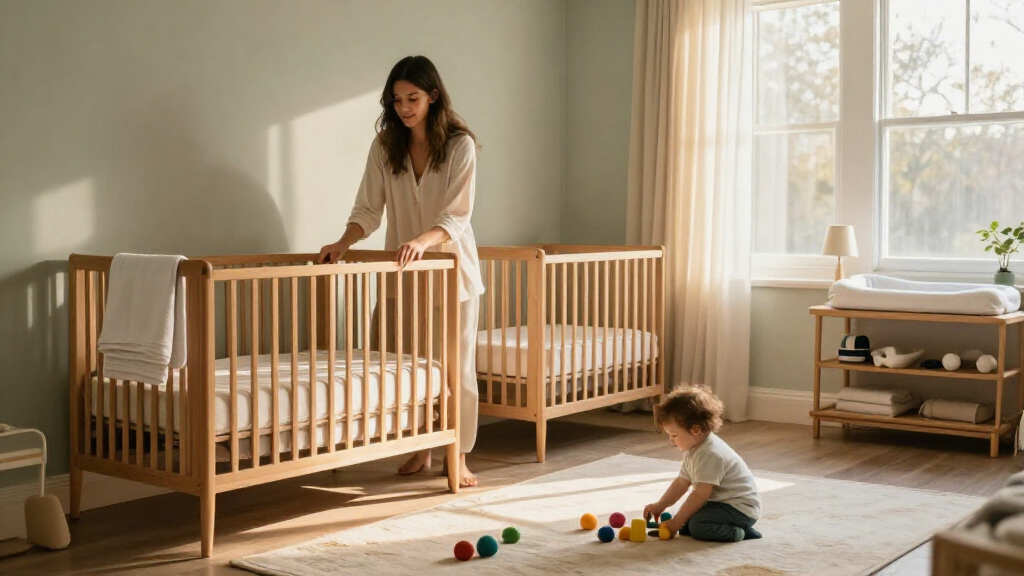
For example, if two cribs fit on opposite walls, that can be more useful than forcing them side by side and blocking the closet. Each caregiver should be able to reach their assigned baby without stepping over a basket or moving a glider. Imagine the quiet shuffle of a night feed: clear floor space and a reachable light matter more than a perfectly mirrored room.
Give each baby a separate safe sleep space, then arrange the room so caregivers can reach both. Ask your pediatric care team for guidance if a baby’s individual health needs call for specific advice.
When choosing a crib, bassinet, or other child product, check that it is suitable for the baby’s age and size, follow the manufacturer’s instructions, and check the CPSC recall database before use. Standards and recommendations can vary by country, so use current local guidance. A twin-specific label alone does not tell you whether a product suits your intended use.
Popular right now

LG 85-Inch QNED84B Mini LED 4K Smart TV (2026)

LG 85-Inch QNED73B Mini LED 4K Smart TV (2026)

Samsung 75-Inch M80H Series Mini LED 4K Smart TV (2026)
As an affiliate, we earn on qualifying purchases.
Choose a layout that fits the room, not a matching set
A useful twin nursery layout is one that keeps sleep spaces safe, doors and windows accessible, and a clear path to each baby. You do not need to arrange furniture in a mirror image. Start by measuring the room, the cribs, and the doorways, then sketch a few arrangements before carrying furniture inside.
Think of the floor plan like a small kitchen: the work triangle matters more than whether every cabinet matches. You need to move between sleep spaces, changing supplies, and the door while carrying a baby. For instance, a dresser with a changing surface can sit near a wall and leave the center of the room open, while the glider goes where you can reach it without crossing a crib’s access path.
Test the sketch with practical questions. Can a door open fully? Can you reach both babies easily? Is a window covering, heater, or cord near a sleep space? Can you walk through the room at night without sidestepping a hamper? Furniture that could tip should be anchored according to its manufacturer’s instructions, and cords, heaters, and window coverings should stay away from sleep spaces.
Suppose one side of the room has a radiator or a narrow closet door. A symmetrical layout may put a crib somewhere awkward; a staggered arrangement may give you better access. Leave enough room to maneuver while holding a baby, and recheck clearances when furniture is in place. Measure first, then arrange for safe access and the tasks you will do every day.
Use this table to decide what to duplicate
In a twin nursery, duplicate items babies need at the same time and share larger furniture when sharing still makes care easy. Two separate sleep spaces are essential; two changing stations are usually a space and routine decision. This simple comparison can help you spend on what solves a real daily need.
| Nursery need | Usually duplicate? | Practical way to decide |
|---|---|---|
| Sleep spaces | Yes | Plan for one separate approved surface per baby. |
| Changing station | Not always | Try one well-stocked station; add another only if access becomes a real bottleneck and the room allows it. |
| Feeding setup | It depends | Match the setup to how your babies are fed and how caregivers work together. |
| Dresser and hamper | Usually no | Share furniture, and use labeled drawers or bins if belongings need separating. |
| Night supplies | Share the stock | Keep diapers, wipes, burp cloths, and spare clothes reachable from the care area. |
For example, one broad dresser can hold each baby’s clothes in separate drawers and still provide a changing surface, if the product and setup are suitable for that use. A shared diaper pail and hamper may save valuable floor space. By contrast, if two caregivers regularly change babies at once and a second station fits without crowding safe routes, duplication could solve a genuine pinch point.
Think of buying furniture as adding tools to a busy workbench. Another tool helps only if you reach for it when the first one is occupied. Start with essential separate sleep spaces and the supplies you actually use; let your routine show whether another station is worth its footprint.
Set up shared zones that make 3 a.m. care easier
Shared zones group supplies by task, such as one changing area, common diaper storage, and a feeding corner. This arrangement often uses space more efficiently than placing a duplicate of every item beside each crib. It works best when you can find essentials quickly and return them to the same place.
Put the changing supplies together: diapers, wipes, a change of clothes, and a safe, dim light within reach of the caregiver. Keep extra stock in a nearby drawer or bin rather than scattering half-open packages around the room. When a baby wakes and the room is quiet except for a soft rustle, that familiar setup can make the next few minutes feel less like a scavenger hunt.
Consider a realistic night. One baby needs a diaper change while the other sleeps; you take the baby to the changing area, use the supplies, and return them to their marked spots. A shared space has saved floor area, but only if you do not have to search three drawers for the right size. A labeled basket or drawer can distinguish each baby’s clothes if they have different sizes or needs, while common items stay in one easy-to-reach place.
Feeding needs vary. Some families may want a chair and supplies in a dedicated corner; others may feed in a different room or need a setup that changes with their feeding routine. Choose for the way your family actually feeds, and seek pediatric guidance for infant feeding questions. A small, consistent care station can do more for nighttime ease than a second set of furniture you rarely use.
Separate each baby’s belongings without doubling the furniture
You can make belongings easy to tell apart without giving each baby a complete matching side of the room. Identifiable personal storage can be as simple as labeled drawers, two baskets, or color-coded tags. Shared furniture still works when every item has a predictable home.
For example, one dresser might hold Baby A’s sleepers in the top-left drawer and Baby B’s in the top-right. A pair of small baskets on a shelf could separate spare clothes by size, while wipes and burp cloths stay in the shared center drawer. If both babies wear the same size, a clear label can still prevent the midnight question of where a clean outfit went.
Matching furniture can make a room feel calm, but matching is a style choice, not a care requirement. A second dresser may fill the only path between a crib and the door. In a smaller room, two labeled bins can provide the useful distinction without adding another bulky object. You can also keep a small note of what belongs where while you learn your routine, then simplify once it becomes automatic.
Be willing to update the system. Twins may change sizes at different times or need different supplies. Store clothing separately if that helps, and keep shared stock—like diapers and wipes—in a common location. Think of the labels as street signs in a small town: they help you get where you need to go quickly, but you do not need a separate road for every resident.
Leave room for routines and needs to change
A twin nursery should be easy to adjust because feeding schedules, sleep patterns, and medical needs can differ between babies. A layout that feels simple before the birth may need a different balance once you see how your days and nights actually unfold. Keep movable storage and open floor space so you can change the arrangement without starting from scratch.
Imagine one baby settles quickly while the other needs a longer feed. You might find that a shared feeding corner works well, or that a second chair in another safe location helps the caregiver who is on duty. The point is not to predict every challenge now; it is to avoid filling every corner with furniture before you know what would help.
A small, consistent night setup can also adapt. Begin with one reachable changing area and keep the most-used supplies together. If two caregivers repeatedly need access at once and the room has the space, consider whether a second location solves that specific problem. If the bottleneck never appears, you have kept the room calmer and left more room to move.
Check product instructions as babies grow, and follow current guidance from your local health authority. Ask your pediatric care team about questions tied to an individual baby’s health, sleep, or feeding. Let the routine lead the next change: a nursery is a working room, and its most useful arrangement may evolve after your family starts using it.
Use this short checklist before you buy
A practical nursery plan starts with the room and the daily tasks, then adds furniture where it earns its space. Before ordering duplicate items, walk through the following steps. They can help you spot a blocked route or missing essential while the room is still just a sketch.
- Measure the room and doorways. Write down the footprint of each sleep space and check that large furniture can get through the entrance.
- Place two separate approved sleep spaces. Check each product’s instructions and follow current local safe-sleep guidance.
- Trace caregiver routes. Make sure doors open, both babies are reachable, and you can move through the room while carrying a baby.
- Choose one changing and feeding arrangement. Start with a shared setup that suits your routine, then identify whether a real access problem calls for a second station.
- Assign storage. Give each baby a clear place for clothes and keep common supplies together near the care zone.
- Check hazards and product history. Anchor furniture as directed, keep cords, heaters, and window coverings away from sleep spaces, and check CPSC recalls for child products.
For instance, a sketch might reveal that two changing tables leave only a narrow strip of floor between a crib and the door. Swapping them for one changing area and a shared dresser could open the route without taking away anything you use every night. That is a useful upgrade even if the new layout is less symmetrical.
Do one final walk-through after setup. Open doors and drawers, reach each crib, and check that the light is soft enough for nighttime care. Buy for a demonstrated need, not because a matching catalog photo suggests that twins require matching furniture.
Frequently Asked Questions
Do twins need separate cribs?
Each baby needs a separate, approved sleep surface. Do not assume that sharing a crib or bassinet is safe. Follow current local safe-sleep guidance and each product’s instructions, and ask your pediatric care team about questions specific to your babies.
Can twin babies sleep in the same room?
Yes, if the room and sleep spaces are set up safely. Room-sharing does not mean sharing one sleep surface; plan a separate approved surface for each baby and follow current local guidance.
Do I need two changing tables?
Usually, one accessible, well-stocked changing area can serve both babies, especially in a smaller room. Consider a second one only if caregivers regularly need the station at the same time and there is safe space for it.
Should everything in a twin nursery match?
No. Matching furniture is a style choice. Separate labels, drawers, or baskets can make belongings easy to tell apart while a shared dresser and other bulky furniture save floor space.
How can I organize clothes and supplies for twins?
Use labeled drawers or bins for each baby’s clothes, especially if their sizes or needs differ. Keep shared supplies like diapers and wipes in one common, reachable place so a nighttime change does not turn into a search.
How much space does a twin nursery need?
There is no single room size that fits every family and layout. Measure the sleep spaces and doorways, then check for clear routes and easy access to both babies, the door, and the supplies you use every day.
What if the twins have different sleep or feeding routines?
Leave room to adjust the setup as you learn what each baby needs. A shared room can still support separate routines through flexible storage, reachable care supplies, and a layout you can change. Ask your pediatric care team for guidance about individual sleep or feeding questions.
What should I buy first for a twin nursery?
Start with two separate approved sleep spaces and the supplies needed for changing, feeding, and storage. Add duplicate equipment when your daily routine shows that sharing creates a real bottleneck. Check product instructions, age and size suitability, and CPSC recalls before use.
Conclusion
Build the room around the things you will do every day: reach two separate safe sleep spaces, change and feed each baby, and move through the room without squeezing past furniture. Share a dresser, hamper, or care zone where it works, and give each baby clearly identified belongings. Duplicate for simultaneous needs; share what stays easy to find.
Before the first sleepy walk across the nursery, check current local safe-sleep guidance, product instructions, and CPSC recalls. Then leave a little open floor. At 3 a.m., that quiet strip of space can feel like the most useful piece of furniture in the room.