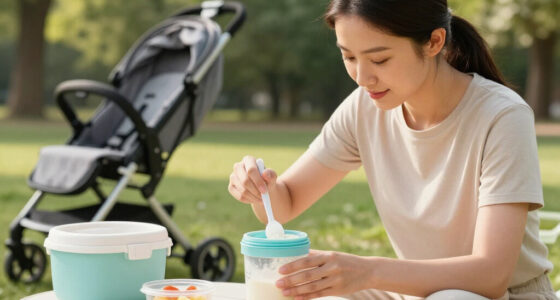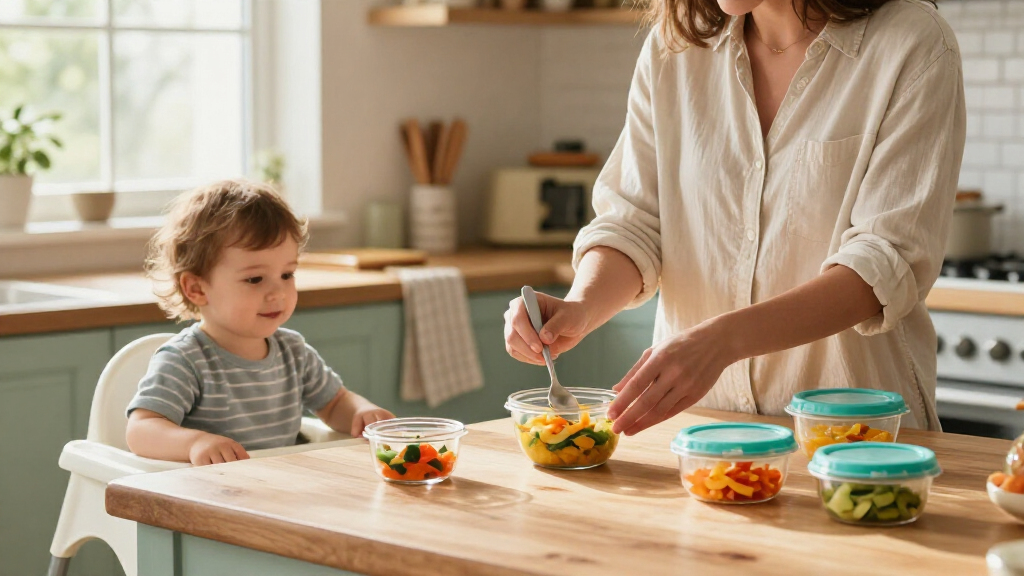

Glass and silicone containers solve different problems for parents storing homemade baby food. Glass gives you a firm container with a smooth surface that is generally easy to clean and does not absorb food odors; silicone cuts weight and tolerates bumps better because it will not shatter. The tradeoff shows up in everyday handling: glass is reassuring for the fridge and home meals but can be cumbersome in a diaper bag, while silicone travels more easily but may be harder to keep feeling fresh after repeated use with strongly colored or scented foods. Choose glass if cleanability and a rigid serving vessel matter most. Choose silicone if low weight, flexibility, and resistance to breakage matter more. Specific temperature limits, lids, and suitability for freezing or reheating vary by product, so the manufacturer’s instructions matter as much as the material.

Turn the school run and nap time into listening time
- Thousands of audiobooks, podcasts and originals
- Listen on your phone, tablet or Echo — also offline
- Cancel anytime

DRKIO Baby Food Storage Containers, 4 oz Glass Jars with Lids, Set of 6
- ✔ Quantity: 6 jars
- ✔ Capacity: 4 oz each
- ✔ Jar material: Food-grade glass

KeaBabies 12-Pack 4 oz Glass Baby Food Containers with Lids
- ✔ Quantity: 12 jars
- ✔ Capacity: 4 oz per jar
- ✔ Material: Glass

Dehov 6-Piece Glass Baby Food Containers with Lids, 4 oz Freezer Safe Storage Jars
- ✔ Quantity: 6 pieces
- ✔ Capacity: 4 oz (120 ml) each
- ✔ Materials: Food-grade glass, BPA-free plastic, and silicone
At a Glance
| Criteria | Glass baby food storage containers | Silicone baby food storage containers | Winner |
|---|---|---|---|
| Cleaning and odor retention | Smooth, rigid surfaces are usually straightforward to wash; glass is generally less prone to retaining food smells. | Flexible surfaces and corners can take more effort to clean; silicone may hold odors or discolor over time. | A |
| Weight and portability | Heavier and less convenient to carry in quantity. | Lightweight and easy to pack. | B |
| Breakage and durability | Can chip or shatter if dropped or struck. | Does not shatter, though it can tear, deform, or become damaged depending on construction and use. | B |
| Freezer and temperature use | Often suitable for freezing and reheating, subject to the product’s instructions and temperature limits. | Many products tolerate cold and heat, but temperature limits and safe uses differ by model. | Depends |
| Serving and portioning | Stays firm on a tray and is easy to scoop from. | Flexible walls can make scooping or holding a full container less stable. | A |
| Lids and leak resistance | Depends on the lid design; a tight lid does not make every container leakproof. | Depends on the lid and seal; flexible material alone does not prevent leaks. | Depends |
| Long-term value | Can last for years with careful handling, though breakage may require replacement. | Resists breakage, but replacement may be needed if the material degrades or retains odors. | Depends |
DRKIO Baby Food Storage Containers, 4 oz Glass Jars with Lids, Set of 6
DRKIO earns our best overall spot by pairing a manageable six-jar set with the most specific portioning detail in this group: markings in 2-ounce increments. For parents dividing a batch of puree into smaller servings, those marks offer a quick visual reference without needing a separate measuring cup. Writable areas on the lids also make it easier to distinguish foods or label prepared portions, and the lids are designed to stack for tidier storage.Compared with KeaBabies, DRKIO gives us half as many jars, but its stated marking increments make the portioning feature clearer. That smaller quantity may suit a compact routine better than accumulating a dozen jars. Dehov also comes as a six-piece set and includes a silicone sealing ring, but the supplied details do not call out measurement marks or a reusable writing area. DRKIO is therefore the more documented fit when labeling and portion control matter.The jars are freezer-safe, microwave-safe, and dishwasher-safe, while the silicone seals are intended to help keep food fresh and reduce spills. The limitation is the same one we need to account for with the other glass picks: 4 ounces is a small serving size, and the plastic lids must come off before microwaving. Families who want fewer containers to wash may prefer larger-capacity jars; anyone who wants a large meal-prep rotation may find KeaBabies’ 12-count set more practical.
Pros:
- 2-ounce measurement markings support portioning.
- Writable lid areas help identify stored food.
- Silicone seals and stackable lids support organized storage.
- Jars are listed as freezer-, microwave-, and dishwasher-safe.
Cons:
- Each jar holds only 4 ounces.
- Plastic lids need to be removed before microwave use.
- A six-jar set provides less batch-prep capacity than KeaBabies.
Best for: Parents who prepare modest batches and want clear 2-ounce portion markings plus writable, stackable lids.
Not ideal for: Families who need more than six jars in rotation or routinely store portions larger than 4 ounces.
Bottom line: We recommend DRKIO for a balanced small set that makes portions and labels easy to manage.
“We recommend DRKIO for a balanced small set that makes portions and labels easy to manage.”
KeaBabies 12-Pack 4 oz Glass Baby Food Containers with Lids
When the goal is to portion a larger batch in one go, KeaBabies gives us twice the jar count of either six-piece alternative. Twelve 4-ounce containers can support a broader rotation of purees, fruit, snacks, or liquids, so we can label several foods and still have portions ready for later. The writable lids and stacking design are useful in that context: they help keep a bigger collection identifiable and orderly.Its feature mix is close to DRKIO’s, including measurement markings, silicone sealing, and writable lids. DRKIO is more precise about the markings, specifying 2-ounce increments, while KeaBabies’ strongest distinction is sheer quantity. Compared with Dehov, KeaBabies provides more explicit labeling and portioning features in the supplied details, as well as twice the number of jars. For households that value a compact six-jar rotation over volume, that extra count may feel like more pieces to wash and store than necessary.The removable silicone O-ring is intended to create an airtight seal and help limit spills, and the jars are described as freezer-, microwave-, and dishwasher-safe. The maker’s top-rack dishwasher recommendation adds a care step to remember. As with the other glass sets, drops can mean breakage, and 4-ounce jars remain limiting for bigger portions. We would choose this set for variety and prep volume, not because each container holds more food.
Pros:
- Twelve jars provide the largest batch-prep capacity in this comparison.
- Writable lids and measurement markings aid identification and portioning.
- Removable silicone O-rings are designed to support an airtight seal.
- Stacking design and broad appliance compatibility support organized storage.
Cons:
- The 4-ounce capacity still requires multiple jars for larger servings.
- Glass may break if dropped.
- Top-rack dishwasher placement is recommended to reduce heat and water pressure.
Best for: Caregivers who prepare multiple small portions or several foods ahead and want a larger labeled jar rotation.
Not ideal for: Those with limited cabinet space, a small washing routine, or a preference for fewer individual containers.
Bottom line: KeaBabies is the strongest fit when we want a dozen small portions ready in rotation.
“KeaBabies is the strongest fit when we want a dozen small portions ready in rotation.”
Dehov 6-Piece Glass Baby Food Containers with Lids, 4 oz Freezer Safe Storage Jars
Dehov is the straightforward six-jar option for shoppers drawn to a colorful set with a precision-fit silicone sealing ring. Its stated focus is keeping homemade baby food, purees, and snacks stored in individual portions, and the silicone ring is intended to create an airtight, leak-resistant closure. If a secure seal is the feature we want to prioritize, Dehov makes that detail prominent.Against DRKIO, Dehov has the same six-container count and 4-ounce size, but DRKIO supplies more detail about measurement increments and reusable lid writing. KeaBabies is the better match for larger prep sessions because it doubles the number of jars and also describes writable lids and measurement markings. Dehov’s role is narrower: it gives us a colorful six-piece alternative with an emphasized sealing ring, rather than the most fully documented labeling setup or the most jars.The glass containers are listed as freezer-safe, microwave-safe, and dishwasher-safe. That combination covers common storage and reheating routines, though we should remove the plastic lids before heating and avoid treating glass as drop-proof. Its 4-ounce capacity can also become restrictive as portions grow. Choose Dehov if six jars and the colorful presentation fit the kitchen; skip it if portion markings, lid labeling, or a larger prep supply would make daily organization easier.
Pros:
- Six 4-ounce glass containers suit small servings and snacks.
- Precision-fit silicone rings are designed to reduce leaks and preserve freshness.
- Listed as freezer-, microwave-, and dishwasher-safe.
- Colorful appearance distinguishes it from the other described sets.
Cons:
- The small capacity may require frequent refilling for larger portions.
- Glass can break if dropped.
- The supplied details do not specify measurement markings or writable lid areas.
Best for: Parents who want a colorful six-piece glass set with a clearly specified silicone sealing ring.
Not ideal for: Buyers who prioritize documented measurement increments, writable labels, or a dozen jars for meal prep.
Bottom line: Dehov makes sense when a colorful six-jar set and sealing ring matter more than labeling features or larger quantity.
“Dehov makes sense when a colorful six-jar set and sealing ring matter more than labeling features or larger quantity.”
As an Amazon Associate we earn from qualifying purchases.
Key Differences
The most meaningful difference is how each material behaves in the hand. Glass stays rigid, which helps when filling, stacking, scooping, and feeding a baby from the container. Its smooth surface is typically simple to wash, and it is less likely than silicone to hold onto the smell of foods such as garlic, fish, or strongly seasoned purées. That makes glass a strong choice for a home storage routine where containers go from fridge to table and cleaning matters more than carrying weight.
Silicone is much lighter and will not break into shards if it falls, which makes it more forgiving in a packed bag or around an active toddler. Its flexibility can also help with releasing frozen portions, depending on the shape and product. The compromise is that flexible sides are less stable when full, and residue or odors can be more stubborn. Neither material automatically guarantees leakproof storage, safe reheating, or a useful portion size: check the lid, capacity, and care instructions on the specific product.
Detailed Comparison
Cleaning and odor retention (Glass baby food storage containers wins — moderate)
Glass wins by a moderate margin for keeping containers easy to wash and fresh-smelling. Its nonporous, rigid surface usually releases purée more readily than a flexible surface with seams or corners. Silicone remains washable, but oils, colors, and odors can linger, particularly after frequent use with strong foods. In practice, glass is easier if containers are used for a wide variety of meals and stored for several days. The details still depend on lid construction and whether the product is dishwasher safe.
Weight and portability (Silicone baby food storage containers wins — major)
Silicone wins by a major margin for carrying food away from home. A few lightweight containers add less weight to a diaper bag than glass, and the material is less likely to break if the bag is dropped. Glass can still work for occasional outings when packed carefully, but it is a less convenient choice for daily travel or several portions at once. If most storage stays in the kitchen, this advantage matters less.
Breakage and durability (Silicone baby food storage containers wins — major)
Silicone wins for impact resistance: it will not shatter when dropped, which makes it more forgiving around children and in transit. Glass offers a firm surface that can remain in good condition for years, but a fall may chip or break it and create sharp fragments. The difference is major for households where containers are often carried or handled by older children. Silicone can still tear or deform, so check for damage and follow care guidance.
Freezer and temperature use (moderate difference)
This criterion depends on the specific product, so neither material wins across the board. Both glass and silicone containers may be designed for freezer use, while reheating limits vary by construction, lid, and manufacturer. Glass can be vulnerable to sudden temperature changes, and a frozen container should not be moved directly into high heat unless its instructions explicitly allow that use. Silicone’s heat tolerance also has limits. Check the temperature range and whether the lid must be removed before freezing or reheating.
Serving and portioning (Glass baby food storage containers wins — moderate)
Glass wins by a moderate margin for feeding directly from the container. A rigid body is easier to hold steady while scooping and can sit more securely on a high-chair tray. Silicone flexes under pressure, which can be useful for releasing food but may make the container wobble or collapse slightly during feeding. For storage that transfers to a bowl before serving, the difference is minor; for meals served straight from the container, glass is generally easier to manage.
Lids and leak resistance (moderate difference)
There is no material-based winner because a lid’s design and fit determine whether a container travels without leaking. Some glass containers have secure snap-on lids, and some silicone products use lids that seal well; others are intended for home storage only. A flexible body does not make a weak seal reliable, and a heavy glass base does not prevent a poorly fitted lid from opening. If the container will carry thin purées or liquids, prioritize a clearly specified leakproof seal and test it before packing.
Long-term value (moderate difference)
The value winner depends on how each container will be used. Glass may be the better buy for home storage if it is handled carefully, stays odor-free, and serves both storage and feeding. Silicone may be better value for frequent travel because avoiding breakage can save replacements and reduce the need for careful packing. Paying extra for either material makes sense only when the product’s lid, size, and care instructions match your routine. A costly set with portions you rarely use is poor value in either material.
Glass baby food storage containers: Pros and Cons
Pros:
- Rigid shape makes scooping and serving easier.
- Generally simple to clean and less likely to retain food odors.
- Can work well for fridge and freezer storage when the product permits.
Cons:
- Heavier to carry in a diaper bag.
- Can chip or shatter if dropped.
- Thermal shock and reheating limits require attention to product instructions.
Silicone baby food storage containers: Pros and Cons
Pros:
- Lightweight and convenient for travel.
- Will not shatter when dropped.
- Flexible sides may help release frozen portions.
Cons:
- May retain odors or stains and can take more effort to clean.
- Flexible sides may feel less stable when full or during scooping.
- Heat limits and leak resistance vary by product and lid.
Who Should Choose What
Choose Glass baby food storage containers if:
- You mostly store and serve food at home.
- You want a rigid container that is easy to scoop from and generally easy to clean.
- You are willing to pack carefully and handle containers to avoid breakage.
Choose Silicone baby food storage containers if:
- You carry baby food in a diaper bag several times a week.
- You want containers that can survive routine drops without shattering.
- Low weight and flexibility matter more to you than a firm serving surface.
Skip both if: Neither material fits if you need a guaranteed leakproof container or a particular reheating method but cannot find a product with clearly stated specifications; choose a product designed and labeled for that use.
Value for Money
Pay more for glass if it gives you a well-fitting lid, a useful portion size, and a container you will use often at home. Its easier cleaning and rigid serving shape can make the extra cost worthwhile for a daily fridge-to-table routine, but fragile glass is poor value if it is regularly carried loose in a bag or dropped. Pay more for silicone when a reliable seal, durable construction, and travel-friendly size solve a real problem; its light weight and resistance to shattering can justify a premium for frequent outings. Material alone does not establish value. Compare the lid, capacity, temperature guidance, and replacement cost, then buy the number of containers your routine needs.
Final Verdict
For most home-based meal prep, choose glass: it is easier to scoop from, generally easier to clean, and less prone to retaining food smells. Choose silicone if containers spend a lot of time in a diaper bag or are likely to be dropped, since avoiding weight and shattering matters more in that routine. The biggest deciding factor is where the food will be handled: glass favors the kitchen and feeding tray; silicone favors travel and rough handling. Before buying either, check the actual product’s seal and temperature instructions, because those features cannot be assumed from the material.
Frequently Asked Questions
Are glass or silicone baby food containers better for freezing?
Either may be suitable if the product is specifically labeled for freezer use. Follow its fill guidance and temperature limits, and avoid sudden temperature changes with glass. Silicone containers may flex to release frozen portions, though this varies by shape and product.
Which material is easier to clean?
Glass is usually easier to keep free of residue and odors because it has a smooth, rigid surface. Silicone is washable, but food oils, stains, and smells may linger. Check whether the container and lid are dishwasher safe.
Are silicone baby food containers leakproof?
Not automatically. Leak resistance depends on the lid and seal, not just the container material. Look for a product that specifically states it is leakproof, especially if you plan to carry thin purées in a bag.
Is glass safe for reheating baby food?
Only use a glass container for reheating if its manufacturer says it is suitable for that method. Temperature changes can damage glass, and lids may have separate restrictions. Stir the food and check its temperature before feeding.