
TL;DR
Motherly updated a guide to 22 packaged lunchbox snacks selected with input from registered dietitians Robin Barrie Kaiden and Lauren Manaker. The report also outlines how they assess ingredients, added sugar, protein and fiber; the specific products are recommendations, not a guarantee that every item suits every child.
Motherly updated its guide to 22 packaged lunchbox snacks, drawing on recommendations from registered dietitians Robin Barrie Kaiden and Lauren Manaker and their advice on reading food labels. The report gives parents specific products to consider while emphasizing that ingredient lists and nutrition facts—not front-of-package marketing—are the more useful guides to a snack’s contents.

Turn the school run and nap time into listening time
- Thousands of audiobooks, podcasts and originals
- Listen on your phone, tablet or Echo — also offline
- Cancel anytime
The dietitians say to start with the ingredient list. Ingredients are listed by weight, Manaker notes, so the first entries make up most of the product. Kaiden says she looks for simple ingredients and compares similar products, while cautioning that claims such as “made with real fruit” do not show how much fruit a snack contains. An unfamiliar ingredient name is not automatically a warning sign: Kaiden points to ascorbic acid as vitamin C and tocopherols as forms of vitamin E.
For sugar, the report distinguishes total sugars from added sugars. Total sugars include those naturally present in foods such as fruit and milk; added sugars are introduced during processing. It cites the Dietary Guidelines for Americans’ recommendation of no added sugars for children under 10, and the American Academy of Pediatrics’ advice that children 2 and older consume less than 25 grams a day. These are daily guidance figures, not a per-snack limit.
Kaiden says protein and fiber can help make a snack more satisfying, particularly when paired with a carbohydrate-rich food. For a substantial afternoon snack, she suggests about 5 to 10 grams of protein and at least 3 grams of fiber, depending on a child’s age, appetite and activity. The target can come from the snack as a whole rather than one packaged item. The product list includes chips and crackers, with examples such as Siete, Boulder Canyon, Top Seedz, Simple Mills, Firehook and Mary’s Gone Crackers. The source material provided here does not include all 22 picks or the complete recommendations from both dietitians.
How Parents Can Compare Packaged Snacks
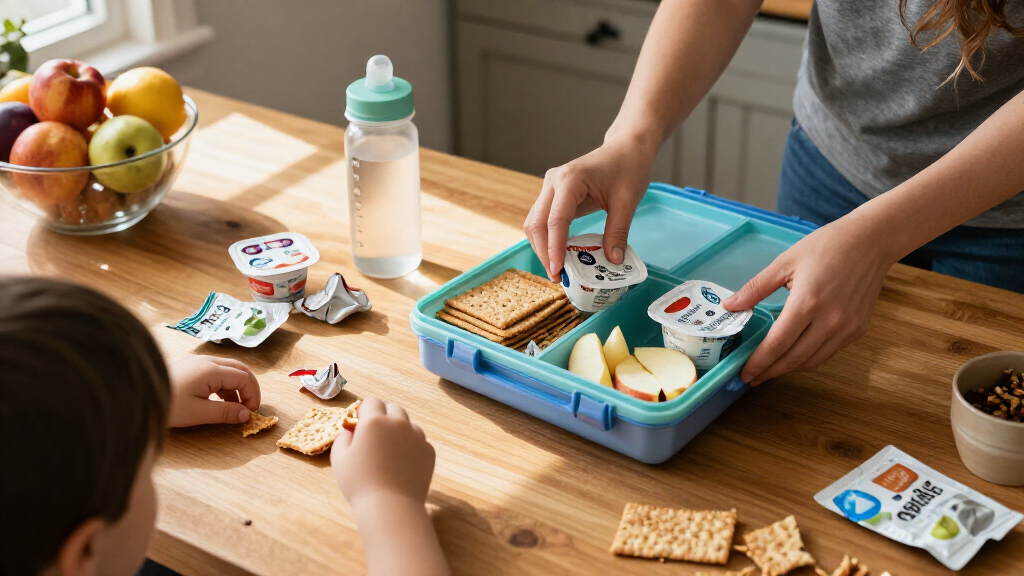
The report offers a practical way to compare snacks in a crowded aisle: read the ingredients and nutrition panel, then consider how the food fits into the rest of a child’s lunch. Protein and fiber are not requirements for every single snack, and a bar or cracker does not need to meet every nutritional goal on its own. Kaiden suggests pairing carbohydrate-rich foods with options such as fruit, cheese or plain yogurt; nuts or seeds may be suitable where school rules allow.
The sugar guidance also needs context. A daily recommendation should not be mistaken for a limit attached to each packaged snack, and children’s needs vary. The article’s selections reflect the dietitians’ professional judgments and shopping preferences; they are not a formal ranking or evidence that every listed item is appropriate for every child.
Popular right now

KitchenAid Artisan 5-Quart Tilt-Head Stand Mixer, Almond Cream

KitchenAid 5.5-Qt Bowl-Lift Stand Mixer, Porcelain White

Bose QuietComfort Wireless Noise Cancelling Headphones – Cypress Green (Limited Edition)
As an affiliate, we earn on qualifying purchases.
What the Dietitians Check on Labels
Both dietitians advise looking beyond claims on the front of a package. Manaker says “good source of fiber” has a defined meaning—10% to 19% of the daily value per serving—while “gluten free” is relevant for people with celiac disease or gluten sensitivity but does not by itself indicate greater nutritional value for others.
Kaiden says she avoids hydrogenated and partially hydrogenated oils and passes on high-fructose corn syrup. On seed oils, she describes a preference for extra-virgin olive or avocado oil when comparable products are available, but says this is about processing and personal choice, not a claim that all seed oils are harmful. She also recommends checking familiar brands again because formulations can change, and evaluating the whole product rather than rejecting it over one ingredient.
““That matters to me more than anything else.””
— Robin Barrie Kaiden, MS, RD, CDN, CSSD
Which Products Made the Full List
The supplied source excerpt does not contain the complete set of 22 products or all of Manaker’s recommendations, so the full list cannot be verified from the material available here. The report also does not establish that the snacks have been independently tested or that they meet every school’s allergy and food policies. Product formulations can change, and individual dietary needs differ.
Check Labels Before Packing
Parents considering a product can compare its current ingredient list and nutrition facts with the dietitians’ guidance, check serving information and account for the child’s overall meals and any allergy or school restrictions. Because ingredients may change, the report advises rereading labels even for brands families already buy. The source gives no follow-up testing or later update schedule; its listed publication status is updated Nov. 6, 2026.
Key Questions
What is the news in the report?
Motherly updated a guide to 22 packaged lunchbox snacks selected with input from registered dietitians Robin Barrie Kaiden and Lauren Manaker. The report also describes how they read product labels.
What should parents check first on a snack package?
The dietitians recommend starting with the ingredient list. Ingredients appear by weight, so the first few make up most of the product. They also advise checking nutrition facts rather than relying on front-of-package claims alone.
How much added sugar should parents look for?
The report cites guidance recommending no added sugars for children under 10 and less than 25 grams per day for children 2 and older, according to the American Academy of Pediatrics. These are daily recommendations, not a per-snack allowance.
Does every snack need to contain protein and fiber?
No. Kaiden’s suggested range for a substantial afternoon snack is about 5 to 10 grams of protein and at least 3 grams of fiber, depending on the child. The report says those amounts can come from the snack as a whole, and not every individual packaged item has to supply both.
Source: mother.ly