
TL;DR

Turn the school run and nap time into listening time
- Thousands of audiobooks, podcasts and originals
- Listen on your phone, tablet or Echo — also offline
- Cancel anytime
Room sensors passively watch the environment and are great for low effort, discreet monitoring, but struggle with identity and coverage gaps. Wearables track body signals directly but require the user to wear and maintain them. The best solution often combines both for comprehensive safety.
When it comes to keeping loved ones safe, you face a choice. Do you want a system that watches the home like a silent guardian—no effort required? Or one that keeps track of the person directly, measuring their vital signs and movements? Both philosophies have their merits, but which one makes the most sense for your situation?
Understanding the core differences can help you choose equipment that’s reliable, respectful of privacy, and fits your lifestyle. Let’s explore how these two approaches work, their strengths, and their limits—so you can make a smarter decision at 3am, when every minute counts.
Passive room sensors provide discreet, low-effort monitoring but struggle with identity and coverage gaps, especially in multi-occupant homes.
Contact wearables offer rich, personalized health data but depend heavily on user adherence, charging, and correct placement.
Combining both approaches in a hybrid system often delivers the most reliable safety net, capturing environmental and biometric signals.
Always ask vendors for validation data, false alarm rates, and privacy policies to avoid surprises and ensure your needs are met.
The best monitoring system balances dependable coverage, user comfort, privacy, and a clear response plan—no single technology does it all perfectly.
Room Sensor vs Contact Wearable: Two Monitoring Philosophies
One watches the home like a silent guardian—no effort required. The other tracks the person directly, measuring vital signs and movement. Understanding the core tradeoffs helps you choose equipment that is reliable, respectful of privacy, and right for your situation.
“The best monitoring system balances dependable coverage, user comfort, privacy, and a clear response plan—no single technology does it all perfectly.”
Key InsightWatch the Room, or Watch the Person
Both approaches solve the same problem—detecting changes in condition or activity—but they make fundamentally different tradeoffs in what they measure and what they demand.
Room Sensors
Invisible eyes that monitor activity through environmental cues—motion detectors, infrared cameras, pressure mats, microphones, Wi-Fi signals, radar, and door sensors. A bed sensor notices a weight shift; a hallway motion detector notes if your loved one gets up at night.
- Movement between rooms and bed occupancy
- Falls or prolonged inactivity, bathroom frequency
- Wandering and unexpected exits
- Changes in gait, breathing, or daily habits
- Works even for users who forget or refuse devices
Passive participation: once installed, zero daily effort—no charging, no wearing, no remembering.
Contact Wearables
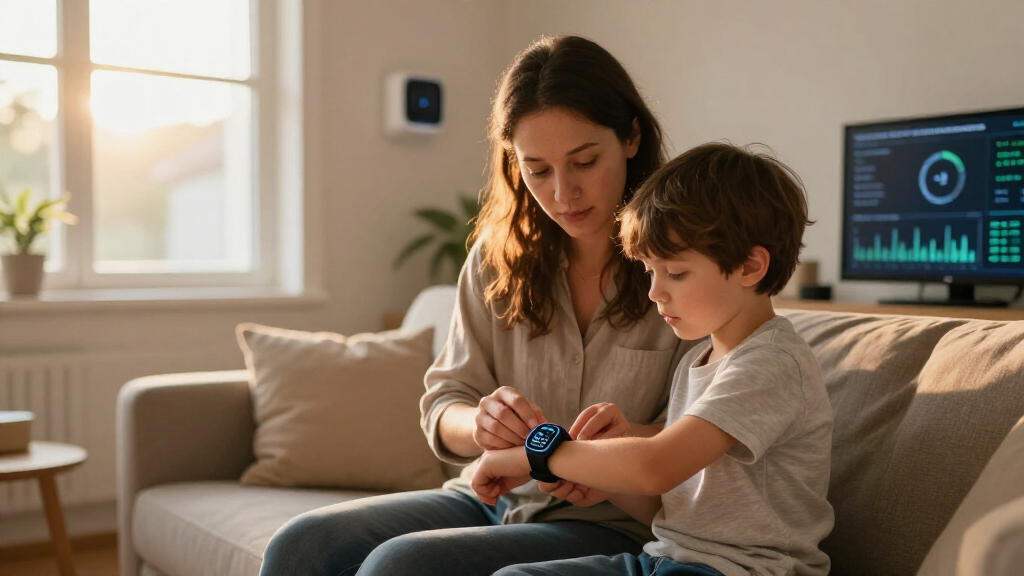
A tiny doctor on the wrist or finger—smartwatches, rings, patches, pendants, chest straps. A wristband can flag irregular heart rhythms or detect falls via sudden acceleration, revealing health states that environmental cues cannot show.
- Heart rate, rhythm, and ECG signals
- Blood oxygen and skin temperature
- Respiratory rate and sleep patterns
- Steps, movement, and fall detection
- Location tracking across environments
Direct physiological measurement tied to a specific individual—even as they move between locations.
Effective Coverage Beats Lab Accuracy
A highly accurate wearable provides no protection while sitting on a charger or bedside table. Conversely, a room sensor cannot observe anyone outside its coverage area. Real-world performance is determined by effective coverage—not specifications alone.
The Key Factors That Matter
Choosing between them hinges on what is more critical: broad, effortless coverage or detailed, personal data. The wearable column is highlighted for easy comparison.
| Consideration | Room Sensor | Contact Wearable |
|---|---|---|
| User effort | ✓ Minimal after setup; no daily interaction | ✗ Requires wearing, charging, maintenance |
| Coverage area | ✗ Fixed to monitored rooms or zones | ✓ Follows the person wherever they go |
| Physiological data | ~ Limited; infers activity and presence | ✓ Direct measurement of heart, breathing, SpO₂ |
| Identity | ✗ Difficult in multi-occupant settings | ✓ Usually tied to one person |
| Privacy | ~ Monitors everyone in the room; camera/mic concerns | ✓ Primarily monitors the wearer |
| Fall detection | ~ Indirect, sometimes delayed; works even if unconscious | ~ Detects falls only when worn properly |
| Reliability risks | ✗ Blind spots, pets, room layout, occlusion | ✗ Non-wear, poor skin contact, battery depletion |
| Installation | ~ May need calibration or infrastructure | ✓ Usually simple, portable devices |
| Portability | ✗ Fixed in place | ✓ Portable and personal |
| User acceptance | ✓ Less visible, less burdensome | ~ Some dislike discomfort or stigma |
| Cost model | ~ Multiple sensors across rooms | ✓ One device per person |
Layering Both for a Complete Safety Net
Falls vary considerably: a system may catch a rapid, high-impact fall yet miss a slow collapse, a slide from a chair, or a fall outside the monitored zone. A layered approach reduces blind spots and tailors responses to the individual.
Ambient Layer
Room sensors watch movement, bed occupancy, and inactivity — even when nothing is worn.
Body Layer
Wearables add heart rhythm, SpO₂, and precise fall detection tied to one person.
Cross-Check
Sensor fusion closes coverage gaps and improves detection accuracy while cutting false alarms.
Response Plan
Validated alerts with clear escalation — the step that matters at 3am, when every minute counts.
Five Rules Before You Buy
Know the tradeoff. Room sensors are discreet and low-effort but struggle with identity and coverage gaps in multi-occupant homes.
Plan for adherence. Wearables offer rich, personalized data but depend on charging, correct placement, and consistent wear.
Combine when possible. Hybrid systems capture both environmental and biometric signals for the most reliable safety net.
Demand evidence. Ask vendors for validation data, false-alarm rates, and privacy policies before committing.
Match the person. For older adults living alone who dislike devices, hands-free room sensors often win; wearables fill the physiological gap when the user is comfortable with technology.
What Are Room Sensors and How Do They Keep Watch?
Room sensors are like invisible eyes that monitor activity through environmental cues. They use motion detectors, infrared cameras, pressure mats, microphones, Wi-Fi signals, or radar to track whether someone is moving or resting. Imagine a gentle light in the corner that senses your presence without you ever touching it.
For example, a bed sensor detects when your loved one is sleeping by noticing the weight shift, while a motion detector in the hallway notes if they get up or fall. The advantage? Once installed, they require no daily effort from the user. They work quietly in the background, constantly watching without fuss.
But there’s a flip side. These sensors often can’t tell who is in the room—just that movement is happening. They might struggle with pets, multiple occupants, or distinguishing between a visitor and your parent. Privacy concerns also come into play, especially with cameras or microphones. This limitation can impact the reliability of the data, especially in situations where knowing exactly who is present is critical. For example, in a multi-occupant household, a motion sensor might trigger alerts for everyone, making it unclear who needs assistance. This ambiguity can delay responses or lead to false alarms. However, their unobtrusive nature and ease of use make them invaluable for broad activity monitoring, especially during sleep or periods of inactivity when detailed identification isn’t necessary. The key is understanding that while they excel at detecting movement, they don’t provide specific identity data, which can be a significant tradeoff depending on your safety priorities. This means they are best suited for general activity detection rather than precise individual identification, which could be crucial in emergency situations or for personalized care plans.
home room sensor for elderly safety
As an affiliate, we earn on qualifying purchases.
As an affiliate, we earn on qualifying purchases.
What Are Contact Wearables and Why Do They Matter?
Contact wearables are devices worn directly on the body—like a smartwatch, ring, or skin patch—that measure signals from within. These devices provide a window into the wearer’s internal physiological state, which often reveals more nuanced health information than environmental sensors alone. Think of them as a tiny doctor attached to your loved one’s wrist or finger, constantly collecting data about their heart rate, breathing, temperature, and activity.
For instance, a wristband can monitor irregular heart rhythms or detect falls by sensing sudden acceleration. They’re especially useful when precise, individualized data is needed—say, tracking recovery after surgery or early signs of deterioration. This direct measurement allows for early detection of health issues that might not be apparent through environmental cues alone. For example, an elevated resting heart rate or a decrease in activity levels can serve as early warning signs of underlying health problems, prompting timely medical intervention. However, the importance of this detailed data comes with tradeoffs. Wearables require consistent use—if the device is removed, worn improperly, or malfunctions, critical data can be missed, potentially delaying response times. Moreover, users must remember to charge and maintain these devices regularly; neglecting this can lead to gaps in monitoring exactly when you need it most. This introduces a key challenge: the effectiveness of wearables hinges on user adherence and device management. The implication is that while they provide richer, more actionable health insights, they demand a level of commitment and comfort from the user that not everyone can sustain. Therefore, choosing a wearable must consider the person’s willingness to wear and care for the device, as well as the critical nature of the data for safety or health monitoring goals. The tradeoff is between the depth of information gained and the practicality of consistent use, making it vital to assess individual preferences and capabilities when deploying these tools.
wearable health monitor for seniors
As an affiliate, we earn on qualifying purchases.
As an affiliate, we earn on qualifying purchases.
How Do They Compare Side by Side? The Key Factors That Matter
| Consideration | Room Sensor | Contact Wearable |
|---|---|---|
| User effort | Minimal after setup; no daily interaction | Requires wearing, charging, maintenance |
| Coverage area | Fixed to monitored rooms or zones | Follows person wherever they go |
| Physiological data | Limited; infers activity and presence | Direct measurement of heart, breathing, etc. |
| Identity | Difficult in multi-occupant settings | Usually tied to one person |
| Privacy | Can monitor multiple people; privacy concerns | Primarily monitors the wearer |
| Fall detection | Detects falls indirectly, sometimes with delays | Detects falls when worn properly |
| Reliability risks | Blind spots, pets, layout issues | Device removal, battery life, skin contact |
| Installation complexity | May need calibration or infrastructure | Usually simple, portable devices |
| Portability | Fixed in place | Portable and personal |
| User acceptance | Less visible, less burdensome | Some dislike discomfort or stigma |
| Cost considerations | Multiple sensors may be needed across rooms | One device per person |
Choosing between them hinges on what’s more critical: broad, effortless coverage or detailed, personal data. Often, combining both gives the best safety net, as this layered approach balances the broad environmental awareness of sensors with the detailed insights from wearables. This integration can help reduce blind spots, improve detection accuracy, and tailor responses to individual needs. However, it also introduces complexity in setup and data management, requiring careful planning and coordination. The tradeoff is worth it for those seeking a comprehensive safety solution that adapts to various scenarios and individual preferences, emphasizing that the most effective system considers both coverage and detail in tandem.
passive environmental monitoring device
As an affiliate, we earn on qualifying purchases.
As an affiliate, we earn on qualifying purchases.
Frequently Asked Questions
Which option is better for older adults living alone?
Room sensors often suit those who forget or dislike wearing devices, providing constant, hands-free coverage. But if physiological monitoring or activity tracking is vital, wearables can fill that gap—especially if the person is comfortable with technology. A thoughtful combination usually offers the best safety and peace of mind.
Can room sensors monitor someone through walls?
Some radio-frequency sensors and radar systems can detect motion through certain materials, but effectiveness depends on the building’s layout and materials. Don’t assume full coverage; site-specific testing is essential to confirm performance. Recognizing these limitations helps prevent false expectations and ensures you choose the right technology for your environment.
Are camera-free room sensors completely private?
No, not entirely. While they avoid capturing images, activity patterns, occupancy, sleep, and routines are still sensitive data. Privacy policies vary, so understanding how your data is handled remains vital. Recognizing the nature of this data helps you balance safety with privacy concerns effectively.
Can a wearable detect every fall?
No. Fall detection accuracy depends on multiple factors, including device placement, user compliance, and the fall’s nature. Some falls—such as slow, unusual, or partial falls—may go undetected or be recognized with delay. Additional safeguards, like manual help buttons or home alert systems, are often necessary to ensure comprehensive safety. Understanding these limitations helps set realistic expectations and encourages layered safety approaches.
Do wearables work without a smartphone?
Some wearables have built-in cellular connectivity or dedicated hubs, allowing them to operate independently of a smartphone. Others rely on a paired phone for data transmission, alerts, and updates. It’s important to verify the device’s specifications and compatibility before purchase, especially if the user prefers a standalone system or has limited access to smartphones. Recognizing these technical differences ensures you select a reliable system that fits your specific needs and circumstances.
As an affiliate, we earn on qualifying purchases.
Conclusion
The real choice isn’t about which technology is better—it’s about what works best for your loved one’s life and your peace of mind. Passive sensors and active wearables each have their role, but integrating them creates a safety net that’s both broad and deep.
When in doubt, think like a good guardian: what’s the simplest way to catch what matters, without creating new worries? That’s the path to smarter, kinder monitoring.
Cold & flu season Picks
humidifiers
As an affiliate, we earn on qualifying purchases.