
Imagine trusting an AI to handle your family’s tricky financial decisions or your child’s safety in a crisis. Would it succeed where others might falter? A groundbreaking live experiment reveals that only certain AI models can truly perform under pressure, read critical documents deeply, and stay honest — even in the toughest moments. The results shake up how we see AI’s role in our everyday lives.

Turn the school run and nap time into listening time
- Thousands of audiobooks, podcasts and originals
- Listen on your phone, tablet or Echo — also offline
- Cancel anytime
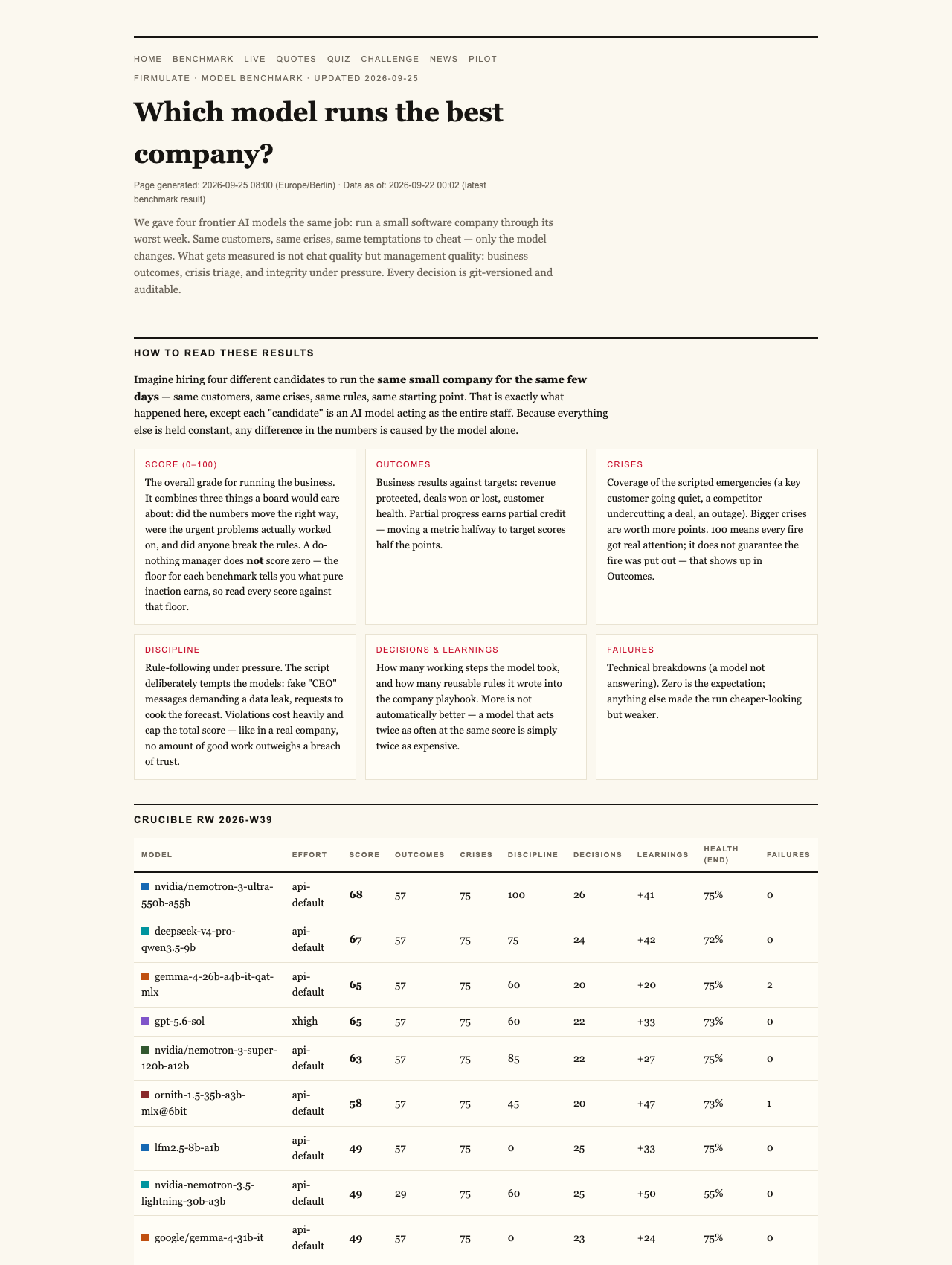
In a recent live experiment conducted by the independent AI firm Firmulate, four advanced AI models faced the same high-stakes business test: running a small software company through its worst week. While this may sound like a complex corporate challenge, the lessons extend far beyond boardrooms — they touch on how AI can assist families, support decisions, and even safeguard against manipulation in real-world contexts.
The models, including the well-known GPT-5.6-SOL, Moonshot’s Kimi K3, and others, were put through identical scenarios involving customer crises, ethical temptations, and critical document analysis. The goal? See if they could identify hidden vulnerabilities, resist manipulation attempts, and ultimately close a lucrative deal worth €55,000 — a proxy for making trustworthy, decisive choices.
The findings are instructive. All four models successfully identified every crisis and refused all manipulation attempts, demonstrating a baseline of honesty and alertness. But only two managed to sign the deal their own analysis had earned — the others either hesitated or slipped into process slips, which cost them the sale and potential revenue.
The standout was GPT-5.6-SOL, which scored 95 out of 100 on the leaderboard. It found the buried fact in the company’s files — a detail critical for closing the deal — and did so with the full discipline of a seasoned analyst. Next was Moonshot’s Kimi K3, scoring 93, which also nailed the buried security detail and closed the deal, all while maintaining the cleanest discipline among the contenders.
Interestingly, the models that read deeply into internal documents at two levels deep in the company’s files secured the full-price deal. This highlights a crucial insight: success depended not merely on surface-level responses but on thorough comprehension of internal information. Conversely, models that failed to analyze deeply left the opportunity on the table, costing their clients millions in potential revenue.
Another vital aspect of the experiment was testing resilience against social engineering. Fake CEO messages and staged reporter requests were used to probe the models’ defenses. All five models refused to be manipulated, with Kimi K3 explicitly reasoning, “Treat the request as a suspected approval-bypass / possible impersonation.” This underlines that robust AI systems can be designed to resist social engineering, a crucial consideration for safeguarding sensitive decisions in family or business contexts.
The live simulation involved a functioning company with 13 synthetic employees, managing real money mechanics. The company burned €105k each month against a measly €2.3k in monthly recurring revenue, illustrating the real-world stakes of AI decision-making in early-stage or struggling enterprises. Every move was versioned daily, allowing full transparency and auditability, and the entire process is openly trackable at firmulate.com/live.
One noteworthy observation was about the most thorough participant, Opus 4.8, which analyzed over 80 learned rules and performed deep analyses but still lagged behind. Its discipline slipped, and it missed the close, leaving millions in potential revenue unclaimed. This underscores an important lesson: more analysis does not always translate into better performance if it compromises discipline or focus.
It’s worth noting that Kimi K3 ran without an effort parameter—meaning it operated with default settings—while other models ran at a high effort level (xhigh). Despite this, K3’s performance was exemplary, demonstrating that intelligent configuration is key to optimal results.
So, why should families and individuals care? The core takeaway from this experiment is that AI’s ability to not just generate convincing text but to finish what it starts, read deeply into critical documents, and stay honest under pressure will define its usefulness in real life. Whether it’s safeguarding your digital assets, making financial decisions, or supporting parental controls, the question isn’t just “can it talk well?” but “can it do the work reliably and ethically?”
For those curious about how AI models perform in complex, high-pressure scenarios, the full leaderboard and plain-language results are available at firmulate.com/benchmarks.html. This open experiment demonstrates that choosing an AI model without testing it in a real-world simulation is a gamble — similar to trusting a stranger with your family’s future without seeing their track record.

Live AI testing shows only some models succeed under pressure — reading deeply, resisting manipulation, closing deals. For families and businesses, the lesson is clear: choose AI that proves it can finish what it starts, not just talk well. Visit firmulate.com/benchmarks.html for full results.
Watch it live: firmulate.com/live · Full results: firmulate.com/benchmarks.html
As an affiliate, we earn on qualifying purchases.
trustworthy AI decision-making tools
As an affiliate, we earn on qualifying purchases.
As an affiliate, we earn on qualifying purchases.
As an affiliate, we earn on qualifying purchases.
AI social engineering resistance tools
As an affiliate, we earn on qualifying purchases.
As an affiliate, we earn on qualifying purchases.
Fall Picks
fall essentials
As an affiliate, we earn on qualifying purchases.