TL;DR

Turn the school run and nap time into listening time
- Thousands of audiobooks, podcasts and originals
- Listen on your phone, tablet or Echo — also offline
- Cancel anytime
Choosing a humidifier by square footage is a good starting point, but room volume, climate, and placement matter just as much. Use a humidistat and monitor humidity to keep your baby’s air comfortable and safe.
Ever feel like your nursery’s humidifier is either doing too little or turning your space into a damp cave? You’re not alone. It’s tempting to pick a unit based strictly on square footage, but that’s like choosing a coat size just by your height. True comfort comes from matching your humidifier’s output to the actual volume of air in the room.
In this guide, you’ll learn how to estimate the right size for your nursery — factoring in ceiling height, drafts, and climate — so you can keep the air just right for your baby’s health and comfort, without risking mold or dust mites.
Calculate your room’s cubic feet—floor area multiplied by ceiling height—to find the right humidifier size.
Choose a unit with adjustable output and a humidistat to prevent over-humidifying.
Place the humidifier away from the crib, walls, and direct mist, and clean it regularly to prevent mold.
Monitor room humidity with a separate hygrometer for accurate readings.
Adjust your humidifier’s settings based on outdoor climate, drafts, and room sealing for best results.
Humidifier Sizing: Matching Output to Nursery Square Footage
Square footage is only the opening estimate. Ceiling height, climate, drafts, heating and placement determine how much moisture your nursery really needs—and whether it stays comfortable instead of becoming a damp cave.
Find the room’s true air volume
Measure length, width and ceiling height in feet. Multiplying all three gives the cubic footage your humidifier must influence.
Raise the ceiling, raise the estimate.
The same 10 × 12-foot nursery contains 1,200 cubic feet when the ceiling rises from 8 to 10 feet.
A practical starting chart
Use these ranges for an 8-foot ceiling with average air leakage. Then adjust for heating, weather, ventilation and how well the nursery is sealed.
| Nursery floor area | Approx. room volume | Useful output range | Starting profile |
|---|---|---|---|
| Up to 150 sq. ft. | Up to 1,200 cu. ft. | 100–200 mL/hour | Compact nursery |
| 150–250 sq. ft. | 1,200–2,000 cu. ft. | 200–300 mL/hour | Typical nursery |
| 250–400 sq. ft. | 2,000–3,200 cu. ft. | 300–500 mL/hour | Large or shared room |
Approximate starting ranges—not universal requirements. Manufacturer area ratings use varying test conditions and are not directly comparable across brands.
What changes the moisture demand?
Output has to replace moisture continuously lost through dry incoming air, heating and leakage. Two identically sized nurseries can need very different settings.
Dry rooms need a stronger opening push.
Raising humidity from 15% takes more moisture than maintaining a room already near 40%.
Cold outdoor air dries further indoors.
Winter air carries little moisture and becomes especially dry when warmed by the heating system.
Forced air often increases demand.
Frequent warm-air circulation can dry the nursery faster than radiant heating.
Drafts constantly remove humidified air.
Leaky windows, open doors and frequent ventilation can require a higher continuous output.
Cold surfaces lower the safe ceiling.
Exterior walls and poorly insulated windows may collect condensation before the room reaches 50% RH.
Mist must reach the room—not a wall.
Moisture aimed at curtains, furniture or the floor creates damp spots instead of balanced humidity.
Compare nursery-friendly designs
Output control, an accurate humidistat and an easy-to-clean tank matter more than flashy connectivity. Tank volume determines runtime—not humidifying power.
Ultrasonic
A quiet, energy-efficient option that turns water into a fine mist.
- Usually very quiet for sleep
- Adjustable output is common
- Hard tap water may create white dust
- Distilled water can reduce minerals
Evaporative
A fan draws air through a wet wick, with evaporation slowing naturally as RH rises.
- Somewhat self-limiting by design
- Less mineral dust in room air
- Fan noise may be noticeable
- Wicks need cleaning or replacement
Warm mist
Effective humidification, but hot water and steam introduce an avoidable nursery hazard.
- Can raise humidity efficiently
- Hot tank and steam can burn
- Consumes more energy
- Less suitable around children
Control the room, not just the machine
A built-in sensor may read the humid air immediately around the unit. A separate digital hygrometer near the crib area provides a more useful room-level reading.
Place safely
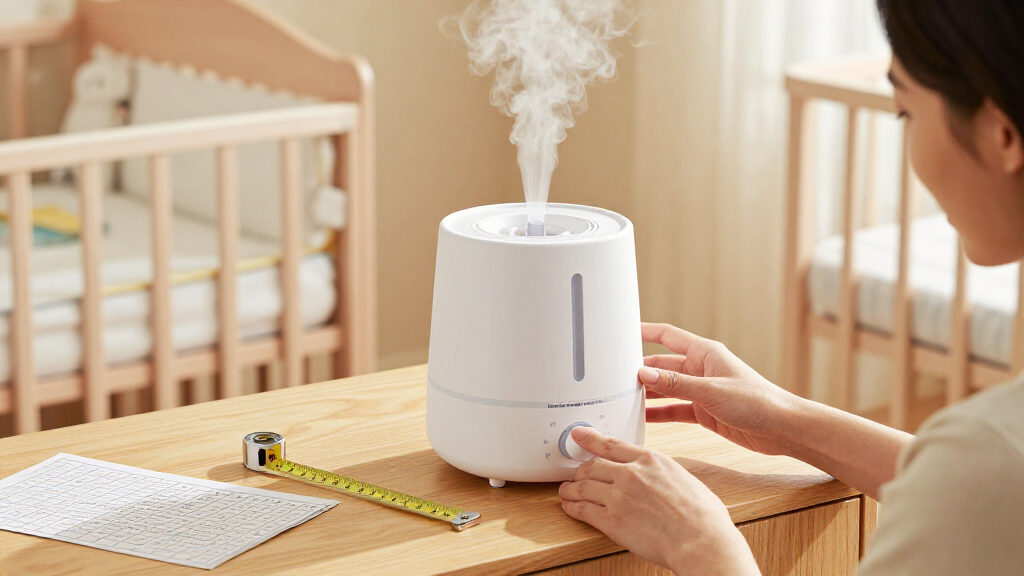
Use a stable, water-resistant surface with the unit and cord completely out of reach.
Aim into open air
Keep mist away from the crib, bedding, walls, curtains, windows and furniture.
Measure separately
Position the hygrometer near the crib zone but outside the direct mist plume and drafts.
Clean routinely
Empty, clean and descale the tank to limit mold, bacteria and mineral buildup.
Humidity stays below 30%
- The unit runs for hours without a meaningful RH increase.
- The room still feels dry despite continuous operation.
- Dry climate, drafts or tall ceilings may exceed the selected output.
Surfaces begin to feel damp
- Windows fog or collect condensation.
- Walls, bedding or nearby furniture feel moist.
- A musty smell suggests humidity should be reduced immediately.
Five rules for a better fit
The best humidifier is not necessarily the largest. It is the unit that can maintain the target range, respond to changing conditions and remain simple enough to clean consistently.
Calculate cubic feet: floor area multiplied by ceiling height.
Choose adjustable output and reliable humidistat control.
Keep direct mist away from the crib, walls and fabrics.
Verify room RH with a separate digital hygrometer.
Adapt settings for weather, heating, drafts and condensation.
Frequently asked questions
What output should I try for a 100-, 200- or 300-square-foot nursery?
With an 8-foot ceiling, start near 100–200 mL/hour for 100 sq. ft., 200–300 mL/hour for 200 sq. ft. and 300–500 mL/hour for 300 sq. ft. Adjust after checking actual RH.
Is a larger humidifier automatically safer?
No. An uncontrolled high-output unit can create condensation and support mold or dust-mite growth. Oversizing is manageable only with dependable humidistat control.
Does a large tank mean the humidifier covers more space?
No. Tank size primarily determines time between refills. The output rate in mL/hour determines how quickly the unit adds moisture.
Do app controls replace a separate hygrometer?
No. Smart controls are convenient, but a sensor inside the humidifier may read its own mist plume. Use a separate meter near the occupied nursery zone.
Why Room Volume Matters More Than Floor Space Alone
Room volume—the total air inside your nursery—dictates how much moisture it needs. A 150-square-foot room with 8-foot ceilings holds about 1,200 cubic feet of air, but bump that ceiling to 10 feet, and you’re at 1,500 cubic feet. That extra 25% air needs more moisture to reach the same humidity level.
Imagine trying to fill a swimming pool versus a small pond with a garden hose. The volume of water needed depends on the pool’s size, not just its surface area. The same logic applies to humidifiers and room air.
For example, a nursery with standard 8-foot ceilings needs about 200 mL/hour of moisture to keep humidity stable, but if your ceilings are taller, your needs increase accordingly.
As an affiliate, we earn on qualifying purchases.
How to Calculate Your Nursery’s Air Volume Quickly
Calculating your nursery’s air volume is straightforward. Multiply the room’s floor area by its ceiling height in feet:
- Measure the room’s length and width in feet.
- Calculate the area: length × width.
- Multiply the area by ceiling height.
For example, a 10×12-foot nursery with 8-foot ceilings: 10×12=120 sq. ft. 120×8=960 cubic feet of air. If ceilings are 10 feet, then 120×10=1,200 cubic feet.
This number is your starting point for choosing a humidifier. Higher cubic footage means you need more moisture output.
As an affiliate, we earn on qualifying purchases.
Matching Humidifier Output to Room Size: The Simple Chart
Here’s a quick reference based on typical room volumes and ceiling heights:
| Nursery Size | Room Volume | Recommended Output Range |
|---|---|---|
| Up to 150 sq. ft. | Up to 1,200 cu. ft. | 100–200 mL/hour |
| 150–250 sq. ft. | 1,200–2,000 cu. ft. | 200–300 mL/hour |
| 250–400 sq. ft. | 2,000–3,200 cu. ft. | 300–500 mL/hour |
If your ceiling height is higher than 8 feet, adjust the area accordingly (see next section).
As an affiliate, we earn on qualifying purchases.
How Ceiling Height Changes Your Humidifier Needs
Ceiling height isn’t just a detail—it’s a game-changer. For every extra foot of ceiling, your room’s volume increases by roughly 12.5%. So, a 200 sq. ft. room with 10-foot ceilings holds about 2,500 cubic feet, not just 2,000.
To adjust your size estimate: multiply the floor area by the ceiling height, then divide by 8. For example, a 200 sq. ft. room with a 10-foot ceiling: (200×10)/8=250 sq. ft. equivalent in standard height.
This means you need about 250–350 mL/hour of moisture to keep humidity stable, depending on other factors like drafts and outdoor climate.
As an affiliate, we earn on qualifying purchases.
What Factors Make You Need More or Less Moisture
Several factors can tip the scales. Cold, dry outdoor air sucks moisture out of your nursery fast. Forced-air heating dries out rooms even more, especially if you keep the door closed. Drafty windows or poor insulation let moisture escape, requiring a higher output humidifier.
Imagine your baby’s room in winter: the outdoor air is bone dry, and the forced heat pulls moisture from the walls and furniture. You might need a humidifier with a higher output—say, 400 mL/hour—to stay within the safe 30–50% RH range.
On the flip side, a well-sealed room in a mild climate may need less, even if it’s bigger.
Choosing the Right Type of Humidifier for Your Nursery
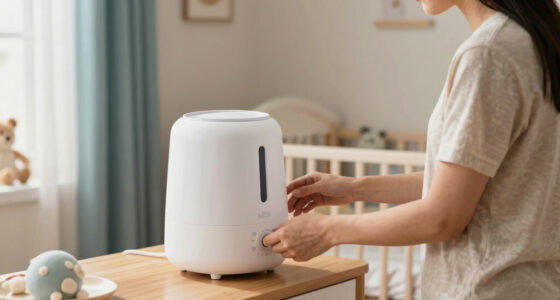
For nurseries, cool-mist ultrasonic and evaporative models are usually safest. Ultrasonic units are whisper-quiet and energy-efficient, but they can produce white dust if you use tap water. Using distilled water can help.
Evaporative humidifiers use a wick and fan, which naturally limit moisture output—helpful if you tend to set it and forget it. Warm-mist units are less common because hot water around children can be risky.
Pick a model with adjustable output and a built-in humidistat. That way, it cycles on and off based on actual room humidity, preventing over-humidification.
Safe Placement and Maintenance Tips for Peace of Mind
Keep your humidifier out of your baby’s reach—on a sturdy, water-resistant surface. Never place it directly inside the crib or aimed at bedding or curtains. Regularly empty, clean, and descale the tank to prevent mold and bacteria growth.
Use a separate hygrometer to monitor humidity—place it a few feet from the humidifier, away from drafts, windows, or direct mist. Ideal RH: 30–50%. Adjust or turn off the unit if surfaces get damp or you notice a musty smell.
Never add essential oils or vapor tablets unless the humidifier is specifically designed for them. These can irritate your baby’s lungs and introduce unnecessary risks.
How to Tell if Your Humidifier Is Doing Its Job
If your humidifier is correctly sized, it’ll keep your nursery at a stable 30–50% RH without running constantly or causing dampness. Use your hygrometer to check regularly.
Signs it’s too small: humidity stays below 30% even after hours of running. The tank empties quickly without a noticeable change. The room feels dry despite the humidifier.
If it’s too big or set too high: windows fog up, walls or furniture feel damp, or you smell mold. Adjust the setting, improve placement, or switch to a smaller unit.
Smart Features and New Designs: Do They Help?
Modern humidifiers often include built-in humidistats, app controls, and sensors. These can make maintaining the right humidity easier but don’t replace good placement and regular cleaning.
Be cautious: sensors inside the unit might read the humidity right around the machine, not your crib. Use a separate hygrometer for a true reading.
Look for units with easy-to-clean tanks, adjustable output, and automatic shutoff. They make your job simpler but aren’t magic.
Frequently Asked Questions
What size humidifier do I need for a 100-, 200-, or 300-square-foot nursery?
For an 8-foot ceiling, start with about 100–200 mL/hour for 100 sq. ft., 200–300 mL/hour for 200 sq. ft., and 300–500 mL/hour for 300 sq. ft. Adjust based on climate, drafts, and room sealing.
Is a larger humidifier safer because it doesn’t work as hard?
Not necessarily. An oversized model without a reliable humidistat can over-humidify, especially in small rooms. Choose a unit with automatic controls for safety and efficiency.
Does tank size determine how much area I can humidify?
No. Tank size mainly affects how long it runs before refilling. The output rate—mL/hour—determines how quickly it humidifies your space.
What’s the ideal humidity level for a baby’s room?
Between 30% and 50% RH is safest and most comfortable. Use a hygrometer to keep track, especially during winter or in dry climates.
Where should I place the hygrometer?
Place it a few feet from the humidifier, away from drafts, windows, and direct mist. Keep it out of your baby’s reach for accurate readings.
Conclusion
Getting your nursery’s humidity just right isn’t about the biggest or most powerful humidifier. It’s about matching the unit’s output to your room’s true size and conditions. A well-sized, properly placed humidifier can turn dry, stuffy air into a gentle, soothing breeze that comforts your baby and keeps mold at bay.
Remember, a little monitoring goes a long way. Regularly check your hygrometer, keep the unit clean, and adjust as needed. Your baby’s comfort—and your peace of mind—depend on it.
Fall Picks
fall essentials
As an affiliate, we earn on qualifying purchases.