TL;DR

Turn the school run and nap time into listening time
- Thousands of audiobooks, podcasts and originals
- Listen on your phone, tablet or Echo — also offline
- Cancel anytime
Nursery air quality monitors should focus on PM2.5, CO₂, humidity, and temperature. Understanding these readings helps parents act quickly to maintain a healthy environment for their babies.
PM2.5 levels are the most directly linked to respiratory health issues in infants and should be monitored closely.
CO₂ readings reveal how well your nursery is ventilated; aim to keep levels below 1,000 ppm for comfort and safety.
Managing humidity between 30–50% prevents mold and skin irritation, improving overall nursery health.
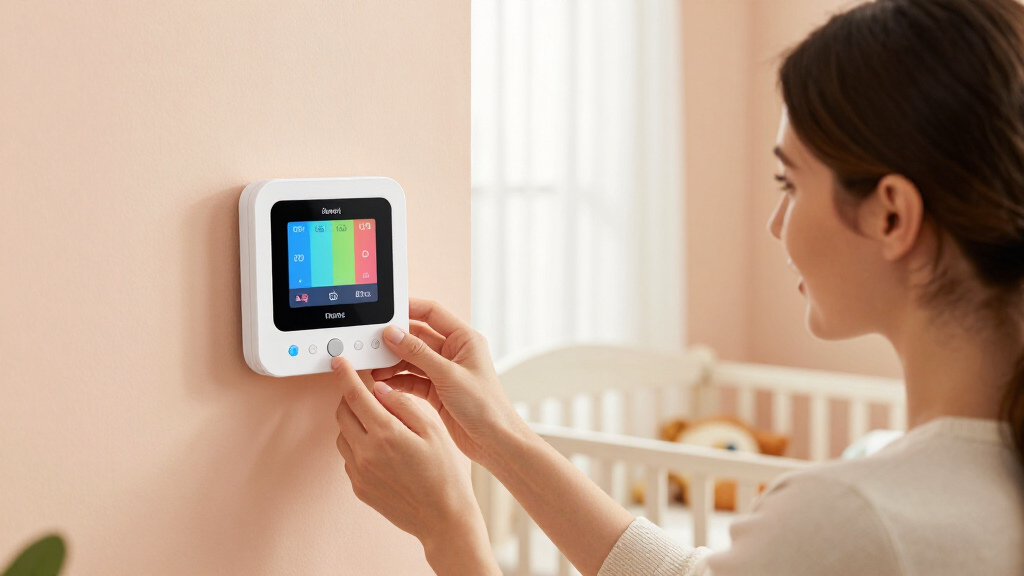
Placement of monitors matters—keep them in the breathing zone but away from direct sources of pollution or sunlight.
Trends and patterns in readings tell you more than isolated spikes—look for persistent issues over time.
Air Quality Monitors for Nurseries: Which Readings Matter
A monitor is useful only when its numbers lead to the right action. For most nurseries, prioritize fine particles, ventilation, moisture, and temperature—and judge patterns over time instead of reacting to every isolated spike.
Read the room, not just the score
Babies breathe more air relative to body weight than adults while their lungs and immune systems are still developing. Individual measurements reveal far more than a proprietary green, yellow, or red “air quality” score.
PM2.5
Priority 01Particles from smoke, traffic, cooking, candles, fireplaces, and tobacco can travel deep into the lungs. Cooking and cleaning may create brief spikes; repeated or persistent elevations deserve investigation.
Act: remove the source, run a HEPA purifier, and compare outdoor air before opening windows.Carbon dioxide
Priority 02CO₂ commonly rises when a nursery is occupied overnight with its door closed. At household levels it is primarily a “room breath meter”—a signal that exhaled air and other indoor pollutants are not being diluted efficiently.
Act: increase safe ventilation or air exchange when readings remain above roughly 1,000–1,500 ppm.Relative humidity
Priority 03Very dry air may irritate skin and nasal passages. Persistent dampness encourages mold and dust mites. Short deviations matter less than condensation, visible mold, or readings that stay above about 60%.
Act: use humidification or dehumidification carefully and keep equipment clean.Temperature
Priority 04A comfortably cool room supports sleep and reduces overheating. Temperature also changes relative humidity and can influence sensor behavior, so interpret both readings together.
Check: do not rely on a comfort score alone—feel the baby’s chest or back for sweating or overheating.What the numbers are telling you
Thresholds are decision aids, not sharp borders between “safe” and “unsafe.” Duration, source, room occupancy, outdoor conditions, and the monitor’s accuracy all affect interpretation.
PM2.5 source patterns
Illustrative relative spike intensity—not a prediction of exact concentration.
Humidity balance
The practical target sits between irritation from dryness and moisture conditions that favor mold or dust mites.
CO₂ measures ventilation. CO can be lethal.
Their names look similar, but they require completely different responses. A carbon-dioxide sensor cannot provide carbon-monoxide protection.
Occupied-room CO₂ guide
Household CO₂ readings are best interpreted as ventilation indicators. They are not a direct measurement of every pollutant in the room.
Never substitute one for the other
Useful sensor, specialist test, or safety alarm?
Some readings are valuable every day. Others are better for spotting changes, need long-term sampling, or belong on dedicated certified safety equipment.
| Reading | Best role | Everyday priority | Interpretation |
|---|---|---|---|
| PM2.5 | Particle exposure and source detection | ✓High | Lower is better; investigate persistent elevation and recurring spikes. |
| CO₂ | Occupied-room ventilation | ✓High | Use trends to decide when safe fresh-air exchange is needed. |
| Humidity | Moisture and comfort management | ✓High | Aim near 30–50%; investigate sustained levels above about 60%. |
| TVOC | Detecting changes after cleaning, furnishing, or painting | ~Trend only | Consumer readings are estimates, not chemical analyses or proof that a room is medically safe. |
| Formaldehyde | Targeted post-renovation or furnishing checks | ~Situational | Low-cost sensors may be inaccurate or cross-sensitive; professional testing may be needed. |
| Radon | Long-term ground-gas assessment | ~Location-based | Use a dedicated test over weeks or months, especially in ground-contact rooms or high-radon areas. |
| CO | Life-safety alarm | ✗Not a substitute | A general air monitor must never replace a separately certified carbon-monoxide alarm. |
From reading to useful action
A number becomes meaningful when you connect it to timing, possible sources, outdoor conditions, and the effect of your response.
Notice a sustained elevation or repeated spike.
Match it to sleep, cooking, cleaning, traffic, or weather.
Identify the likely indoor or outdoor source.
Remove, ventilate, filter, dry, or adjust temperature.
Confirm the reading improves and the pattern does not return.
Choose transparent measurements over a mysterious score
The best monitor makes individual readings and trends easy to understand. Extra sensors are not automatically better if their accuracy, calibration, and limitations are unclear.
Real sensor technology
Look for a laser-based particle sensor and true NDIR carbon-dioxide sensor. Confirm which measurements are directly sensed and which are estimated.
Visible raw data
Choose individual PM2.5, CO₂, humidity, and temperature values with historical graphs—not only a proprietary color or composite score.
Practical nursery design
Prioritize quiet operation, dimmable screens, adjustable alarms, clear calibration guidance, and reliable data retention.
Bottom line: Monitor PM2.5, CO₂, humidity, and temperature. Use dedicated smoke and CO alarms. Treat VOC data as a pattern detector, radon as a long-term testing task, and every composite air-quality score as an invitation to inspect the underlying measurements.
Why PM2.5 is the Most Critical Pollutant to Watch
PM2.5 refers to tiny particles less than 2.5 micrometers across—smaller than a human hair. These particles come from wildfire smoke, traffic exhaust, cooking fumes, and even candles. For a nursery, high PM2.5 levels are like a silent smoke cloud that can irritate your baby’s lungs and trigger asthma or infections.
Imagine a wildfire burning hundreds of miles away. Your monitor detects a spike in PM2.5, even though you don’t see smoke. That’s your cue to turn on the HEPA filter, close the windows, and avoid indoor activities that generate dust or fumes. But why does this matter so much? Because these tiny particles penetrate deep into the lungs, causing inflammation and impairing breathing, especially in infants with developing respiratory systems. Persistent exposure, even at low levels, can lead to long-term health issues, including reduced lung function or increased allergy risk. The tradeoff is balancing indoor air quality with necessary activities like cooking—using air purifiers and proper ventilation can mitigate these risks without sacrificing comfort. According to the WHO, keeping PM2.5 below 15 µg/m³ over 24 hours is ideal, but even brief spikes can be harmful, so timely action is essential.
As an affiliate, we earn on qualifying purchases.
Decoding CO₂: The Ventilation Indicator Every Parent Must Know
CO₂ levels in a nursery reveal how well the space is ventilated when occupied. A monitor shows parts per million (ppm): outdoor air is about 400–500 ppm, while indoor spaces should stay below 1,000 ppm for healthy breathing.
Think of CO₂ as your room’s breath meter. If it climbs above 1,500 ppm, exhaled air is accumulating, signaling poor ventilation. For example, during naptime with the door closed, CO₂ can quietly rise from 600 to over 1,200 ppm, making the room stuffy and uncomfortable.
Why does this matter? Elevated CO₂ levels don’t just mean stale air—they can also indicate inadequate removal of indoor pollutants like VOCs or allergens, which can accumulate and cause respiratory irritation or fatigue in infants. Poor ventilation can increase the risk of airborne illnesses and reduce oxygen intake, affecting your baby’s alertness and growth. Conversely, good ventilation dilutes indoor pollutants, reducing potential health risks. Actively managing CO₂ levels by opening windows or using air exchange systems can significantly improve indoor air quality. An accurate CO₂ reading provides insight into whether your nursery’s ventilation is sufficient and whether your environment is conducive to healthy breathing, especially during long periods of occupancy.
As an affiliate, we earn on qualifying purchases.
Humidity and Temperature: The Comfort Duo You Can’t Ignore
Dry air can dry out your baby’s nose and skin, leading to discomfort and increasing susceptibility to colds. Dampness fosters mold growth and dust mites, which are common allergens that can trigger asthma or respiratory issues. Maintaining a humidity level of about 30–50% creates a balanced environment that minimizes these risks. Think of it as balancing a teeter-totter—too dry or too damp can tip the scales toward health problems.
Temperature influences comfort and physiological regulation. Overheating can cause restlessness, sweating, or heat rash, while too cold can make the space uninviting and hinder sleep. A nursery maintained at around 68–72°F (20–22°C) offers a cozy, safe environment that supports healthy sleep and growth.
Why is this important? Fluctuations outside this range can compromise your baby’s immune system and skin integrity. For instance, high humidity above 60% can promote mold and dust mites, aggravating allergies or asthma. Conversely, low humidity below 30% can dry out mucous membranes, making infants more vulnerable to respiratory infections. Proper management includes using humidifiers or dehumidifiers as needed, and monitoring these levels regularly to ensure they stay within the safe zone. Keeping a stable temperature also prevents stress on your baby’s developing thermoregulatory system, fostering better sleep and overall health.
As an affiliate, we earn on qualifying purchases.
Other Readings: When and Why You Should Care About VOCs, CO, and Radon
VOCs (volatile organic compounds) and formaldehyde come from paints, furniture, and cleaning products. They can cause eye, nose, and throat irritation, especially in sensitive infants. While consumer monitors give estimates, they’re less precise. Use them to spot trends, not exact toxicity levels. Recognizing elevated VOCs can prevent long-term health issues like developmental delays or respiratory problems, especially with prolonged exposure. Ventilating the space after painting or choosing low-emission furniture can significantly reduce these risks.
Carbon monoxide (CO) is a silent killer—odorless and deadly. It’s best to have a dedicated CO alarm, not rely solely on a monitor. CO poisoning can cause headaches, dizziness, and even death in extreme cases. It’s crucial to ensure your heating appliances are functioning properly and to have detectors installed in key areas. Radon, a radioactive gas, seeps in from the ground and raises long-term lung cancer risk. Testing is the only way to know if radon is present at dangerous levels. If radon is detected, mitigation strategies like sealing cracks or installing ventilation systems are necessary. Being aware of these lesser-known hazards and acting promptly can prevent serious health consequences for your baby and family.
nursery humidity and temperature monitor
As an affiliate, we earn on qualifying purchases.
As an affiliate, we earn on qualifying purchases.
Placement and Action: How to Make Your Monitor Work for You
Position your monitor at your baby’s nose level—about 2–3 feet off the ground. Place it away from windows, vents, or direct sunlight that could skew readings. It should be in a stable spot, not near the crib or humidifier.
When numbers spike, act swiftly. Open a window for fresh air, turn on fans, or turn off sources of pollution like candles or cleaning sprays. For example, during cooking, keep the hood vent on and close windows if outdoor air quality is poor.
If readings stay high despite your efforts, consider professional testing or replacing your monitor. Remember, trends matter more than single spikes—look for patterns over days.
What to Know Before Buying a Nursery Air Monitor
Focus on accuracy and reliability. Look for monitors with true NDIR CO₂ sensors and laser-based PM sensors. Check if they display raw data and offer calibration options. Quiet operation and adjustable alarms are also helpful.
Avoid models that promise vague “air quality scores” without transparency. Trustworthy devices give you concrete numbers and trend graphs. Also, consider privacy—some monitors upload data to the cloud, which can be a concern for sensitive households.
In the end, a good nursery monitor is a tool—not a magic solution. It helps you understand your space, but it’s your actions that make a real difference.
Keeping Your Nursery Safe: Realistic Expectations and Next Steps
Monitoring is about making smarter decisions, not chasing perfect numbers. If you see consistent high CO₂ overnight, improve airflow. Spotting elevated PM2.5 during wildfire season? Use filters and limit outdoor time. Persistent humidity issues? Ventilate or dehumidify.
Remember, no monitor replaces good habits—regular cleaning, avoiding smoking, and ensuring proper ventilation are key. Think of your monitor as a helpful guide, not a magic shield.
For a safe nursery, stay informed, act promptly, and don’t ignore your instincts. A fresh, clean space is the best gift for your baby’s tiny lungs.
Frequently Asked Questions
Do I really need an air-quality monitor in a nursery?
If your home is tightly sealed, near wildfire zones, or has poor ventilation, an air monitor can help catch hidden dangers. For most households, certified smoke and CO alarms are the essentials. But if you’re concerned about indoor pollutants or recent renovations, a monitor adds valuable insight.
What is the most important reading for nursery safety?
PM2.5 often directly impacts your baby’s lungs, especially during outdoor pollution episodes. CO₂ is crucial for spotting ventilation issues—if it rises overnight, your baby might be breathing stale air without you realizing. Both are key in maintaining a safe environment.
Is 1,000 ppm CO₂ dangerous for a baby?
Not immediately. 1,000 ppm indicates limited ventilation, which can lead to discomfort or sleep disturbances. It’s a sign to improve airflow, but it’s not an acute poisoning level. Regularly exceeding 1,500 ppm warrants action to freshen the air.
Should I open windows when CO₂ rises?
Only if outdoor air quality is good. During wildfire smoke or heavy pollution, opening windows can make things worse. Use mechanical ventilation or air purifiers instead, and always weigh outdoor conditions before airing out the room.
Can an air purifier remove VOCs?
HEPA filters only trap particles. To reduce VOCs, look for activated carbon filters. But remember, they’re only partially effective; the best approach is to eliminate or ventilate sources like scented products or new furniture.
Conclusion
Choosing the right air quality readings isn’t about chasing every number; it’s about understanding what truly impacts your baby’s health. Focus on PM2.5, CO₂, and humidity—these are your best allies in creating a safe, cozy nursery. Remember, a vigilant eye and quick action turn a good nursery into a safe haven for your little one’s first breaths.Fall Picks
fall essentials
As an affiliate, we earn on qualifying purchases.