
TL;DR
Open a free Amazon Business account
Business pricing, bulk buying and tax-exempt orders.
Create a free accountAs an affiliate, we earn on qualifying purchases.
Pack all essential baby tech—like monitors, pumps, and batteries—in your carry-on. Keep batteries protected, declare liquids, and organize gear for quick screening. Prepare ahead to avoid delays and surprises.
Traveling with a baby isn’t just about packing clothes and diapers. It’s about managing the tech that keeps your little one safe, fed, and entertained—without drama at security or during delays. The trick? Know what belongs in your carry-on, how to pack it, and what rules you must follow.
Whether it’s a monitor, a breast pump, or a smart stroller, each piece of baby tech has its own quirks. Getting it right means fewer surprises and more peace of mind. Ready to streamline your baby tech packing? Let’s walk through what to put where, and how to keep everything safe and accessible.
Always pack batteries, power banks, and essential electronics in your carry-on. Never check them.
Organize your items into clear kits for security screening—label labels and keep manuals handy.
Verify your airline’s rules for batteries, medical devices, and smart gear before packing.
Declare liquids and food separately; use insulated bags for feeding supplies and cooling packs.
Stay updated on airline policies, especially for new tech like app-connected monitors or smart luggage.
Baby Tech in Carry-On Luggage: What to Pack Where
Keep essential electronics close, isolate every spare battery, and organize feeding and medical supplies for fast screening. A few deliberate packing choices can prevent confiscation, damage, and avoidable delays.
Keep the journey-critical gear within reach
Use checked baggage only for bulky, nonessential equipment with no prohibited battery—and only when the airline accepts it. Cabin space should protect the devices that are fragile, expensive, powered, or needed during delays.
Power kit
Power banks, spare rechargeable batteries, chargers, cables, and plug adapters. Cover terminals or enclose each spare battery separately.
Carry-on onlyPump kit
Portable or wearable pump, tubing, bottles, valves, membranes, charging supply, and enough accessories for a missed connection.
Personal itemSleep tech
Baby monitor, parent unit, portable sound machine, night-light, and white-noise toy. Secure switches against accidental activation.
Carry-onHealth kit
Smart thermometer, rechargeable nasal aspirator, medications, prescriptions, probe covers, and small replacement parts.
Personal itemScreen kit
Phone or tablet, child-safe headphones, charging cable, and offline content downloaded before leaving home.
Personal itemStroller and seat
Check or gate-check when permitted. Smart or motorized models require battery specifications and may need battery removal.
Airline-specificRead the label before the airport reads it for you
Lithium cells can ignite when damaged or short-circuited. Never travel with a battery that is swollen, leaking, recalled, or visibly damaged.
Calculate watt-hours
If the battery label shows only voltage and capacity, calculate the rating before packing.
Wh = volts × milliamp-hours ÷ 1,000
Prepare every cell
Cover terminals with tape or caps, or place batteries in individual protective sleeves.
Switch devices fully off and prevent buttons or motors from activating in the bag.
Photograph labels and confirm the airline’s battery count, approval, and smart-luggage rules.
A quick decision table for common baby tech
“Carry-on” includes a cabin bag or personal item. Exact acceptance, use, and battery rules can vary by airline, aircraft, and country.
| Item | Best location | Status | Pack it this way |
|---|---|---|---|
| Baby monitor and camera | Carry-on | ✓Cabin | Protect screens and lenses; disable accidental activation. |
| Portable breast pump | Personal item | ✓Accessible | Keep parts, bottles, power supply, and spare valves together. |
| Power bank | Carry-on only | ✗Never check | Protect terminals and confirm the watt-hour rating. |
| Tablet or phone | Personal item | ✓Cabin | Download content and keep headphones within reach. |
| Bottle warmer | Carry-on if needed | ~Check use | Empty before screening; onboard heating may be restricted. |
| Battery-free sterilizer | Checked if nonessential | ~Either | Protect against crushing and confirm baggage allowances. |
| Smart stroller battery | Depends on design | ~Verify | Find voltage, watt-hours, and whether the battery is removable. |
| Electric ride-on suitcase | Airline-specific | ✗Do not assume | Large or non-removable batteries may make the bag unacceptable. |
Build a bag that explains itself
Separate kits make equipment easier to present, inspect, and repack. Keep labels, prescriptions, manuals, and airline approvals available as photos or printed copies.
Inspect
Check batteries, cables, containers, recalls, and visible damage.
Separate
Group feeding, power, care, entertainment, and delay supplies.
Protect
Cover terminals, cushion screens, secure switches, and cap liquids.
Declare
Present breast milk, formula, baby food, medication, and cooling packs separately.
Recheck
Confirm airline rules shortly before departure and follow crew instructions.
Pack for access, safety, and one unexpected delay
The best carry-on is not the fullest one. It is the bag where critical gear can be found, identified, and removed in seconds.
What Baby Gear Belongs in Your Carry-On — No Exceptions
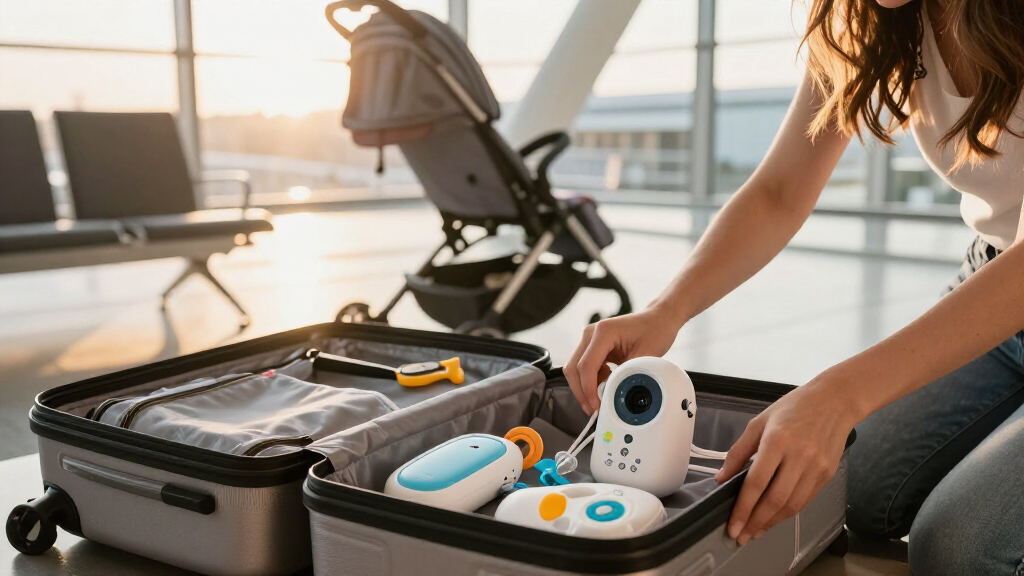
The first step: keep your essential baby tech in your carry-on or personal item. This includes anything that involves batteries, needs during the flight, or is fragile and expensive. Think monitors, pumps, and your tablet.
For example, your portable sound machine or baby monitor should stay with you. They’re small, valuable, and often contain lithium batteries that must stay in the cabin. You’ll need them at your destination, and you don’t want to risk damage in checked luggage.
Heavy or bulky items like car seats or strollers go in checked baggage, unless they’re lightweight and airline-approved for cabin use. But always check your airline’s specific policies ahead of time.
As an affiliate, we earn on qualifying purchases.
Batteries and Power Banks: How to Pack Them Safely
Spare lithium batteries and power banks are the biggest fire risk—damaged or short-circuited cells can ignite. According to airline rules, these must always stay in your carry-on luggage, not checked bags.
Ensure battery terminals are protected: cover them with tape, caps, or keep them in individual plastic sleeves. Never pack swollen, leaking, or recalled batteries. For example, a 10,000mAh power bank with a 37Wh rating is usually fine in carry-on, but check the label.
Most airlines limit batteries to 100Wh. Batteries between 100-160Wh require airline approval, and anything above 160Wh is generally banned. Always verify watt-hour ratings before packing.
Why does this matter? Properly packing batteries reduces the risk of fire hazards during transit, which can have serious safety implications. Overlooking these rules can lead to confiscation, delays, or dangerous situations onboard. The tradeoff is a little extra care and time during packing, but it’s worth it for safety and peace of mind.
As an affiliate, we earn on qualifying purchases.
Feeding Supplies and Medications — Pack Smart for Security
Breast milk, formula, and baby food often get special treatment at security. You can usually carry more than the standard liquid limit—declare these items separately for faster screening.
For instance, a mom with a bottle of breast milk and a jar of pureed fruit will find airport officers more lenient if these are in a clear, insulated bag. Ice packs or gel packs are usually allowed when used to keep items cold, but check local rules.
Why is this important? Proper packing of feeding supplies ensures you don’t have to discard or repack at the last minute, which can cause delays or stress. Using insulated bags and declaring liquids helps security process your items smoothly, reducing the risk of confiscation or rechecking. This proactive approach minimizes last-minute surprises, keeps your baby’s nutrition uninterrupted, and allows you to focus on enjoying your trip rather than dealing with security hassles.
As an affiliate, we earn on qualifying purchases.
Medical Devices and Breast Pumps — Keeping Them Ready and Safe
Breast pumps are considered assistive or medical devices. They often contain rechargeable batteries and need careful packing. Include all parts: pump, tubing, bottles, and chargers. Keep spare valves and membranes handy.
For example, a portable electric pump with a rechargeable battery should be packed in your cabin bag. Remove the battery if the airline requires, and keep it in your hand luggage with terminals protected.
Why does this matter? Proper packing ensures your device remains functional and ready when needed, without risking damage or safety violations. It also prevents delays caused by security checks or airline restrictions. Being prepared means you won’t be caught off guard, especially in situations where quick access to your pump is essential for your comfort and baby’s feeding schedule. Properly packed, these devices minimize the risk of damage, loss, or safety issues, allowing you to focus on your journey with confidence.
smart stroller with app connectivity
As an affiliate, we earn on qualifying purchases.
As an affiliate, we earn on qualifying purchases.
Smart Travel Gear: Strollers, Car Seats, and Batteries
Smart strollers, bassinets, or motorized car seats with batteries introduce extra questions. Always locate the battery label: note voltage, watt-hours, and whether it’s removable.
For example, a smart stroller with an integrated motor and a 20Wh battery should be checked if it’s non-removable. Remove the battery, protect terminals, and carry it separately if required.
Why is this important? Handling smart baby gear properly prevents onboard accidents or device activation during transit, which could cause safety issues or delays. Many airlines require batteries to be removed and carried separately, so understanding your gear’s specifications helps you comply easily. Disabling motors and Bluetooth features minimizes the risk of accidental activation, ensuring a smoother journey for everyone involved. Taking these precautions also helps avoid last-minute surprises or delays at security checkpoints, giving you peace of mind throughout your trip.
Using Baby Tech Onboard Without a Hassle
Carrying devices on the plane doesn’t mean you can use them freely at all times. Devices like monitors or Bluetooth-enabled gadgets often need to be switched to airplane mode and stowed during taxi, takeoff, and landing.
For example, a parent might use a baby monitor during the flight but must turn it off during ascent and descent. Heating devices and sterilizers are usually prohibited in-flight due to safety concerns.
Why is this important? Following airline policies and crew instructions helps ensure safety and avoid potential disruptions. Misusing devices can lead to being asked to turn them off or even confiscation. Planning ahead for device use—such as turning monitors to airplane mode or packing sterilizers properly—reduces stress and ensures compliance. This proactive approach not only keeps everyone safe but also avoids unnecessary delays or conflicts with crew members, making your journey smoother and more comfortable.
Organizing Your Carry-On for Smooth Screening
Organize your carry-on into clear, separate kits: feeding, power, care, entertainment, and delay supplies. This makes security checks faster and reduces stress.
For example, keep all feeding items—bottles, formula, cooling packs—in a dedicated insulated bag. Power kit with cables, power banks, and protected batteries should be together. Label or photograph labels for quick reference if needed.
Why does this matter? Well-organized bags not only speed up screening but also prevent accidental mixing of items, which can cause delays or confusion. Having manuals, prescriptions, and approvals accessible offline ensures you can answer questions confidently, avoiding unnecessary unpacking or delays. Preparing your carry-on this way minimizes stress, helps you respond quickly to security questions, and keeps your essential items within easy reach, making the entire process smoother and less daunting for you and your family.
Avoid These Common Mistakes When Traveling with Baby Tech
Many families trip up by packing power banks in checked luggage or forgetting to declare liquids. Don’t check batteries or essential electronics—keep them with you.
For example, a common mistake is packing a bottle warmer without confirming onboard use. Also, assume “airline approved” means universal acceptance—check your airline’s specific policies.
Why is this important? These mistakes can lead to delays, confiscation, or safety hazards. Packing batteries or electronics improperly can cause fires or security issues, and failing to declare liquids can result in confiscation or delays. Double-checking your gear, understanding the rules, and packing smart minimizes these risks, ensuring a smoother, safer trip for you and your baby.
Latest Trends and What’s Changing for Baby Tech Travelers
Recent years have seen more baby gear with rechargeable batteries, Bluetooth, and motors. Airlines are tightening rules around power banks, smart luggage, and overheating incidents.
Travelers now need to verify battery capacity, removability, and airline approval more carefully. Airport scanners are more advanced, but procedures for liquids and batteries are still inconsistent across airports.
Emerging trends include app-connected monitors, wearable pumps, and tracking tags—each with new safety, privacy, and battery considerations. Staying updated with airline policies and checking the latest regulations close to your departure date is essential to avoid surprises. Understanding these trends helps you navigate the evolving landscape of baby tech travel, ensuring safety, compliance, and peace of mind.
Frequently Asked Questions
Can I bring a power bank for baby devices?
Yes, most airlines allow power banks in carry-on baggage as long as they stay within capacity limits—usually 100Wh or less. Always check the watt-hour rating and pack protected terminals to avoid issues.
Can I put a baby monitor in checked luggage?
It’s better to carry your monitor in your cabin bag. Battery-powered monitors should be switched off and protected from activation. If it contains a lithium battery, follow airline rules for safe packing.
What if my carry-on gets gate-checked?
Remove batteries, medical supplies, feeding gear, and valuables before handing over your bag. Keep these essentials in your personal item under the seat for easy access and safety.
Does a breast pump count as a carry-on?
Many airlines treat breast pumps as medical or assistive devices, so they often qualify as carry-on. Confirm with your airline before traveling, and remove batteries if required.
Are frozen ice packs allowed for baby food?
Yes, ice packs and gel packs are typically permitted when used to keep milk or formula cold. Make sure they are frozen or partially frozen to pass through security more smoothly.
Conclusion
Traveling with baby tech means planning ahead and knowing the rules. Organize your gear, protect your batteries, and keep essentials accessible—this is your best strategy for stress-free airport moments.
Picture this: a calm parent, a well-packed bag, and a smooth security line. That’s the goal. So next time you pack, think about where each item belongs—and enjoy the journey.
NFL season / tailgating Picks
team gear
As an affiliate, we earn on qualifying purchases.