
TL;DR

Turn the school run and nap time into listening time
- Thousands of audiobooks, podcasts and originals
- Listen on your phone, tablet or Echo — also offline
- Cancel anytime
A dehumidifier size calculator guides you to choose the right capacity based on room size, moisture sources, and climate. Proper sizing prevents mold, reduces energy waste, and extends equipment life.
Choosing the right dehumidifier isn’t just about picking a big or small unit. It’s about matching capacity to your space and conditions. A simple calculator acts like a GPS for your humidity needs, guiding you straight to the right size. Without it, you risk mold, dust mites, or wasting money on oversized models.
Think about a basement that’s 1,200 square feet with damp walls. Without proper sizing, you might choose a 30 pint unit, which struggles to keep moisture in check. A calculator helps you avoid that mistake and find the perfect fit—saving energy and preventing problems.
A dehumidifier size calculator uses room size, moisture sources, and climate data to recommend the right capacity in pints per day.
Recent tools incorporate smart sensors and local weather info for more precise sizing advice.
Choosing a capacity too small results in ineffective humidity control, while too large wastes energy.
Compare units based on your room’s size and moisture level — don’t rely on guesswork.
Always interpret the calculator’s recommendation as a starting point, then adjust for your specific conditions.
What exactly does a dehumidifier size calculator do?
At its core, a dehumidifier size calculator translates your room’s specifics into a recommended capacity, usually in pints per day. It considers factors like the room’s size, moisture sources, and climate. For instance, a bathroom with a shower and a window might need a different size than a sealed bedroom.
By inputting details such as square footage, presence of moisture sources, and local humidity, the calculator suggests a capacity that keeps the air comfortable without wasting energy. It’s like a personalized humidity prescription.
Understanding how this works is crucial because choosing a capacity that’s too small means your dehumidifier will struggle to maintain desired humidity levels, leading to persistent dampness and potential mold growth. Conversely, an oversized unit will cycle frequently, wasting energy, causing unnecessary wear, and possibly drying the air too much, which can cause discomfort and static electricity. The calculator’s role is to balance these tradeoffs, helping you find a capacity that’s just right for your specific conditions.
As an affiliate, we earn on qualifying purchases.
How do recent advances make these calculators smarter?
Today’s calculators go beyond simple formulas. They often connect with smart sensors or use local weather data. Imagine a calculator that adjusts your recommendation based on the current humidity in your city—like San Francisco’s 65% average or Houston’s 80%. This dynamic approach improves accuracy.
Some tools even factor in seasonal shifts, moisture from appliances, or ventilation habits. The result? A tailored suggestion that’s more precise than ever, helping you avoid overspending or under-protecting your home.
These innovations matter because humidity levels fluctuate not just daily but seasonally. A static recommendation might lead to under- or over-dehumidifying at different times of the year. By integrating real-time data and smart technology, these calculators enable you to adapt your dehumidifier’s operation, ensuring consistent comfort, energy efficiency, and mold prevention all year round. They help you understand that effective humidity control isn’t just about size—it’s about smart, responsive management.
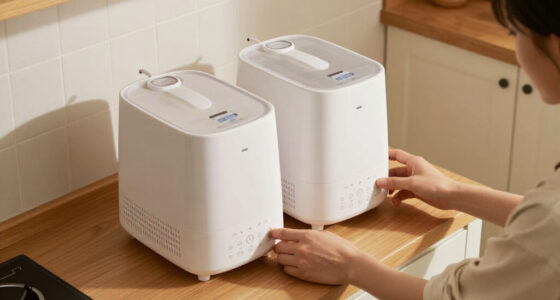
smart dehumidifier with humidity sensor
As an affiliate, we earn on qualifying purchases.
As an affiliate, we earn on qualifying purchases.
How to interpret the calculator’s recommendation — a simple guide
Using a dehumidifier size calculator is straightforward, but understanding the result is key. Let’s say it recommends a 40 pint unit. That means your space needs a unit that can remove 40 pints of moisture daily to keep humidity between 30-50%—the sweet spot for health and comfort.
To make sense of it, consider your space’s size and moisture level. A basement with damp walls may need more than the standard recommendation. Use the calculator as a starting point, then adjust based on your actual conditions.
Here’s a quick step-by-step:
- Enter your room’s square footage.
- Describe moisture sources—kitchen, bathroom, laundry.
- Input your climate zone or local humidity data.
- Review the recommended capacity and compare it to your needs.
- Pick a model that meets or slightly exceeds that capacity for safety margin.
Remember, the recommendation is a guideline, not an absolute. If your space tends to be more humid or damp, consider selecting a unit with a slightly higher capacity. Conversely, if your environment is drier, you might opt for a smaller model. The goal is to find a balance that prevents overworking the unit while ensuring consistent humidity control, which ultimately protects your health and property.
As an affiliate, we earn on qualifying purchases.
Comparison: 30, 40, and 50 pint dehumidifiers — which is right for you?
| Pint Capacity | Ideal For | Room Size | Moisture Level |
|---|---|---|---|
| 30 pints | Small rooms, minimal moisture | Up to 300 sq ft | Light to moderate humidity |
| 40 pints | Medium-sized spaces, moderate moisture | 300-600 sq ft | Average humidity with some moisture sources |
| 50 pints | Larger spaces, high moisture | 600-1000+ sq ft | High humidity, damp environments |
Choosing the right capacity depends on your room size and moisture level. For example, a damp basement of 900 sq ft might need a 50 pint unit, which can handle higher moisture loads efficiently. Meanwhile, a small bedroom of 200 sq ft with minimal dampness could be effectively managed with a 30 pint model, conserving energy and reducing operational costs. Recognizing these tradeoffs helps prevent under- or over-sizing, which can lead to ineffective humidity control or unnecessary energy consumption, respectively. Proper matching ensures your space stays comfortable, healthy, and energy-efficient.
energy-efficient dehumidifier for large rooms
As an affiliate, we earn on qualifying purchases.
As an affiliate, we earn on qualifying purchases.
What happens if I pick the wrong size?
If you go too small, your dehumidifier might run constantly without reaching the target humidity—think of it as trying to fill a bathtub with a tiny faucet. It wastes energy and leaves you with damp or mold-prone air. Over time, this persistent dampness can lead to mold growth, dust mites, and other health issues, especially in poorly ventilated spaces. The continuous operation also strains the unit, increasing wear and reducing lifespan.
Opt for too large, and you’ll spend more on energy bills than necessary. Oversized units can dry out the air excessively, leading to discomfort, static electricity, and potential damage to furniture and electronics. Frequent cycling caused by overcapacity not only wastes energy but also accelerates component wear, leading to more frequent repairs or replacements. The tradeoff here is between immediate cost savings versus long-term efficiency and health implications. A size calculator helps you navigate these tradeoffs by guiding you toward a capacity that balances effectiveness with energy efficiency, ultimately protecting your investment and your well-being.
Frequently Asked Questions
Can I use a smaller dehumidifier than the calculator recommends?
It’s possible, but not ideal. Smaller units may struggle to control humidity in damp spaces, leading to mold or musty smells. This can result in ongoing issues that are hard to resolve later. Using a smaller unit might also cause it to run constantly without effectively reducing moisture, which can increase energy costs and wear on the device. Considering the calculator’s recommendation ensures you select a capacity that effectively manages your space’s humidity, balancing efficiency and performance.
How often should I run my dehumidifier once it’s the right size?
Run it until the room’s humidity stabilizes between 30-50%. This typically involves several hours daily, especially during humid seasons or in damp areas. Continuous operation isn’t always necessary if your space reaches and maintains the desired humidity level. Using a hygrometer to monitor the actual moisture levels helps you fine-tune operation times, saving energy and extending your dehumidifier’s lifespan. Properly sized units may require less frequent cycling, but regular checks ensure optimal performance.
Are online calculators accurate for basement or large open areas?
They provide useful estimates based on standard assumptions, but large or complex spaces like basements or open-plan areas often have unique factors—such as insulation quality, ventilation, and specific moisture sources—that can affect the actual capacity needed. For these spaces, online calculators serve as a helpful starting point, but consulting with a professional or performing detailed assessments can ensure you select a unit that truly meets your needs. Proper evaluation of these factors helps prevent under- or over-sizing, ensuring effective humidity control and energy efficiency.
What should I do if my room’s humidity varies seasonally?
Use the calculator to establish a baseline capacity for your space, then adjust your dehumidifier’s settings or upgrade to a slightly larger or more powerful model for peak moisture times. Seasonal variations—like increased humidity in summer—may require more capacity or different operational strategies. Installing a unit with adjustable humidity settings gives you flexibility to respond to changing conditions. Regular monitoring with a hygrometer allows you to fine-tune performance, ensuring your space remains comfortable and protected year-round without unnecessary energy expenditure.
Conclusion
Getting your dehumidifier size right isn’t about guessing or buying the biggest unit. It’s about matching capacity to your space’s needs — preventing mold, saving energy, and staying comfortable.
Think of the calculator as your humidity map. Use it, then trust your judgment to fine-tune your choice. Your home will thank you with fresher air and fewer worries.
Dehumidifier Size Calculator
Estimate daily pint capacity from room size and how damp the space feels.
Your room likely starts in the 20 to 30 pint range. Compare compact dehumidifiers for smaller spaces.
See compact dehumidifier matchesYour room points to a 35 to 40 pint unit. Compare mid-size dehumidifiers and check drainage options.
See mid-size dehumidifier matchesYour conditions call for a 50 pint or larger unit. Compare larger dehumidifiers and confirm room moisture sources.
See larger dehumidifier matchesEstimate only. Check product specs, local rates, and site conditions before buying or planning around these numbers.
Halloween Picks
halloween
As an affiliate, we earn on qualifying purchases.