
TL;DR

Turn the school run and nap time into listening time
- Thousands of audiobooks, podcasts and originals
- Listen on your phone, tablet or Echo — also offline
- Cancel anytime
Descaling removes mineral deposits, often called limescale, from a humidifier; it does not disinfect the unit. Check your model’s manual, use only an approved method such as white vinegar or citric acid on approved removable parts, rinse and dry thoroughly, and descale when deposits appear or the manufacturer’s schedule calls for it.
Descaling removes mineral limescale; it does not disinfect a humidifier or replace its regular cleaning routine.
Check the manual before using white vinegar or citric acid, and treat only the parts the maker approves.
Unplug the unit, keep acid away from the motor and electrical base, then rinse and dry thoroughly before reuse.
Descale when you find mineral deposits or when the manufacturer’s instructions call for it; timing varies with water hardness and use.
Distilled or demineralized water may reduce scale and ultrasonic white dust, but it does not eliminate cleaning.
HOME CARE FIELD GUIDE · HUMIDIFIER MAINTENANCE
Descaling a Humidifier: Vinegar, Citric Acid and How Often
That chalky ring is mineral scale left behind as water evaporates. Remove it with a method approved for your model, then rinse and dry thoroughly. Descaling handles deposits; regular cleaning handles a different job.
THE KEY INSIGHT
There is no universal descaling interval.
Water hardness, run time, and model design all affect how quickly deposits appear. Let the manual and visible scale guide timing.One device, two different maintenance jobs
Minerals in water remain when it evaporates, leaving a pale, chalky or tan film on a tank, tray, or other approved part. Scale may affect water flow or mist output, but a clean-looking surface does not prove the unit is free of microbes.
01 · DESCALING
Loosen mineral buildup
Removes limescale from surfaces that contact water. Treat only the parts and materials the manufacturer permits.
02 · ROUTINE CLEANING
Empty, dry, clean
Follow the manual’s routine care steps. Standing water can support microbial growth, even when the tank looks shiny.
03 · DISINFECTION
Use the specified procedure
Scale removal does not reliably kill germs. Disinfection is a separate task and does not necessarily dissolve scale.
Vinegar or citric acid?
Both can loosen mineral deposits. The better choice is the one your humidifier’s instructions approve for the specific removable part.
| Option | What it offers | What to check |
|---|---|---|
| White vinegar | Common and inexpensive; acetic acid can loosen scale. | Check compatibility. Odor may linger, and some metals, coatings, seals, or components may not tolerate it. |
| Citric acid | Dissolves mineral deposits and often leaves less lingering odor. | Use approved concentration. Rinse thoroughly; stronger is not automatically safer or more effective. |
| Distilled or demineralized water | May reduce scale buildup and ultrasonic “white dust.” | Still clean regularly. Lower mineral content does not remove the need for maintenance. |
Safe descaling, step by step
The manual sets the permitted cleaner, concentration, contact time, and drying instructions. Don’t adapt a generic recipe or assume a longer soak is harmless.
Confirm which parts are removable and which treatment the maker permits.
Empty the unit. Keep liquid away from the electrical base and motor.
Use one approved method on specified parts, at the stated strength and time.
Rinse thoroughly and dry as directed before reassembling or using.
Check for leftover scale, damage, or cleaner odor. Ask the maker if unsure.
How often should you descale?
Use inspection and the manufacturer’s schedule instead of a universal calendar interval. Some makers specify weekly cleaning or more frequent maintenance; descaling timing varies by model and household.
What changes the pace of buildup?
Water hardness: harder water can leave more minerals behind.
How often it runs: frequent operation means more water evaporates through the unit.
Model and conditions: design and warm indoor conditions can affect buildup.
Inspect regularly. Visible deposits, reduced mist output, or unusual noise are cues to check the manual and the affected parts.
Keep the care sequence clear
Treat scale, routine hygiene, and safe operation as connected but distinct checks.
Know what descaling removes—and what it leaves behind
Descaling a humidifier removes mineral deposits—often called limescale—from surfaces that contact water. It does not reliably kill germs, and it does not replace the cleaning or disinfection steps in your manual. These are separate jobs, like wiping crumbs off a counter and then washing it: one does not automatically do the other.
Minerals in tap water remain behind when water evaporates. Over time, they can form a chalky white or tan film on a tank, tray, or other approved removable part. For instance, you may spot a rough ring near the water line after running the unit nightly for a couple of weeks. That ring is a cue to inspect the manual and the affected parts. It matters because scale can accumulate where water flows or mist is produced, potentially affecting performance, but its appearance alone cannot tell you whether the unit is clean or safe from microbes.
Why make the distinction? A humidifier holds water, and standing water can support microbial growth. Removing scale alone is not a complete hygiene routine. Emptying, drying, and cleaning the unit as directed still matter, even if the tank looks shiny after descaling. A bright, scale-free surface can create a false sense of completion if the unit’s cleaning steps have been skipped.
Scale removal and disinfection solve different problems. A parent who sees residue at Sunday’s refill can plan a manual-approved descaling treatment, then do the scheduled cleaning separately. Don’t assume a product that tackles one task handles the other. Keeping the tasks distinct helps you choose the right treatment and avoid applying an acid where a separate cleaner or procedure is required.
Popular right now

Vitamix Propel Series 750 Professional-Grade Blender, 4 Programs, Black

Shark PowerDetect Corded Stick Vacuum, Self-Cleaning (Eggplant, HZ4002)

Apple AirPods Pro 3 Wireless Earbuds with Active Noise Cancellation
As an affiliate, we earn on qualifying purchases.
Choose vinegar or citric acid by checking your model first
White vinegar and citric acid can loosen mineral deposits, but the humidifier’s instructions decide which option is suitable for your unit. Materials and designs vary, so an acid that works on one model may harm a seal, coating, or metal part on another. The manual wins over a general household tip. This is why there is no useful universal recipe: the same liquid and soak time can be acceptable for one removable tank and unsuitable for another component.
| Option | What it offers | What to check |
|---|---|---|
| White vinegar | Common, inexpensive, and its acetic acid can loosen scale. | Odor may linger; some metals, coatings, seals, or components may not tolerate it. |
| Citric acid | Dissolves mineral deposits and often leaves less lingering odor. | Use only a manufacturer-approved concentration and rinse thoroughly. |
Imagine you are cleaning the tank while a baby naps nearby. Vinegar may be easy to find, but its sharp, sour smell can linger; citric acid may smell milder, but a stronger mix is not automatically better or safer. Follow the product’s stated method and concentration, and use just one approved treatment at a time. Choosing a method also involves a practical tradeoff: a familiar household product may be convenient, while a lower-odor option may be more comfortable, but neither advantage outweighs material compatibility or the need to rinse completely.
If the manual names neither acid, check the manufacturer’s care advice before trying one. Don’t combine vinegar and citric acid for extra effect, and never mix either one with bleach or another disinfectant. A household sink is not a chemistry experiment: mixed cleaners can create harmful gases or other hazards. Using one product at a time also makes it easier to understand what caused an odor, residue, or surface change if something seems wrong.
Follow these steps to descale removable parts safely
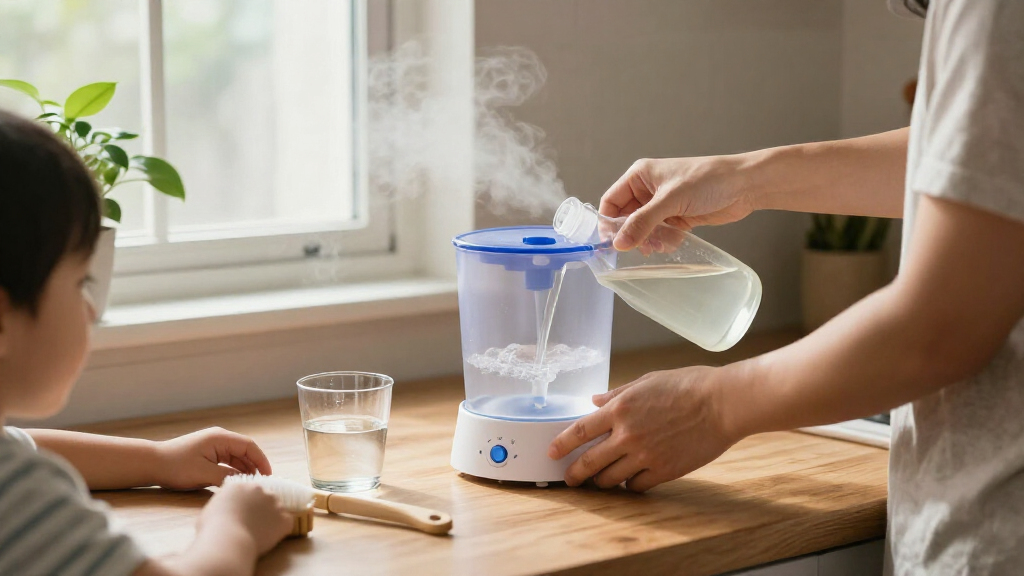
To descale safely, unplug the humidifier, treat only parts the manual identifies, and rinse them thoroughly before reuse. The maker’s instructions set the permitted cleaner, concentration, and contact time. If they call for a different method, follow that method rather than adapting a generic recipe. These limits protect parts that may look sturdy but contain seals, coatings, or electrical components that are not designed for acid exposure.
- Read the manual. Check which parts can be descaled and whether it permits vinegar, citric acid, or another method. A tank and tray may be removable while the base needs a dry wipe only. This step prevents a treatment meant for a washable part from reaching the motor or damaging a surface.
- Unplug and empty the unit. Disconnect power before handling water. Keep acids away from electrical parts and the motor. Unplugging also prevents the humidifier from being switched on accidentally while a cleaning liquid is present.
- Apply the approved method. Treat only the specified removable parts, using the stated concentration and soak time. Don’t guess that a longer soak is harmless. More time or a stronger mixture may increase contact with vulnerable materials without meaningfully improving the result.
- Rinse and dry as directed. Rinse thoroughly, since leftover cleaner could be dispersed into the air or irritate users. Let parts dry as your manual instructs before putting the unit back together. Rinsing removes treatment residue; drying also reduces the time water sits in the device before its next use.
- Inspect before running it. Check for remaining deposits, damage, or a cleaner smell. If scale remains, repeat only an approved treatment or contact the manufacturer. This check helps distinguish an incomplete treatment from a damaged part or a separate performance problem.
For example, if the manual says the tank may soak but the base must not get wet, remove the tank and treat it at the sink while the base stays unplugged and dry. Never immerse the base unless the maker explicitly allows it. Don’t scrape stubborn scale with a knife or other sharp tool; scratches can damage surfaces and give residue places to collect. A patient, approved treatment protects the surface you will need to clean again.
Let the buildup—not a universal calendar—set the timing
There is no single descaling schedule for every humidifier. How quickly scale appears depends on the model, your water’s mineral content, and how often the unit runs. Follow the manufacturer’s schedule where one exists, and inspect the water-contact surfaces regularly for deposits. A fixed interval could lead one household to descale unnecessarily while another misses buildup that develops sooner.
In a home with hard tap water, a humidifier that runs every night may develop a pale crust faster than an occasional-use unit supplied with distilled water. Visible deposits, reduced output, or a new rattling noise can all prompt an inspection; they do not prove that scale is the only cause. If you see buildup, check the manual before choosing a treatment. The distinction matters because symptoms can have more than one cause, and an acid soak will not repair a blocked opening or worn part.
Some manufacturers call for weekly cleaning or other frequent upkeep. That does not mean every model needs weekly descaling: cleaning and scale removal are different tasks, and the right interval depends on the unit and water. A calendar reminder can help you inspect, but don’t treat a guessed schedule as a safety standard. Inspection gives you a chance to respond to actual conditions while still meeting the manual’s required care schedule.
Try a simple routine: when you empty the tank for the cleaning schedule in your manual, look for rough patches or a white ring. For instance, if you spot fresh scale after several nights of use, check whether your manual recommends descaling and whether your water choice may be contributing. A reminder to inspect is more useful than blindly repeating an acid soak. If deposits appear repeatedly, that pattern can help you decide whether an approved lower-mineral water option is practical.
Reduce mineral residue with a water choice that fits your unit
Distilled or demineralized water can reduce scale buildup, though it does not remove the need to clean the humidifier. It may also reduce white dust from ultrasonic models. These units use high-frequency vibration to create fine mist, and minerals from tap water can travel with that mist and settle as a powder on nearby surfaces. Reducing minerals can address both the residue on the unit and visible dust in the room, but it does not change the need to care for water-contact parts.
If you find a faint white film on the dresser beneath the humidifier, the water may be part of the story. Check whether the manufacturer allows distilled or demineralized water, or recommends a compatible demineralization cartridge. Such features can help with mineral residue, but they do not replace emptying, drying, and cleaning the unit according to its instructions. The dust is a useful clue about mineral carryover, not a reliable measure of whether the inside of the humidifier needs cleaning.
Water choice has a practical tradeoff: distilled water may mean more trips to the store or extra cost, while tap water can leave scale sooner in a hard-water area. The right choice depends on the model and your household routine. There is no need to buy a special water product just because its label promises easier care if your manual does not support using it. Weighing convenience against how quickly deposits return can help you choose a routine you can maintain.
For example, if an ultrasonic unit leaves dust on a dark nightstand, test an approved lower-mineral water option and see whether the film decreases. Keep checking the unit itself, since a clean-looking room does not tell you whether its tank and internal water-contact parts need care. If the dust changes but deposits remain inside, continue following the manufacturer’s cleaning and descaling directions.
Keep nursery use steady with a clear care routine
Humidifier care for a nursery starts with the manual and a regular empty, dry, and clean routine. Descaling fits into that routine when minerals build up; it is not a substitute for everyday care or pediatric advice. If you are using a humidifier for an infant, follow your pediatrician’s guidance about whether and how to use one. Clear separation between routine care and descaling makes it less likely that a visible mineral ring will distract from other upkeep the device needs.
At the end of a night, leftover water can sit in the tank until the next bedtime. Emptying and drying the parts as directed helps avoid leaving standing water in the device. Then, when you see a rough mineral line, use the approved descaling steps rather than pouring acid into a full tank and switching the machine on. Running an acid mixture could expose internal components and disperse cleaner into the air, while treating removable parts lets you control where the solution goes.
Never run the humidifier with vinegar or citric acid unless the manufacturer specifically instructs you to do so. The liquid could reach components or be dispersed into the air. Unplugging the unit and treating only approved removable parts keeps the cleaning task separate from operation. This separation also gives the cleaner time to work without exposing the room to mist made from a descaling solution.
Think of the routine like washing a bottle: the cleaner’s job is only one part of the process, and a good rinse matters. If a sour smell remains after treatment, keep rinsing as directed and don’t restart the humidifier until the parts are ready for use. When instructions are unclear, contact the manufacturer rather than improvising around a sleeping baby. A routine that is easy to repeat can make care more consistent, especially when nursery tasks compete for attention.
Troubleshoot stubborn scale without damaging the humidifier
If scale will not come off, repeat only a treatment the manufacturer approves or ask the manufacturer for help. Stronger acid, longer soaking, and rough scraping can damage a part without solving the underlying problem. Mineral crust may be stubborn, but the unit’s materials still set the limits. Damage can make a part harder to clean or compromise a surface that holds water, so persistence should not mean increasing the treatment beyond what the maker permits.
For instance, a white patch remains on a tray after the approved soak. Don’t attack it with a knife, steel wool, or abrasive powder; a scratch can hold residue and may make the surface harder to clean. Check the directions for a second treatment or a recommended replacement part instead. If the instructions offer no next step, the manufacturer can advise whether the mark is scale, a material change, or a reason to replace the part.
Also pay attention to symptoms beyond visible scale. Lower mist output or new noise might be related to mineral buildup, but could also point to a blocked opening, a worn component, or another issue. If approved cleaning does not help, stop experimenting and consult the manual or customer support. Treating every symptom as scale can delay attention to a mechanical problem, while an inspection keeps the response matched to the likely cause.
Use one cleaner at a time, and rinse fully between treatments. Vinegar and citric acid do not need to be combined, and neither should be mixed with bleach or another disinfectant. That shortcut offers no useful descaling advantage and can create a chemical hazard. A slow, model-approved approach is easier to repeat safely than trying a stronger kitchen-counter formula. It also makes it clearer whether the approved treatment worked before you decide to contact support.
Frequently Asked Questions
Can I use white vinegar to descale my humidifier?
Often, but only when your model’s instructions permit it. Apply it only to the approved removable parts, then rinse and dry them as directed. Vinegar’s smell can linger, and some metals, coatings, seals, or components may not tolerate it.
Is citric acid better than vinegar?
Neither is universally better. Citric acid can dissolve mineral deposits and may leave less odor, while vinegar is common and inexpensive. Your humidifier’s approved method, concentration, and material compatibility matter more than a general ranking.
How often should I descale my humidifier?
It depends on the model, your water, and how often the unit runs. Follow the manufacturer’s schedule and inspect for deposits during routine care. Hard water and frequent use can lead to faster buildup, but there is no universal interval.
Does descaling disinfect the humidifier?
No. Descaling loosens mineral deposits; it does not reliably kill germs. Emptying, drying, cleaning, and any disinfection step are separate tasks. Follow the manual for each one, and never mix acids with bleach or other cleaners.
Can I put vinegar in the tank and run the humidifier?
Do not run it with vinegar or citric acid unless the manufacturer specifically instructs you to. Unplug the unit and treat only approved removable parts. Rinse thoroughly before the humidifier runs again.
Why is my ultrasonic humidifier leaving white dust?
Minerals from tap water can be carried into the air as an ultrasonic humidifier makes mist. Distilled or demineralized water, or a compatible demineralization cartridge, may reduce the dust. Check your model’s instructions, and keep up with cleaning even if the dust goes away.