
TL;DR

Turn the school run and nap time into listening time
- Thousands of audiobooks, podcasts and originals
- Listen on your phone, tablet or Echo — also offline
- Cancel anytime
Begin with the bassinet’s lowest motion setting. Most smart bassinets auto-escalate in response to crying, mimicking gentle womb movements. This approach balances comfort with safety and helps avoid overstimulation.
When you unbox a smart bassinet in the dead of night, the first instinct is to make sure your baby is both soothed and safe. But how much motion is enough? How much is too much? These questions flood your mind as you hold a tiny bundle, ears attuned to every squeak and sigh. The good news? Starting low—really low—sets the stage for a peaceful, safe sleep routine. Understanding how these devices respond and adapt can make all the difference in those early weeks.
This guide walks you through the best starting point for motion levels, why gentle rocking matters, and how to manage escalation without fuss. Because when it comes to your baby’s sleep, a calm, confident approach makes all the difference.
Always start with the lowest motion setting on your smart bassinet to mimic womb-like comfort.
Let the device’s auto-escalation respond to crying—manual increases are usually unnecessary early on.
Understand the escalation levels: from gentle sway to more vigorous bouncing—use them only if needed.
Safety isn’t just about motion; ensure your sleep environment is flat, firm, and free of loose items.
Adjust settings gradually as your baby grows, and transition to crib sleep when ready, using weaning modes.
Newborn Sleep · Smart Nursery Guide
Smart Bassinet Motion Levels: Which Setting to Start With
It’s 2 a.m., the box is open, and the app is asking you to pick a motion level. The answer is simpler than the anxiety: begin at the lowest setting and let the bassinet’s cry-response logic do the work. Gentle, womb-like rhythm is the baseline — not the exception.
The Starting Rule
Level 1
Always begin at baseline. Subtle sway taps the calming reflex — the “swing” in the 5 S’s framework.
Escalation Ladder
4 Steps
Devices step up through levels in response to crying, then back down. Built for settling, not all-night use.
Usage Window
~6 Mo
Rated to roughly 6 months, ~25 lb, or until pushing up / rolling — whichever comes first.
1st
Setting to choose: the lowest baseline level
5min
Wait before judging — let auto-response escalate
2022
Safe Sleep for Babies Act banned inclined sleepers
2023
FDA De Novo authorization for SNOO supine system
Step-by-Step
Choosing the Right Starting Level: A Simple 3-Step Guide
The initial setting is a starting point, not a permanent solution. Most smart bassinets are designed to escalate in response to crying, so manual adjustments are usually unnecessary early on. Your job is to observe your baby’s cues.
Set the Baseline Level
Most smart bassinets have a dedicated ‘start’ or ‘low’ setting — use that. Gentle, rhythmic motion activates the calming reflex, like a soft rocking hug that soothes without overwhelming.
Watch the Response
If your baby settles quickly, stay there. If they fuss or cry, wait a few minutes and let the auto-response escalate naturally. Sometimes patience with gentle motion is all they need.
Fine-Tune Only If Needed
Seems overstimulated or fussier? Lower the motion or pause escalation temporarily. Still unsettled after several minutes? Consider a gentle increase or a different setting.
The Escalation Ladder
Four Levels, One Goal: Settle, Then Back Off
Devices like SNOO, Cradlewise, and Halo BassiNest climb these levels automatically in response to crying, mimicking the soothing motion of the womb — then gently back off once the baby settles. Moving up too quickly can overwhelm; staying too low may under-soothe an alert baby.
| Level | Motion Intensity | When It’s Used |
|---|---|---|
| 1BaselineStart Here | Very gentle, almost like a soft sway | Ideal for newborns and light fussing — your everyday sleep setting |
| 2Level 2 | Moderate rhythm, more noticeable | When baby shows signs of fussiness after initial settling |
| 3Level 3 | Vigorous, similar to a bouncing motion | For stubborn fussiness or after crying persists |
| 4Level 4Temporary Only | Strongest setting, like bouncing on a firm cushion | Use only if necessary — and usually only temporarily |
Safety First
Rocking Is Not Shaking — and the Rules Still Govern
Smart bassinets deliver gentle, low-amplitude, head-supported movement — calibrated to mimic natural rocking, not jarring or jostling. Approved devices are tested to strict standards and sit well within safe limits.
“Motion will shake my baby’s brain”
A common 2 a.m. worry. But bassinet motion does not resemble the forces involved in shaken baby syndrome — it’s a gentle breeze, not a jolt.
Low-amplitude, womb-like rhythm
Carefully calibrated movement that mimics natural rocking or bouncing, known to promote sleep without posing safety risks.
Flat, Firm & Non-Inclined
The AAP (2022 update) requires a flat, firm, non-inclined surface, baby on back, no loose items. Motion itself is not a hazard on a compliant flat bassinet. Inclined sleepers like the Rock ‘n Play were recalled (2019) and outlawed by the Safe Sleep for Babies Act (Nov 2022).
A Tightened Federal Standard
The CPSC’s Infant Sleep Products rule (16 CFR 1236, effective 2022) requires any product marketed for infant sleep to meet the bassinet standard — framing flat smart bassinets as the compliant category.
SNOO’s Supine Authorization
SNOO became the first bassinet FDA-authorized as an “infant supine sleep system” for keeping sleeping babies safely on their backs via its clip-in swaddle — a positioning claim, not a claim of preventing SIDS.
White Noise Pairs With Motion
Most smart bassinets couple sound with motion. A 2014 Pediatrics study found some infant sleep machines exceed recommended noise levels — keep volume low-to-moderate and the source away from baby’s head.
Adapting Over Time
When and How to Adjust as Your Baby Grows
Around 3 to 4 months, sleep patterns shift — the gentle sway that once worked may stop calming. Adjustments aren’t always about turning up the volume: sometimes reducing motion or switching to sound-only mode helps, especially during teething or fussy spells.
Designed to Be Faded
SNOO’s weaning mode keeps motion at a low, consistent level while sound stays responsive — easing the crib transition around 5–6 months. Motion is meant to fade, not become permanent.
When Motion Is No Longer Right
If your baby starts to push up or show rolling signs, they’re becoming more mobile — the bassinet’s motion may no longer be appropriate. Swaddling stops at the first signs of rolling.
Not Every Baby Is a Rocker
If escalating motion worsens crying, drop back to baseline or try stillness with sound only. Watch for dependency cues and trust your baby’s individual temperament.
The Calm Night Chain
From Unboxing to Crib: One Confident Path
Key Takeaways
Five Things to Remember at 2 A.M.
Always start with the lowest motion setting to mimic womb-like comfort and avoid overstimulation.
Let auto-escalation respond to crying — manual increases are usually unnecessary early on.
Understand the escalation ladder — from gentle sway to vigorous bounce — and use higher levels only if needed.
Safety isn’t just about motion — keep the sleep environment flat, firm, and free of loose items.
Adjust gradually as your baby grows, then transition to crib sleep using built-in weaning modes.
Key insight: gentle, rhythmic, in-utero-like motion activates the calming reflex without risking overstimulation or dependency — especially when you start at the lowest setting.
Why Starting Low Sets Your Baby Up for Better Sleep
Smart bassinets mimic the gentle, rhythmic movements babies are used to in the womb. Starting at the lowest setting taps into that familiar sense of comfort. It’s like a soft, rocking hug that soothes without overwhelming. For example, a newborn’s natural response is to settle faster when the motion is subtle, almost like a gentle sway you might do in a rocking chair.
Most devices, like the SNOO or 4moms mamaRoo, are designed to start with a gentle baseline. This isn’t just safety advice; it’s backed by research. According to an anonymous researcher, gentle rhythmic motion activates the calming reflex—think of it as a baby’s internal switch for feeling secure and sleepy.
Starting low also prevents overstimulation, which can backfire. If the motion is too vigorous from the get-go, your baby might cry harder or become more alert instead of drifting off. Think of it like tuning a musical instrument—less is more at first. This careful approach helps avoid overstimulation, which can lead to difficulty in falling asleep or even cause your baby to become conditioned to only sleep with high levels of motion, making future transitions more challenging.
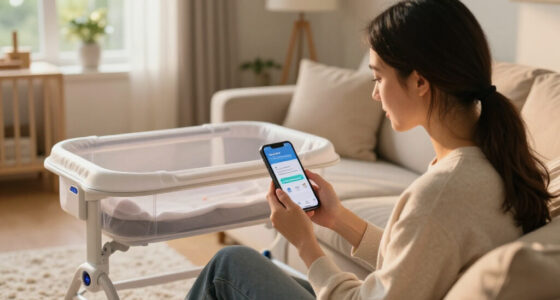
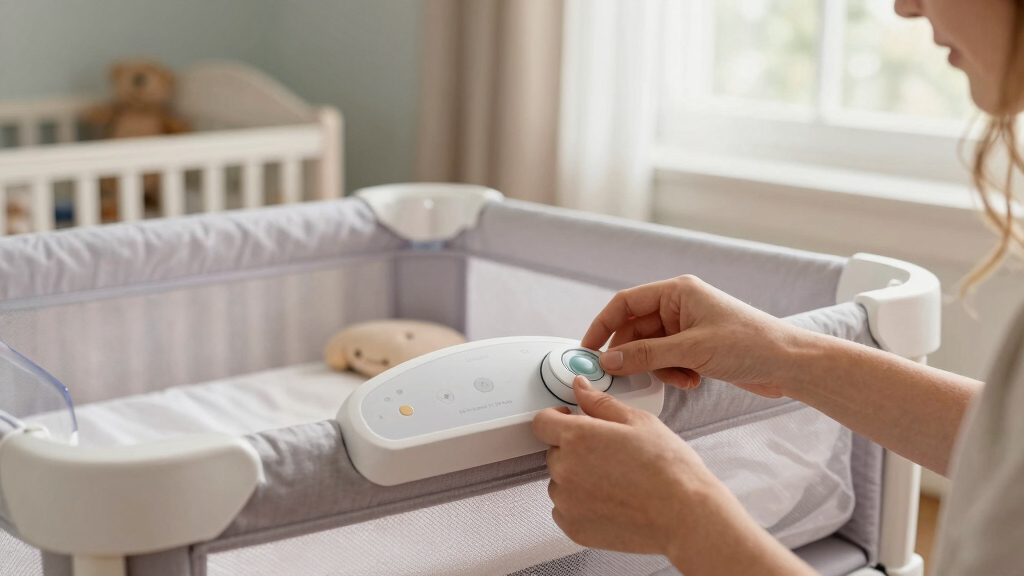
smart bassinet with motion settings
As an affiliate, we earn on qualifying purchases.
As an affiliate, we earn on qualifying purchases.
How to Choose the Right Starting Level — A Simple 3-Step Guide
- Set the bassinet to the lowest (baseline) level. Most smart bassinets have a dedicated ‘start’ or ‘low’ setting—use that.
- Observe your baby’s response. If they settle quickly, stay there. If they fuss or cry, wait a few minutes and let the auto-response escalate naturally.
- Adjust if needed. If your baby seems overstimulated or fussy, lower the motion or turn off escalation temporarily. If they’re still fussy after a few minutes, consider increasing gently or trying a different setting.
For example, if your baby fusses at the lowest setting after five minutes, keep it there for a while longer—sometimes, patience with gentle motion is all they need. Remember, most smart bassinets are designed to escalate in response to crying, so manual adjustments are usually unnecessary early on. The key here is understanding that the initial setting should be a starting point, not a permanent solution, and that observing your baby’s cues is essential for fine-tuning comfort and safety.
As an affiliate, we earn on qualifying purchases.
Understanding the Escalation Ladder — Why It Matters
| Level | Motion Intensity | When It’s Used |
|---|---|---|
| Baseline (Level 1) | Very gentle, almost like a soft sway | Start here; ideal for newborns and light fussing |
| Level 2 | Moderate rhythm, more noticeable | When baby shows signs of fussiness after initial settling |
| Level 3 | Vigorous, similar to a bouncing motion | For stubborn fussiness or after crying persists |
| Level 4 | Strongest setting, akin to bouncing on a firm cushion | Use only if necessary, and usually only temporarily |
Most smart bassinets, like the Cradlewise or Halo BassiNest, escalate through these levels automatically in response to crying. The goal? Mimic the soothing motion of the womb, then gently back off once the baby settles.
Understanding the escalation levels is crucial because it allows you to balance soothing with overstimulation prevention. Moving too quickly up the levels can cause your baby to become overwhelmed, leading to increased fussiness and difficulty settling. Conversely, staying too long at a low level might mean the device isn’t providing enough stimulation to comfort a fussy or more alert baby. Recognizing when and why to escalate helps in fine-tuning the sleep environment, ensuring the motion supports sleep without crossing into overstimulation territory.
As an affiliate, we earn on qualifying purchases.
Safety First: What You Need to Know About Motion and Sleep Safety
Parents often worry: does motion shake the baby’s brain? The answer is a reassuring no. Smart bassinets deliver gentle, low-amplitude movements designed to be safe. Think of it like a gentle breeze—nothing jarring or jostling. These movements are carefully calibrated to mimic natural rocking or bouncing, which are known to promote sleep without posing safety risks.
Safety experts emphasize that the motion on approved devices is well within safe limits. These devices are tested to meet strict standards, and their movements mimic natural rocking or bouncing, not shaking or bouncing in a swing. Understanding these distinctions is critical because inappropriate or overly vigorous motion can increase the risk of injury or sleep disturbances. Therefore, always adhere to manufacturer guidelines and ensure the sleep environment remains flat, firm, and free of loose items.
Remember, all sleep surfaces should be flat, firm, and placed on a safe surface. The American Academy of Pediatrics (AAP) notes that safe sleep involves a flat, non-inclined surface, and smart bassinets meet these criteria when used properly. Inclined sleepers, like the old Rock ‘n Play, are now banned for safety reasons.
So, gentle motion paired with a safe sleep environment is perfectly fine—just stay within manufacturer guidelines. This balance ensures your baby benefits from soothing motion without compromising safety or sleep quality.
As an affiliate, we earn on qualifying purchases.
When and How to Adjust Settings as Your Baby Grows
As your baby reaches 3 to 4 months, their sleep patterns and preferences change. You might find that the initial gentle sway no longer calms them effectively. That’s when you consider adjusting the levels. Recognizing these shifts and adapting the settings is vital because a one-size-fits-all approach can lead to sleep difficulties or dependency.
For example, if your baby starts to push up or roll, it’s a sign they’re becoming more active and mobile, and the bassinet’s motion might no longer be appropriate. Many devices, like the SNOO, include a ‘weaning’ mode that keeps motion at a low, consistent level—helping transition to a crib smoothly without abrupt changes that could disturb sleep patterns.
Adjustments aren’t always about turning up the volume. Sometimes, reducing motion or switching to sound-only mode helps when your baby is fussier or teething. These changes can prevent overstimulation, which often leads to longer settling times or disrupted sleep. It’s also important to watch for signs of dependency—if your baby refuses to sleep without motion, it may be time to gradually phase out the device’s assistance.
Follow your pediatrician’s advice on milestones and sleep safety. Transitioning gradually, with patience and observation, minimizes stress and helps your baby adapt comfortably to new sleep routines. Recognizing when to modify settings ensures that the device remains a helpful tool rather than a crutch that hinders independent sleep development.
Real-World Example: How One Parent Nailed the Starting Level
Emily unboxed her SNOO at 2 weeks old, feeling nervous about overdoing it. She set the motion to the lowest level immediately. Her baby, Lily, responded with soft, contented sighs and quickly drifted off. When Lily fussed after a few minutes, the bassinet’s auto-escalation gently increased the motion, calming her without a fuss. Emily paid close attention to Lily’s reactions—if she seemed overstimulated, she’d turn the motion down temporarily. Over a week, Lily learned to settle with the gentle baseline, and Emily felt confident that she was starting on the right foot.
This real-world scenario shows how starting low and observing responses builds trust and comfort for both parent and baby. It also highlights the importance of patience and responsiveness—adjusting as needed based on your baby’s cues ensures both safety and effective soothing.
Frequently Asked Questions
Should I always start with the lowest setting for my newborn?
Yes, starting at the lowest setting is safest and most natural for newborns. It mimics the gentle movements they are used to in the womb and prevents overstimulation. The device’s auto-escalation will handle the rest based on crying cues.Is it safe for my baby if the bassinet escalates to higher levels?
Absolutely, as long as the device is approved and used as directed. The motion is designed to be gentle, similar to bouncing on a soft cushion, and should never cause harm. Always follow safety guidelines and keep the sleep environment flat and firm.When should I start to reduce or stop motion altogether?
When your baby begins pushing up or rolling, usually around 4-6 months, it’s time to transition away from motion-based sleep aids. Many bassinets offer a weaning mode that keeps sound but reduces motion, easing the switch to a crib.Can I manually change the motion level instead of waiting for the auto-response?
While you can, it’s best to let the device respond automatically. Manual adjustments can interfere with the calming reflex and lead to dependency. Use manual changes sparingly, mainly if your baby reacts negatively to escalation.Conclusion
Starting slow isn’t just a good idea—it’s the safest, most effective way to help your baby settle. Remember, these devices are designed to respond, not to replace gentle human touch. Trust the process, watch your baby’s cues, and let the bassinet’s auto-response do the heavy lifting.
In the quiet moments of the night, that gentle, rhythmic motion can be the bridge to peaceful sleep—yours and theirs. Keep it simple, keep it safe, and enjoy those precious early weeks.
Halloween Picks
halloween
As an affiliate, we earn on qualifying purchases.