
TL;DR

Turn the school run and nap time into listening time
- Thousands of audiobooks, podcasts and originals
- Listen on your phone, tablet or Echo — also offline
- Cancel anytime
While manufacturers suggest 6–12 months for HEPA filter replacement, real-world use—like 24/7 operation, pets, and wildfire seasons—often shortens that to 3–6 months. Regular pre-filter cleaning and watching for airflow or odor issues help extend filter life and maintain air quality.
Ever wonder if those 6–12 month replacement guidelines are actually realistic? If your nursery purifier runs all night and the windows stay closed, the answer is probably no. The truth is, real-world conditions—like wildfire smoke, pets, and constant operation—shrink that timeline significantly.
You need to know what signs to watch for and how to stretch your filter’s life without sacrificing your baby’s air quality. This guide cuts through the marketing fluff and gives you practical, real-world advice on HEPA filter replacement for nursery purifiers.
Most nursery HEPA filters need replacement every 3–6 months with continuous use or during wildfire smoke seasons.
Timer indicator lights are estimates, not precise sensors; check for airflow drops, odors, or visible dirt to gauge saturation.
Regular pre-filter cleaning extends HEPA filter life and maintains air quality, especially in dusty or smoky environments.
Wildfire smoke, pets, and older homes reduce filter lifespan, so plan for more frequent replacements in these scenarios.
Smart filters with app tracking offer more accurate lifespan estimates but still require attention to signs of saturation.
HEPA Filter Replacement: Real-World Timelines for Nursery Purifiers
Manufacturers rate true-HEPA filters for 6–12 months — based on an 8-hour day in clean air. A nursery purifier running 24/7 through wildfire season or pet dander can saturate in half that time. Here is what actually dictates the schedule.
Key Insight
“The red replacement light on most units is a countdown timer, not a sensor. It has never smelled your air.”
Check airflow, odor & media color instead
6–12mo
Manufacturer claim
3–6mo
24/7 nursery reality
2–4wk
Pre-filter cleaning cycle
99.95%
H13 capture @ 0.3µm
01 — The Timeline Gap
Rated Life vs. Real-World Life
Ratings assume 8 hours/day in clean conditions. Continuous runtime, smoke and dander load the filter like a sponge — saturation arrives months early.
02 — Load Factors
What Fast-Tracks (and Protects) Your Filter
Filter lifespan is a pollutant-load equation. These six variables move the date on the calendar more than any timer ever will.
Accelerator
Wildfire Smoke & PM2.5
Fine smoke particles saturate media rapidly. A filter rated for 8 months can be exhausted in 3 months during a heavy smoke season.
Impact: −50–60% lifespan
Accelerator
Pets, Dust & Older Homes
Fur, dander, nearby construction, attached garages and leaky older homes all raise the particle load on the HEPA layer.
Impact: replace every 4–6 mo
Hidden Cost
Undersized Unit on High
A purifier too small for the room runs constantly at max fan speed — pulling more air (and more particles) through the media per day.
Fix: size by AHAM CADR
Extender
Pre-Filter Cleaning
Vacuum or rinse the pre-filter every 2–4 weeks. It traps hair and large dust before they ever reach the HEPA layer.
Gain: up to +3 months
Extender
Sealed, Clean Room
Closed windows during smoke events and regular dusting reduce incoming load — letting the filter work on recirculated air only.
Gain: stretch 3 → 6 mo
Never Do
Washing True HEPA
Unless explicitly rated washable, water or vacuuming destroys the fiber matrix. Only the designated pre-filter is cleanable.
Rule: replace, don’t rinse
03 — Detection
Four Signs Your Filter Is Done
Don’t wait for the light. A saturated filter restricts airflow, strains the motor, and a loaded carbon layer can re-emit trapped odors.
Reduced Airflow
The room feels stuffy even with the purifier running — clogged media can no longer push clean air.
Louder Fan
The motor works harder against restricted media; a new hum or strain means rising resistance.
Persistent Odors
Musty smells or diaper-pail odor returning = the carbon layer is saturated and may re-emit VOCs.
Gray / Black Media
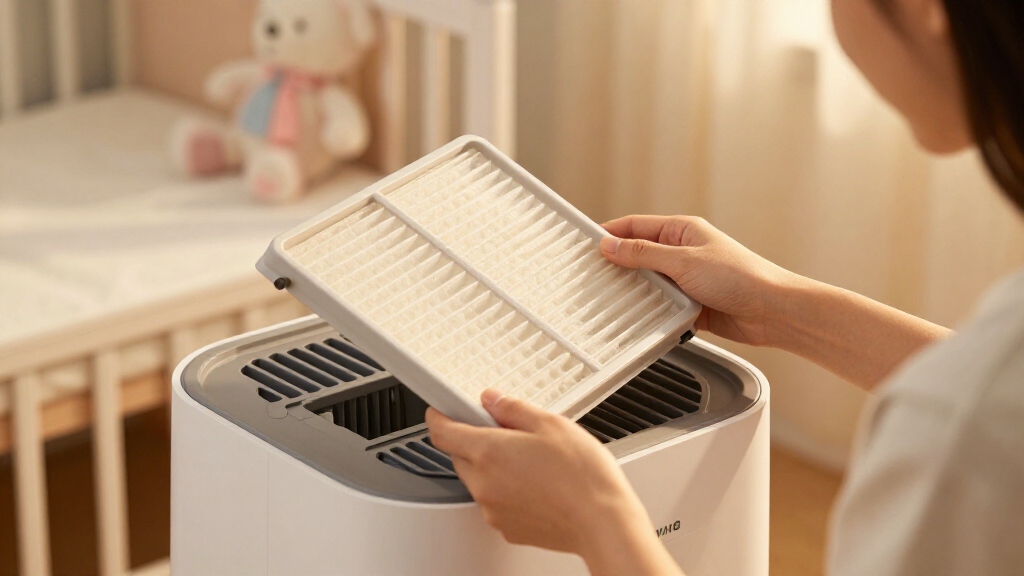
Visual check: uniformly dark pleats and dust building up around the unit mean swap time.
04 — Tracking Tech
Timer Lights vs. Smart App Tracking
Both are estimates — neither measures actual filter loading. Smart tracking is sharper, but your senses are the final audit.
| Feature | Timer-Based Indicator | Smart App Tracking |
|---|---|---|
| How it estimates life | Fixed countdown, usually 6–12 months of runtime | Percentage-based, using runtime history + fan speed + air-quality trends |
| Accuracy | ✗ Approximate — ignores smoke, pets, fan speed | ~ More precise — accounts for actual use patterns |
| Ease of use | ✓ Simple light, zero setup | ~ Requires app setup, but offers detailed data & graphs |
| Detects real saturation? | ✗ No — it is a clock, not a sensor | ✗ Still an estimate — confirm with airflow & odor checks |
05 — The Nursery Routine
A Maintenance Cadence That Works
Three repeating habits keep air quality high without guessing — and can stretch a 3-month filter toward 6.
Clean the Pre-Filter
Vacuum or rinse it to strip hair and large dust before they clog the HEPA layer. Increase frequency during dusty or smoky stretches.
Audit the Signals
Sniff for musty odor, listen for fan strain, eyeball the media color. Use the indicator light as a reminder, not a verdict.
Replace the Cartridge
Swap sooner during wildfire seasons or with pets. Budget $20–80 per cycle — brand subscriptions trim the cost slightly.
Safety note: skip ionizers and ozone-generating devices in nurseries entirely — look for CARB-certified units — and never wash a true HEPA filter unless it is explicitly rated washable. H13 (99.95%) or H14 (99.995%) per EN 1822 / ISO 29463 is the real thing; “HEPA-type” labels are not.
06 — Cause & Effect
How the Whole Chain Connects
What’s the real lifespan of a HEPA filter in a nursery?
Most true HEPA filters are rated for about 6–12 months under typical household use. But in a nursery where the purifier runs 24/7, especially during wildfire season or with pets, you should expect to replace filters every 3–6 months. For example, during a wildfire event, a filter that normally lasts 8 months might be exhausted in just 3.
Manufacturers base their ratings on a standard 8-hour daily run in clean conditions. Once you add continuous operation, dust, pet fur, or smoke, the filter’s life shortens. Think of it like a sponge—soaking up dirt and particles faster with heavy use. This accelerated saturation impacts air quality because a saturated filter can no longer effectively trap pollutants, leading to poorer indoor air, which is especially critical in a nursery where vulnerable infants are present. Understanding this tradeoff helps you decide when to replace filters sooner to maintain a safe environment.
HEPA filter replacement for nursery air purifier
As an affiliate, we earn on qualifying purchases.
As an affiliate, we earn on qualifying purchases.
How do I know when my HEPA filter really needs replacing?
Signs of a saturated filter include reduced airflow, a louder fan, persistent odors, or visible gray/black media. For instance, if your baby’s room suddenly feels stuffy despite the purifier running, it indicates reduced filtration efficiency. Recognizing these signs early is crucial because waiting too long can allow pollutants to accumulate, potentially impacting your baby’s health.
Many filters come with indicator lights—these are mostly timers, not sensors. If your purifier has a smart app, it might give a percentage of remaining life, but don’t rely solely on it. Regularly inspecting the media and listening for airflow drops makes all the difference. Being attentive to these practical clues allows you to replace filters proactively, ensuring continuous protection rather than reacting only after air quality decreases.
air purifier pre-filter cleaning kit
As an affiliate, we earn on qualifying purchases.
As an affiliate, we earn on qualifying purchases.
Can I extend HEPA filter life without risking my baby’s health?
Yes. Regularly cleaning the pre-filter every 2–4 weeks helps. It catches large dust and hair before they clog the HEPA layer, which prolongs its effectiveness. Using a vacuum or rinsing the pre-filter keeps airflow strong and filter life longer. This routine prevents premature saturation caused by large particles that would otherwise quickly fill the main filter, reducing its efficiency and lifespan.
Additionally, keeping the room sealed and dust-free minimizes external sources of pollution. During wildfire seasons, running the purifier at a lower speed or increasing pre-filter maintenance can make filters last longer—sometimes up to 6 months instead of 3—by reducing the load on the HEPA media. Balancing pre-filter upkeep with appropriate fan speeds is a strategic tradeoff to maintain high air quality without frequent replacements, especially during high pollution periods.
smart HEPA air purifier with app tracking
As an affiliate, we earn on qualifying purchases.
As an affiliate, we earn on qualifying purchases.
How wildfire smoke and pets change the filter replacement schedule
Wildfire smoke and pet dander are big fast-trackers. During smoke events, filters can saturate in just 3 months, compared to 6–8 months in normal conditions. Pets shed fur, and their dander can reduce filter efficiency in 4–6 months. Recognizing these factors helps you plan ahead and avoid sudden drops in air quality.
For example, in summer 2023, many parents found they needed to replace filters every 3 months during heavy smoke seasons, despite the 6–12 month claim. If your home has pets or is near construction, expect to replace filters more often. The key is understanding that these external factors significantly increase pollutant load, which accelerates filter saturation. Proactive replacement ensures continuous protection for your baby’s delicate respiratory system.
air purifier replacement filters wildfire season
As an affiliate, we earn on qualifying purchases.
As an affiliate, we earn on qualifying purchases.
Comparison: Regular vs. smart filter life tracking
| Feature | Timer-based indicator | Smart app tracking |
|---|---|---|
| Estimates remaining life | Fixed countdown, usually 6–12 months | Percentage-based, runtime history, trend graphs |
| Accuracy | Approximate, based on runtime | More precise, accounts for actual use and air quality |
| Ease of use | Simple light or timer setting | Requires app setup, but offers detailed data |
What should I do to keep my nursery’s air clean longer?
Follow this simple routine: vacuum or rinse the pre-filter every 2–4 weeks, check for odors or airflow issues, and replace the HEPA filter every 3–6 months if the room has heavy use or during wildfire seasons. Use the indicator light as a reminder, but don’t rely solely on it.
During wildfire seasons or periods of heavy pollution, being proactive can make a significant difference. Sealing windows and doors reduces external pollutants entering the room, which lessens the workload on the purifier. This not only extends filter life but also ensures that your baby breathes cleaner air consistently. Adjusting your routine based on environmental conditions is key—more frequent checks and replacements during high pollution periods are a responsible tradeoff for peace of mind.
Conclusion
Keeping your nursery’s air fresh and safe isn’t about hitting an exact replacement date. It’s about watching for clues—airflow, odors, and visible dirt—and adjusting your routine accordingly. Think of your filter as a vital teammate, not just a timer.
By staying proactive—cleaning pre-filters and replacing HEPA media every few months—you give your baby the cleanest air possible, season after season. It’s not just about the filter; it’s about peace of mind.
Fall Picks
fall essentials
As an affiliate, we earn on qualifying purchases.